
by Barbara Miller
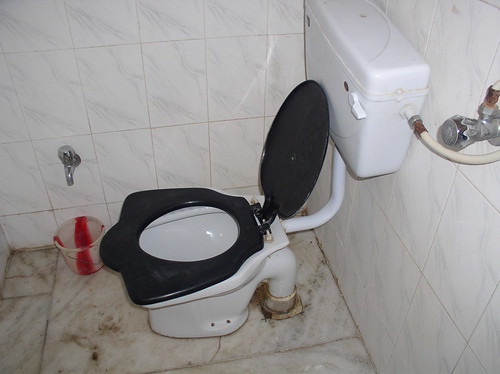
A loud and hopeful buzz on twitter about toilets and women’s empower in India has followed the publication of an article in the Washington Post on October 12 that has been picked up by CNN and other mainstream media. “No toilet no bride” is the slogan of a growing number of families when seeking to arrange the marriage of a daughter.
In rural areas, less than 30 percent of the population has access to latrines. And those latrines are not necessarily located so that women and girls can get to them safely. They may not be covered. They may be filthy. In low-income neighborhoods in cities, the situation is not much better.
Throughout India, it’s easier and safer for men and boys to defecate and urinate publicly than it is for women and girls. A week’s visit to India will afford the viewer plenty of opportunities to see open defecation of men and boys. Women and girls have to wait until it’s dark to try to find a semi-private field away from the village. Any they may run into trouble from some male hasslers on the way.
The right to a safe toilet is on many people’s list of human rights in India.
It is a good thing that more Indian women will have access to a safe place for these everyday biological necessities—those who can find a husband whose family can provide one for the new couple. But I have problems with the implication that Indian women are finding new bargaining power in marriage arrangements through the “no toilet, no bride” mantra. I hate to throw cold water on all the enthusiasm, but that’s not likely to be how things will work out in northwestern India in the short run, at least.
Yes, women may get toilets: the good news. But the bad news is that toilet-possessing grooms will be even more highly sought after, and that will spike up the dowries that the bride’s family has to give to get a top-notch groom. In the end, the bride’s family will pay for the toilet.
Here’s how northern Indian (Hindu) marriage arrangements tend to work (with the inevitable exceptions of course of some who opt for love marriage and no dowry payment at all). Among northern Indian Hindus, a system of hypergyny has long existed. It means that the bride has to “marry up,” within her general birth group (jati, or subcaste): the groom should be more educated than she is, as well as taller and older. These criteria establish a demographic squeeze, from the start, on potential brides because they knock out many men from being preferred. Even with the many thousands of “missing” girls and women due to female-selective abortion and direct and indirect infanticide, which are particularly endemic in northern India, there is still a shortage of the “best” potential grooms. Hypergyny drives a system that makes the parents of daughters always on a lower par, having to provide huge dowries to attract the “best” grooms.
For decades, families with highly educated sons and families with property and wealth can and do “demand” the largest dowries from the bride’s families. The dowry amount and contents are discussed up front before a marriage is finally negotiated, and much of the value of the dowry goes to the groom’s parents rather than to the newly married couple. I call this a “fly-over dowry” since it flies right over the heads of the bride and groom. Having a son in northern India, come time for his marriage, is a windfall.
In terms of the groom, educated, wealthy, tall, and handsome men are most sought after. Now those desirable potential grooms whose families can guarantee that the new bride will have “a room of her own” will have even more leverage in demanding a large dowry. But in the end, it’s the bride’s family that’s buying the toilet.
Photo from Flickr via Creative Commons.

 anthropologyworks