Anthro in the news 11/30/09

• Publication of Ann Dunham’s revised dissertation

Working with the American Anthropological Association, Duke University Press has published “Surviving against the Odds: Village Industry in Indonesia,” a revision of Ann Dunham’s doctoral dissertation in anthropology. President Obama’s mother was trained as an economic anthropologist at the University of Hawai’i and worked in Indonesia as a development consultant. Duke is publishing the book as part of its list of books that critique conventional foreign aid and offer ways to rethink it. Dunham’s dissertation, completed in the early 1990s, prefigures much of today’s discussion in development circles of small-scale entrepreneurship, self-help, and micro-credit financing. The book includes rare photographs of Dunham in Indonesia and a foreword by Maya Soetoro-Ng, Dunham’s daughter and President Obama’s half-sister. I hope the Press comps the White House and that it receives a prominent place there.

• Following one’s nose to a good mate?

Several news sources picked up on an article published in the Journal of Evolutionary Biology about mate selection among mandrills, the world’s largest monkey. A team of researchers followed 200 mandrills living in the tropical rainforest of Gabon in central Africa observing their behavior and collecting DNA samples. They found that female mandrills choose mates with different genes from their own. They are apparently guided to genetically dissimilar mates by their acute sense of smell. The adaptive outcome is that they have healthy babies with strong immune systems. Dr. Joanna Setchell of the University of Durham led the study and comments that mandrills are much like humans so the findings have relevance to human mate selection and the potential power of smell as an underlying factor. One important complication is that the study was done on a relatively closed population of mandrills, so it may have more relevance, Setchell  and her colleagues suggest in their paper, to closed and isolated human populations with minimal migration to introduce new genes. I wonder if the team is aware of the many groups of people, from the Middle East to South India, that practice close-cousin or uncle-niece marriages which involve spouses with very similar genetic structures. Why are these many thousands of people not behaving like mandrills? Is their sense of smell perhaps damaged by life outside the rainforest and no longer effective in sniffing out a genetically different spouse? Or is the problem that, in these cultures, a woman doesn’t choose her husband and thus is unable to follow her nose? Or are humans, with all their culturally variable baggage, really not so similar to mandrills after all?

• Knowledge in cultural anthropology for war…and more

Wired Magazine offers a brief portrait of Montgomery McFate, a cultural anthropologist and prominent proponent of the US military using anthropological methods and approaches. She is currently Senior Social Science Advisor at Army Human Terrain System. Starting with the war in Iraq and impetus provided by General Petraeus, the US military has increasingly incorporated anthropologists and other social scientists in operations. The Wired piece points out that HT involvement of anthropologists “might be the start of something bigger” beyond the battlefield including more attention to training military personnel in cultural awareness, more effective intelligence gathering by “hanging around with regular folks” (not okay for anthropologists if done under cover or with any possibility of causing harm to those regular folks) and strategically addressing an array of global issues such as the rising China, a soon-to-be-nuclear-armed Iran, and a resurgent Russia. McFate is quoted as  saying that “We can’t have effective strategy without cultural knowledge…” and, maybe we can figure out “how to engage Iran to get the outcome we want without going to war.” That would be a good thing, and a goal to which many anthropologists would willingly contribute–if they can do so within the bounds of anthropological ethics.

• Culinary anthropology

Journalist and culinary ethnographer Kayla Wexelberg discusses the cultural importance of food consumption choices, time allocation for food preparation, and sociality in a brief article in The Durango Herald.

Sexism, racism, and death in Second Life

Virtual worlds research can provide insights into important social questions such as racism and ethnic discrimination. An exploratory study of a “Muslim” avatar in Second Life provides intriguing findings that beg for more in-depth research.

Methal Mohammed teaches English as a second language in the Department of Teaching, Learning and Culture at Texas A&M University. She first came to the US as a Fulbright Scholar from Baghdad, Iraq. As part of a class in visual culture, she created a Second Life (SL) personal avatar, “noorelhuda Beb”. “Noorelhuda” first dressed in long trousers, a long sleeved shirt and white shoes. She had “basic” features and long brown hair. She teleported to several sites to make friends but spent most of her time sitting alone.

The researcher decided to add a hijab (headscarf) to her avatar. Noorelhuda with her hijab then set out to a variety of sites to meet other avatars using the question, “I am new here, can you please help me?” Avatars she met either commented briefly or turned away and kept going.

A handful of vignettes from noorelhuda’s visits reveal that she was making some progress establishing contacts and engaging in constructive conversations related to her hijab and its cultural meaning. Things were going well until noorelhuda decided to revisit an earlier site: a beach resort where other avatars were sunbathing or dancing. She was approached by a male avatar policeman who pushed her into the sea where she drowned. She was “killed.”

This brief study connects to many questions about what SL interactions reveal about Real Life (RL) including racism, sexism, exclusion, appearance-based judgments, and aggression. It also raises the issue of research ethics: in cultural anthropology, it is unethical to carry out undercover research. One has to inform research participants about the goals of the research and protect their anonymity. “Informed consent” is thus an important guideline, but it has the downside of preventing anthropologists from doing research in “natural” situations where actors are not influenced by knowing that their words, thoughts, and behaviors are being observed and recorded.

Research in SL necessarily protects the anonymity of “research participants.” So is it okay for someone like “noorelhuda” to conduct “under cover” research in SL? If she had told people that she was visiting sites and trying to meet people as part of a research project, would her experiences have been different? Would people have been more interested in talking with her, or the opposite? Would people displayed less racism? Would the policeman have “killed” her?

Photo, “A Muslim lady in SL”, from Flickr and Creative Commons.

Anthro in the news 11/23/09

• LSE anthropologist wins Victor Turner Award

Dr. Matthew Engelke, a senior lecturer (professor) in the Department of Anthropology of the London School of Economics, has won the 2009 Victor Turner Prize for his book, A Problem of Presence: Beyond Scripture in an African Church, an historical ethnography based on research in Zimbabwe. The Victor Turner Prize for Ethnographic Writing was established in 2001 by the Society for Humanistic Anthropology. Dr. Engelke will receive the prize and read from his book at the American Anthropological Association meetings in Philadelphia on December 4.

• Increase in flatheadedness in the US

A study conducted for an undergraduate honors project by an anthropology major at Arizona State University, Jessica Joganic, has developed into a major research project on head shape of more than 20,000 children in the United States. The rate of “flatheadness,” or deformational plagiocephaly, has increased since 1992, and boys are twice as likely to be flatheaded than girls. Sleep position, specifically head position, was the best predictor of flatheadedness. The increase in flatheadedness coincides with the launch of the “Back to Sleep” education campaign by the American Academy of Pediatrics recommending that parents place their infants on their backs to sleep to reduce the risk of Sudden Infant Death Syndrome. Joganic, now a doctoral student in physical anthropology at Washington University in St. Louis, is the lead author of an article reporting the findings that will appear in the December issue of Pediatrics.

Note: This blogger did a little Internet research on the consequences of deformational plagiocephaly  but couldn’t find any evidence of developmental problems related to cognition or speech, for example, but mention only of “cosmetic” issues. The aesthetics of head shape in Western culture connects  with prehistoric cranial deformation including widespread practice among the Incas.

• Hobbits are us

Statistical analysis of a well-preserved female skeleton, “Flo” or LB1,  carried out by researchers at Stony Brook University, New York, indicates that Homo floresiensis is a distinct human species and not a descendant of a genetically flawed version of modern humans. Details appear in the December issue of Significance.

• Expensive pig roast but for a good cause?

Under funding from a $300,000 grant from the National Institute of Justice, faculty and students from Mercyhurst College are analyzing the remains of a house in Washington County, Pennsylvania, that was intentionally burned down along with two euthanized pigs, knives, guns, and shell casings that were placed inside it. Ten students in the Forensic and Biological Anthropology MA program are gathering evidence from the rubble as part of their training and to test how archaeological methods can improve arson investigations. Three such mock investigations have been completed, and seven more are planned. The National Institute of Justice will use the findings to develop standards for investigating devastating fires involving human remains.

• Dell Hymes, linguistic anthropologist and giant in his field

Dell Hymes passed away at age 82. Dr. Hymes grew up in Portland, Oregon, where he attended Reed College. He conducted his first field research at Warm Springs reservation in Oregon and established a lifelong relationship with the Wasco and other tribes in the Pacific Northwest.  His doctorate, in linguistics from Indiana University, was on the language of the Kathlamet Chinook. He taught at Harvard University, the University of California Berkeley, and then joined the University of Pennsylvania in 1965 as professor of anthropology. During the 1960s he helped establish sociologinguistics, the study of how social class affects language. Hymes was committed to social justice and the relevance of anthropology to addressing social inequality. Along with other Penn professors, he protested the Vietnam War. In 1987, he left Penn to become professor of anthropology and English at the University of Virginia, teaching there until his retirement in 1998. His books include In Vain I Tried to Tell You : Essays in Native American Ethnopoetics, and Foundations in Sociolinguistics: An Ethnographic Approach. Deborah Tannen, professor of linguistics at Georgetown University, calls Hymes a “giant” in both anthropology and linguistics. A memorial gathering for him will be held at the upcoming meeting of the American Anthropological Association in Philadelphia, on Saturday, December 5, from 7:30-9:30pm in the ballroom of the Courtyard Marriott, 21 N. Juniper Street.

DIY development aid

From Bono to a college student who takes an alternative spring break to help people living in poverty, interest and participation in development-related activities has increased among non-specialists in the past decade. Philanthropists, students at many levels, and people in business, professional groups, and migrants’ associations now constitute a fourth pillar of development alongside the traditional three pillars of bilateral aid, multilateral aid, and NGOs. Patrick Develtere and Tom De Bruyn discuss the fourth pillar drawing on their experiences and research in Belgium. They point out that the fourth pillar is often neglected in the development discourse and their potential impact and contributions go uncounted in the overall development picture.

The authors are optimistic about the potential of the emerging fourth pillar in helping the poor: “There are large numbers of young graduates applying in vain for jobs with traditional development organizations, as well as people who want to do more than give or collect money during NGO fundraising campaigns.  The alternative often lies in starting up a project of one’s own, or joining a fourth-pillar organization that celebrates modern volunteering.” They also see potential in reshaping longstanding patterns of development thinking and replacing development jargon (mechanisms of participation, gender sensitivity, outcome mapping) with a “concrete story of co-operation, told by a few faces and many pictures on the Internet.”

An example of a development organization launched just a few years ago by a former student of mine is Adam Carter’s Cause and Affect Foundation. Adam earned an MA from the Elliott School of International Affairs and took classes on development (including The Anthropology of Development from me), so he did have some academic background. His achievements go far beyond what he learned in college, however, and I am happy to have contributed in a small way to the fourth pillar of development through Adam’s work.

Photo, “Bono & Bob Geldof”, from Flickr and Creative Commons.

CIGA event today at GW

For those readers in the D.C. area, please join us for the final Culture in Global Affairs program talk of the year.

Sharia and Gender

in the Malay-Muslim Corporate Workplace

Patricia Sloane-White, Assistant Professor of Anthropology, University of Delaware

This talk will explore how in Malaysia, the growing muscularity and masculinity of sharia (Islamic law) in personal and domestic settings has been reproduced as corporate policy in many Malaysian companies. What Sloane-White calls “personnel sharia” increasingly defines and regulates Muslim women’s positionality and vulnerability vis-à-vis men in the Malaysian corporate workplace, providing insight into how Malay-Muslim women’s corporate roles are being reconfigured in an increasingly sharia-ized Malaysia.

November 20 – 12 noon – 1957 E Street NW, Room 211

RSVP: ghcornwell@gmail.com

Anthro in the news 11/16/09

• More on Lévi-Strauss

Tributes to Claude Lévi-Strauss continued to appear in mainstream media worldwide such as the Times of India and the Economist, extolling his contribution to the discipline of anthropology. In my comments last week, I joined the chorus of positive notes. I do quibble, however, with those who call him the “father of modern anthropology” as going too far…unless we agree that contemporary anthropology is the product of multiple fathers. And several mothers as well. Speaking of fathers of the French variety, I would wager that contemporary cultural anthropologists cite Bourdieu and Foucault far more often than  Lévi-Strauss. Perhaps Lévi-Strauss is better typified as a grandfatherly figure in the field–important in his time, but a bit quaint now.

Continuing with the kinship metaphor, I cannot recall any historic female anthropologist ever being referred to as the “mother of modern anthropology.” Margaret Mead would be my nomination for this accolade, odd-sounding as it is.

• Michael Kearney: pioneer of migration studies in anthropology and activist

Michael Kearney, professor of anthropology at UC Riverside died at the age of 71 years. He received his PhD in 1968 from the University of California at Berkeley. A founding figure in the anthropological study of migration, he carried out long term fieldwork with Mixtex-speaking Indians in Oaxaca, Mexico starting in the mid-1960s and returning frequently to maintain ties with members of the community and document changes taking place. He also studied Oaxacan migrants in the United States and how they maintained ties with their communities of origin. In addition to his scholarly work, he was an activist for civil rights and human rights. Tom Patterson, chair of the UCR anthropology department, comments that “Michael was protective of the Mixtex communities…He was fearless in confronting oppressive authorities on both the Mexican and American sides of the border.”

• Jane Goodall on endangered species

Primatologist and animal rights activist Jane Goodall provides inspiring examples of efforts to save animal species nearing extinction in her new book, Hope for Animals and Their World: How Endangered Species Are Being Rescued from the Brink.  It was reviewed in Sunday’s Washington Post, earning nearly three-fourths of the page and commanding attention with four large color photographs of species that have been rescued from extinction.

Meanwhile, Sunday’s New York Times carried an article conveying little to no hope for the cultural survival of the Ogiek, Kenya’s last “forest people.” They are in grave danger of being booted out of their traditional lands in the Mau Forest due to a purported conservation effort of the government.

India go back, India gobar

by Barbara Miller

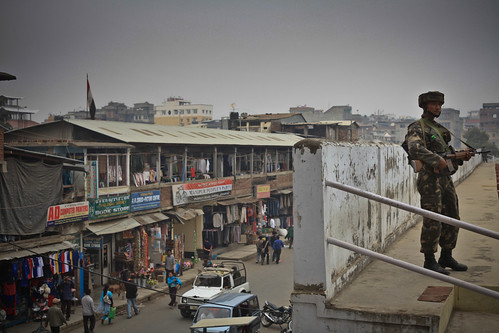
Poet and political activist Irom Chanu Sharmila has been protesting abuses by Indian military forces in Manipur, northeastern India, for ten years. Fasting unto death is her chosen, nonviolent method of protest. Indian law however now rules that fasting unto death is illegal.

Manipur, located in the northeastern region is India’s most war torn state. Forested, hilly, rainy, and the  home of many diverse tribal groups, it was forcibly incorporated into the Indian state in 1949 along with the other states in the northeast.

Sharmila is seeking the repeal of the Armed Forces Special Power Act (AFSPA) which allows the Indian army to detain, and sometimes kill, northeastern people. The UN’s human rights chief, Navi Pillai, has urged India to repeal the law. So far: no progress at all.

Getting rid of the hated AFSPA is an important step toward peace in the region. Greater political autonomy for all the northeastern states would also help reduce the violence and misery. India should wield a lighter hand rather than a heavier hand in the region. But of course, India has major strategic and resource interests in the area. While the central government pursues those interests, the local people suffer terribly.

What do Manipuris want? India out of Manipur.  Not likely.  But perhaps a less repressive presence would suffice?

So what is “gobar” (or “gober”)? It’s a Hindi word that refers to cow dung. Many years ago my college Hindi teacher, Professor Robert Swan, told me a story prompted by the appearance of the word “gobar”  in one of my readings. It was about colonial India’s reaction to the so-called Simon Commission which was charged in the late 1920s with reforming governance of the colony. The Commission did not include a single Indian member to participate in such important policy making.

Sir John Simon, head of the Commission, came to the subcontinent in 1928 to present the report. Everywhere on his tour, including major cities such as Mumbai (then Bombay) and Lahore, he was met with massive and vocal protests. The protestors chanted in English, “Simon go back!” [to Britain]. The many Indian protestors who didn’t know English picked up the chant, recasting it into what they thought they heard: “Simon gobar!” Twenty years later, India gained its independence from Britain. At the same time, it colonized Manipur.

For information on Manipur’s struggle for peace, go to the Manipur Freedom website.

Photo, “Imphal Encounter”, from Flickr and Creative Commons.

Heavy metal and mental health


by Barbara Miller

Metal music fans in France are no more anxious or depressed than the general population, in fact, they are somewhat less so. Fewer than 5 percent of the 333 fans in a recent study have pathological symptoms, as evaluated on the Hospital Anxiety and Depression Scale (HADS). Characteristics of the small minority with high scores for anxiety and depression are: literature/arts interests rather than scientific interests, writing metal music lyrics, alcohol consumption, and body modification/scarification.  Relevance: opponents of metal music should re-examine the basis for their criticism.

Photo, “Heavy Metal Funhouse”, via Flickr and Creative Commons.

Anthro in the news 11-09-09

• Tristes tropes for a “towering” anthropologist

The French anthropologist who established the theory of “structuralism” outlived most other prominent anthropologists of his era. Claude Lévi-Strauss died over the weekend in Paris at the age of one hundred years. He left an impressive legacy in cultural anthropology and beyond. Reflecting his fame, his obituary appeared in media sources worldwide.

A founding father of the line of symbolic and interpretive anthropologists, Lévi-Strauss wrote books and articles showing how myths and practices should be understood as based on an underlying code of meaning based on dualities (culture and nature, male and female, raw and cooked). Such codes help people move through life by reducing the complexity of reality to something more manageable.

Richard Shweder, cultural anthropologist at the University of Chicago, provides a summary of  Lévi-Strauss’ approach that was picked up in several obituaries:

Logically deduce all the possible ways in which people can behave. Then, observe which behaviors are actually exhibited in the real world. Finally, try to explain the reason why some behaviors exist and why other logically possible behaviors are never seen. These reasons form a grammar, a structure, upon which all cultures are based.

Lévi-Strauss analyzed kinship systems, myths, food practices, and more. While the anthropological study of kinship and myths is on the wane in anthropology today, research in and beyond anthropology on food and cooking and cuisine is a hot item. It would be wonderful to hear what L-S would have to say about food studies now.

On another front, Lévi-Strauss argued that so-called “primitives” are not really different from modern people in thinking and behavior. And so he was an early champion of cultural relativism. My favorite Lévi-Strauss quotation comes from this area of his work, in his early book Tristes Tropiques: “No society is perfect.”

• The poor of rural Oregon in a “double bind”

Oregon has one of the highest rates of income inequality in the United States. In the past three decades, the wealthiest 1 percent tripled its income while that of the poorest remained flat. Joan Gross and Nancy Rosenberger, both cultural anthropologists at Oregon State University, conducted in-depth interviews with members of 76 low-income households in two rural communities of Benton County. Results indicate that people know what kinds of foods they should be eating, but that when money is short they cut back on food expenditures in favor of paying the mortgage, power costs, health care expenses, and material goods for their children such as decent clothing and computers so that they don’t face stigma in school. The people in the study, however, are reluctant to accept government assistance. One woman said: “My husband wouldn’t use food stamps. He’s got pride.” Hence the double bind. NewsRx Health covered this study which will appear in the December issue of the journal Food, Culture, and Society.

• Fewer androgens, more cooperation and sociality

Science News highlighted findings about primate sociality by Emma Nelson, the School of Archaeology at the University of Liverpool and Susanne Schultz, the Institute of Cognitive and Evolutionary Anthropology at the University of Oxford. Among primates, exposure in the womb to higher levels of androgen is correlated with longer fourth fingers compared to index fingers. Nelson and Schultz have looked at finger length in several primate species and found a relationship between shorter fourth fingers and greater male-male cooperation and sociality. The coverage in Science News is a little hard to follow since the article states that digit ratio indicates lower levels of androgen exposure in orangutans and other Great Apes, thus explaining why these primates show high levels of cooperation and tolerance. Not the orangutans I’ve read about: aren’t they loners? Readers should consult the original article published in the American Journal of Physical Anthropology.

• Newborns cry in code

BBC covered a comparative study of 60 healthy French and German babies found that French newborns cry with a rising accent while German babies’ cries have a falling tone, reflecting dominant patterns in French and German. This finding, from a study led by Kathleen Wermke of the University of Wurzberg and published in Current Biology, confirms earlier research indicating that fetuses learn sounds in the last three months of pregnancy. Wermke comments that neonates have learned “melody patterns that are typical for the ambient language” and that newborns are likely “highly motivated to imitate their mother’s behaviour in order to attract her and hence to foster bonding.” Isn’t it also likely that they can only reproduce melodies to which they have been consistently exposed? Or, if there’s a little Mozart in the womb, perhaps Mozart the neonate will compose innovative cry melodies? …lot’s to learn in this area.

• The changing culture of philanthropy in New Delhi

Erica Bornstein of the University of Wisconsin, Milwaukee, conducted ethnographic research in New Delhi with Hindu philanthropists who have made large donations for temple construction or NGOs  and with people who give small donations (dan) on a daily basis. Her findings are published in Cultural Anthropology and attracted the attention of Science Letter. Bornstein examines the interface between traditional giving practices and motivations, especially that of the most meritorious form which is anonymous (gupt dan) and emerging ideas of social responsibility and argues that new forms of philanthropy are emerging.

• From foot to head: biological anthropologists and archaeologists in PBS series on human evolution

Along with articles about archival works of Beethoven and creating headliners at The Onion, the art section in the New York Times last Tuesday included a “Television Review” piece about the three-part Nova series, “On Becoming Human.” It praises Dan Lieberman, biological anthropologist at Harvard University, for a “nicely accessible account” of why bipedalism evolved. Rick Potts, paleoanthropologist at the Smithsonian Institution in DC, is mentioned for his theory that the human brain increased in size as a way of coping with the climate instability that occurred about 2 million years ago. So, given global warming and instability in our times, the Potts theory predicts that humans brains will keep expanding. And our heads will get every larger.

Lost in Yemen

by Barbara Miller

The lead article in the International section of the Sunday New York Times was entitled “Thirsty Plant Steals Water in Yemen–Farmers Grow Narcotic: Drought Fuels Conflict.” Lots to attract readers from environmental concerns to drugs and conflict. Three photographs add to the grab. One small image shows qat leaves. A very large image is of a lone Yemeni man standing in a dry and drab scene. A third showings a qat vendor and a customer. An inset map shows how close Yemen is to Somalia, another country in the not-good news.

What about the text of the article? It’s a rambling account that flings causes around like candies from a busted piñata:

–The country’s scarce water is used to feed an addiction
–Drought is killing off Yemen’s food crops so farmers turn to planting qat trees
–The water table is sinking
–Yemen’s poverty and lawlessness make the water problem more severe
–Qat trees are proliferating
–Lack of water is fueling tribal conflicts and insurgencies
–Climate change is deepening the problem
–At the root of the water crisis is rapid population growth
–The Yemeni government supports qat despite its destructive elements
–There is no coordination within the government

The article is little more than a laundry list. It offers no sense of order about the most basic, underlying causes versus intermediate causes or simply correlates. Such writing would not be acceptable to me in an undergraduate term paper.

I know that journalists, in contrast to academic social scientists, are supposed to write in a nonlinear, engaging, conversational style. Which apparently precludes logic and clarity. What does the casual reader take away from this article?  That Yemenis are intoxicated, lawless, and constantly having babies?

I do thank the writer for providing some important material three-quarters of the way in:

“For milleniums, Yemen preserved traditions of careful water use. Farmers depended mostly on rainwater collection and shallow wells. In some areas they built dams…But traditional agriculture began to fall apart in the 1960s after Yemen was flooded with cheap foreign grain, which put many farmers out of business. Qat began replacing food crops. and in the late 1960s, motorized drills began to proliferate…”

The rest of the article, however, makes nothing of this information, instead mentioning the government’s irresponsibility and lack of coordination.

I am intrigued by what happened in the 1960s: do any readers know about who supplied the “cheap foreign grain”? What about possible outside influences in earlier times? And is anyone in Yemen, including the World Bank, working to revitalize traditional patterns of water management which are likely to prove more successful than exogenously designed and imposed projects?

Photo, “Khat”, from Flickr via Creative Commons.