A different kind of cooking show

For those of you (including me) who enjoy watching TV cooking contests, we know that the worst that can happen is that an aspiring winner is perspiring, or the presentation was chaotic, or the judges made nasty comments about the taste of one of the dishes.

For millions of women who cook family meals, especially in developing countries, the challenges are quite different. There is no panel of judges and no “time’s up” called out to arrest the work of the contestants in their well-equipped stainless-steely kitchen.

Rob Bailis speaks at the Elliott School of International Affairs, Nov 3, 2011.

Instead, there is a “killer in the kitchen” which calls time’s up for mothers and children who spend a lot of time inhaling cook stove fumes.

On November 3, Rob Bailis, assistant professor of environmental social science in the department of Forestry and Environmental Studies at Yale University, gave a CIGA seminar entitled, “Arresting the Killer in the Kitchen: The Promises and Pitfalls of Commercializing Improved Cookstoves.”

Bailis took the audience on a rich and insightful tour of how improved cook stoves could have a major positive impact on women, children, and the environment. His talk drew on knowledge about the effects of various types of fuel for daily cooking on the cooks and the wider environment.

His slides included maps of types of household fuel in various regions of the world. He brought together data from the fields of environmental studies, public health, and local surveys.

He discussed the “energy ladder hypothesis” which says that as people get wealthier, they use cleaner fuels. As I was listening, I was thinking: okay, this doesn’t sound good for the earth, given the way the economy is going.

Another point to share is this: Bailis said that Western development experts have been pushing improved cook stoves for three decades but there is very little evidence about their effectiveness in terms of reducing health risks for cooks/children and reducing deforestation and other environmental problems.

China is the country to watch on improved cook stoves. Of the 200 million improved cook stoves in the world, 80 percent are in China. Let’s hear about the “best practices” there and how they might be replicated elsewhere.

Thirty years is a long time, especially without much to say in terms of what works. Time to switch channels and get back to the cooking throw-down.

Maybe we need a TV show about what works in development?

Update from Professor Rob Bailis:
In fact, there is evidence that some improved stoves certainly improve quality and, based on that, we can justifiably hypothesize that if families adopt such stoves and use them regularly, then their air quality will improve and their health risk will be reduced. More importantly, there is evidence of this – just last week (about a week after my presentation) a paper was published in the Lancet by Kirk Smith and his team. This reports the results of the first randomized control trial based on improved cookstove adoption. They found that the stoves they promoted reduced the incidence of severe forms of respiratory infection by around 30%. So the evidence exists. What is lacking is program-specific follow-up to understand whether a given intervention is resulting in effective and long-term stove adoption. But, like I hinted at in my talk, the carbon markets are having an interesting influence on project monitoring by creating elaborate protocols to make sure stoves are actually used.

Is there hope for the Niger Delta?

A new report from the United Nations Environment Programme reveals the extent of environmental devastation in Nigeria’s Niger Delta due to extractive oil and petroleum industries. Although the study was partially funded by Shell, it appears that it has some bite. Perhaps a sign of hope.

Niger Delta
Niger Delta viewed from space, with north to the left. Source: NASA via Wikipedia
Meanwhile, an African king is suing Shell, and Niger Delta villagers are going to the Hague to take on Shell. Perhaps further signs of hope.

Oil-related problems in the Niger Delta are not new. They are old, enduring and stain the future of Nigeria. They have to do with powerful corporate and state interests, corruption, global oil and petroleum demand, and the unrelentingly harsh cruelty of capitalist profiteering at the expense of local people and their environment and livelihoods. Nigeria is a major provider of petroleum to the United States.

The Niger Delta region has been exploited with impunity by outside powers for many years. During the British colonial era, Nigeria provided wealth for the Crown through the export of palm oil (Osha 2006). In the postcolonial era of globalization, a different kind of oil dominates the country’s economy: petroleum. Starting in the 1950s, with the discovery of vast petroleum reserves in Nigeria’s Delta region, several European and American companies have explored for, drilled for and exported crude oil to the extent that Nigeria occupies an important position in the world economy.

Most local people in the delta, however, have gained few economic benefits from the petroleum industry. Instead, most have reaped major losses in their agricultural and fishing livelihoods due to environmental pollution. They are poorer now than they were in the 1960s. In addition to economic suffering, they have lost personal security. Many have become victims of the violence that has increased in the region since the 1990s through state and corporate repression of a local resistance movement.
Continue reading “Is there hope for the Niger Delta?”

Herbal answer to Prozac will promote San culture

Guest post by Sean Carey

Think of a South African herb, and the chances are that Hoodia gordonii will come to mind. The much-publicized succulent, which has been traditionally used by the San to ward off hunger and thirst on hunting trips, was the focus of 15 years of research and development by UK-based company, Phytopham — first with pharmaceutical giant, Pfizer, and then with international conglomerate, Unilever, which planned to use the herb in its Slim Fast range of weight-loss products.

Traditional preparation of Sceletium by a Nama goatherd.
Traditional preparation of Sceletium by a Nama goatherd. Courtesy: Nigel Gericke.
Unfortunately for Unilever, which invested around £20 million in R&D, double blind and other trials using P57, an extract of Hoodia, indicated that there were a number of adverse effects including a rise in blood pressure and digestive disturbances amongst some subjects. The result was that last November, Phytopharm returned the commercialisation rights of P57 to South Africa’s Council for Scientific and Industrial Research (CSIR). CSIR now plans to review the data from 14 clinical trials and decide whether it is worth pursuing further projects.

This development was undoubtedly extremely disappointing for the San, who after a dispute about intellectual property rights had successfully secured an agreement in 2003 to receive a share of the royalties from sales of the appetite-suppressant.

However, there is much better news about another South African ground-covering succulent, Sceletium tortuosum, more familiarly known as kagoued (in Afrikaans meaning “something to chew”) or kanna, another herb traditionally used by the San as an analgesic, antispasmodic, sedative, tonic and mood elevator. The herb, which can also be consumed as a tea or taken as a snuff, has been the subject of intensive research by HGH Pharmaceuticals, a company set up in 2007 by South African-born medical practitioner and ethnobotanist, Nigel Gericke.
Continue reading “Herbal answer to Prozac will promote San culture”

Response, recovery and social dimensions of the disaster in Japan

Mayumi Sakamoto on left. Credit: FEMA.
Mayumi Sakamoto on left, New Orleans, La., March 3, 2011. Credit: FEMA.

Guest post by Mayumi Sakamoto

As of March 18, the situation is very serious in Fukushima prefecture due to the nuclear power plant problem. The complex after-effects of the tsunami are disturbing the entire S&R (search and rescue) efforts and related disaster response activities, as well as creating problems for economic activity, agriculture, the environment and people’s lives.

DRI
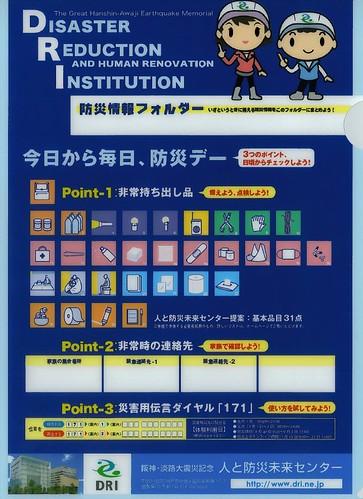
DRI brochure for children.

In Fukushima, many people are making amazing efforts, in spite of clear health risks to themselves, in order to prevent the situation from worsening.

The DRI dispatched our expert team on Monday to Miyagi prefecture to support the local government. We will continue our operation for the next several weeks.

So far, the recovery of infrastructures is just amazing. After one week, electricity, water-supply, roads and the banking system are recovering. In terms of resilience of infrastructure I would say we are very resilient.

On the other hand, the many evacuated people are in a severe condition, and these displaced people will face many long-term challenges.

The disaster-affected area in Japan is one of the most well prepared area for tsunami. But planning was based on reasonable estimates which, in this case, nature has exceeded. So how can one be prepared for such massive destruction?

The DRI believes we have to pay keen attention to social impact of the disaster and find a way to establish some framework to analyze it. I am collecting information regarding to this disaster in national level and also trying to establish archives for this disaster. I am also interested in learning about relevant experiences from other post-earthquake/disaster situations to learn about how to address the social impact including many displaced persons.

Mayumi Sakamoto, who holds a Ph.D. from Kyoto University, specializes in disaster recovery assistance (particularly in Aceh during the 2004 tsunami) and international cooperation at Japan’s Disaster Reduction and Human Renovation Institution.

Anthropology and Japan’s triple disaster

Aerial of damage to Wakuya, Japan. Flickr/U.S. Navy.

The three-way hit from the major earthquake, tsunami and nuclear meltdown has created a situation beyond what even the most prepared country could manage. Entire villages were swept into the massive wave. Hundreds of bodies are now washing back to the shore. Nuclear plants are melting down. People are evacauting their home areas by the thousands to avoid radiation exposure.

Three questions for anthropologists:

  1. What do anthropologists have to say about the massive loss of lives from so-called natural disaster? The most obvious recent example is Haiti after the earthquake of January 2010. Readers, please share references and insights.
  2. What do anthropologists know about life in a nuclear melt-down zone? Read this: Adriana Petryna‘s amazing study, Life Exposed: Biological Citizens after Chernobyl. Her study of the making of “biological citizens” has much relevance to northern Japan. Can readers please offer other sources of knowledge?
  3. What do anthropologists know about people’s perceptions of risk and security around the world? Many anthropologists are addressing these important questions. The course syllabus for a graduate seminar I taught in spring 2009 on Culture, Risk and Security (embedded below) includes some ideas for reading and further thought.

This university-based blogger sends her heartfelt wishes to everyone in Japan and to those in any way related to people in the affected regions.

Anthropology 222 course syllabushttp://www.scribd.com/embeds/50953048/content?start_page=1&view_mode=list(function() { var scribd = document.createElement(“script”); scribd.type = “text/javascript”; scribd.async = true; scribd.src = “/javascripts/embed_code/inject.js?1300351301”; var s = document.getElementsByTagName(“script”)[0]; s.parentNode.insertBefore(scribd, s); })();

Ideological dogmatism and United States policy toward Haiti

Guest post by Alex Dupuy

Testifying before the United States Senate Foreign Relations Committee on March 10, 2010, former US President Bill Clinton, who is now serving as Special Envoy to Haiti for the United Nations, said that the trade liberalization (aka neoliberal) policies he pushed in the 1990s and that compelled Haiti to remove tariffs on imported rice from the US “may have been good for some of my farmers in Arkansas, but it has not worked. It was a mistake…  I had to live everyday with the consequences of the loss of capacity to produce a rice crop in Haiti to feed those people because of what I did.”

Unloading Rice delivered from the United States Credit: US Marine Corps, Creative Commons License on Flickr
Delivery of US rice to Haiti in February 2010
Credit: US Marine Corps, Creative Commons License on Flickr

Two weeks later, Haitian Prime Minister Jean-Max Bellerive appeared in front of the Haitian Senate to present the government’s post-earthquake recovery plan known as the Action Plan for the Reconstruction and National Development of Haiti.  The Action Plan, originally conceived by the US State Department and co-chaired by former President Clinton and Haitian Prime Minister Jean-Max Bellerive, called for the creation of an Interim Haiti Recovery Commission (IHRC) charged with deciding on and implementing the programs and projects for the reconstruction of Haiti for 18 months after the Haitian Parliament ratifies it.

When questioned by members of the Haitian Senate that Haiti in effect surrendered its sovereignty to the IHRC, PM Bellerive responded candidly that “I hope you sense the dependency in this document. If you don’t sense it, you should tear it up. I am optimistic that in 18 months… we will be autonomous in our decisions. But right now I have to assume… that we are not.”

These admissions by high-ranking public officials representing the two sides of the international community-Haiti partnership express succinctly the dilemma that Haiti faces in rebuilding its shattered economy in the wake of the massive destruction caused by the January 12, 2010 earthquake.

As accurate as PM Bellerive’s statement about Haiti’s dependence on and subordination to the international community is, that did not originate with the creation of the IHRC, and it is not as temporary as Bellerive suggests. Rather than recounting the long history of foreign involvement and dominance in Haiti, we can consider the 1970s as having marked a major turning point in understanding the factors that created the conditions that existed on the eve of the earthquake and contributed to its devastating impact.

Continue reading “Ideological dogmatism and United States policy toward Haiti”

All we like sheep

Spring is a perilous time for sheep. Lambs are born in the spring, and often capricious weather can spell their doom. In the spring, many one year-old lambs are slaughtered to provide meat for a feast. It is the time of the sacrifice of the lambs.

Sheep are one of the earliest domesticated animals, and they still figure largely in the economies of pastoralist cultures from Afghanistan to Zimbabwe with China currently having the most sheep of any country in the world. Images of sheep appear in ancient rock art. Their wool provided one of the first textiles for humanity. Artisanal cheese from sheep’s milk is now a highly sought-after product. And don’t forget haggis.

What do cultural anthropologists have to say about this important animal? Compared to the amount of published sources by archaeologists: not much. In my search of AnthropologyPlus and AnthroSource, using the search words “sheep” or ‘lamb,” I found fewer than 30 articles published since 1995. I then looked in Google Scholar, using the search terms “culture sheep” and “culture lamb” and found a few more sources scattered among the many non-anthropological studies.

Several sources in the following list have to do with herding practices. Another prominent theme is the importance of sheep as items of exchange and sacrifice. Others look at sheep in mythology, symbolism, and healing. The most famous individual sheep in the world, Dolly, attracted some recent attention in terms of bioscience and ethics.

Cultural anthropologists have not written much about the animals in our lives, period. So sheep are not any more neglected than are dogs, horses, pigs, and other animals wild or domesticated. Cultural anthropologists have probably written more books with the word “car” than “sheep” in the title. Perhaps these gentle, low-demand, high-yield animals deserve more of us.

The following sources are the result of a few hours’ research and, with apologies again, they are not open-source:

Abu-Rabia, Aref. 1999. Some Notes on Livestock Production among Negev Bedouin Tribes. Nomadic Peoples 3(1):22-30.

Ayantunde, Augustine A., Timothy O. Williams, Henk M. J. Udo, Salvador Fernández-Rivera, and Pierre Hiernaux. 2000. Herders’ Perceptions, Practice, and Problems of Night Grazing in the Sahel: Case Studies from Niger. Human Ecology 28(1):109-140.

Bolin, Inge. 1998. Rituals of Respect: The Secret of Survival in the High Peruvian Andes. Austin: University of Texas Press.

Maggie. 2005. Quartering Sheep at Carnival in Sud Lípez, Bolivia. In Wendy James and David Mills, eds., The Qualities of Time: Anthropological Approaches. Pp. 187-202. New York: Berg Publishers.

Brower, Barbara. 2000. Sheep Grazing in National Forest Wilderness: A New Look at an Old Fight. Mountain Research and Development 20(2):126-129.

Dám, Laszlo. 2001. Buildings of Animal Husbandry on Peasants’ Farms in Hungary. Acta Ethnographica Hungarica 46(3/4):177-227.

Continue reading “All we like sheep”

Follow the aid

Despite an abundance of aid materials and the good intentions of relief agencies, relief efforts in Thailand following the December 2004 earthquake/tsunami were afflicted by skewed distribution.

Jin Sato, associate professor in the Institute for Advanced Studies on Asia at the University of Tokyo, analyzes the factors that skewed relief good distribution in an article in Development in Practice. He discusses how the political and economic turmoil caused by relief efforts themselves constitute an additional risk for victims.

Sato also notes that while the social ramifications of relief efforts are substantial, yet they are often overlooked for three reasons:

  • most “disaster management” experts are engineers
  • social analysis requires time
  • relief organizations are poorly coordinated which prevents the generation of lessons for the future

His recommendations for more effective responses, based on lessons from the 2004-2005 tsunami relief efforts, are:

  • the selection of goods and distribution mechanisms are of paramount importance
  • aid efforts should not only supply goods but should focus on strengthening institutional resources that allow recipient communities to more effectively absorb the goods and distribute them fairly
  • relief agencies should co-ordinate with each other after the emergency stage to develop ways to reduce pre-existing inequalities or dominance

After reading his article, I decided to contact Professor Sato to learn more about him and his involvement in disaster response work. Here is my email interview with him:

Q: What is your background in terms of academic training?

A: My B.A. from the University of Tokyo was in anthropology, and I have a master’s degree in both international relations and public policy from the Kennedy School at Harvard University. My Ph.D. was in international studies (interdisciplinary) at the University of Tokyo, and my dissertation topic was on natural resource governance and politics in Thailand. I did a post-doc at the Agrarian Studies Program at Yale University under Jim Scott in 1998-1999.

Since my student years, I have been interested in natural resource governance and foreign aid. The article is a spin off from my interest in the latter.

Q: When you worked as a policy advisor to the Ministry of Natural Resources and Environment of Thailand, what were your major responsibilities?

A: I was there to advise on the formulation (and prioritization) of the Environmental Policy 5-year plan, particularly about citizen participation and the role of international assistance (especially that of the Japanese government).

Q: Where were you when the tsunami hit, and what role if any did you play in responding to the tragedy?

A: As you might remember, the Tsunami hit on Dec. 25. I was taking a vacation in Samui Island in Thailand. Since my duty was to advise on environmental policy, I was not sure what to do, but I contacted the JICA office to offer assistance since I could speak the language. They put me on the first assistance survey team to develop livelihood assistance strategy from Japan. But Japanese assistance was too slow, and I don’t think we had any impact at all.

Q: Can you comment on the current situation in Haiti, in terms of how your findings about Thailand might relate to that context?

A: Since I have not been to the field, it is hard to comment. But judging from the news, there was more order and discipline in Thailand where people could wait in lines to receive aid goods. The tsunami hit only the coastal zone and other parts remain intact (unlike the earthquake). This is a huge difference in terms of the availability of assistance and speed of recovery. I suspect that there will be some structural concentration in either damage or assistance due to pre-existing resource inequity.

Image courtesy of Jin Sato.

Why is Haiti so poor?

UPDATE 1/14: This post was linked in a story by Discovery News’ James Williams.

Haiti and the Dominican Republic share the island of Hispaniola. Following the island’s discovery by Columbus in 1492, Spanish colonialists exterminated the island’s indigenous Arawak Indians. In 1697, the French took control of what is now Haiti and instituted an exceptionally cruel system of African plantation slavery. In the late 1700s, the half million slaves revolted. In what is the only successful slave revolution in history, they ousted the French and established the first Black republic in the Western Hemisphere.

Haiti’s population of over eight million people occupies a territory somewhat smaller than the state of Maryland in the United States. The land is rugged, hilly or mountainous. More than 90 percent of the forests have been cleared. Haiti is the poorest country in the Western Hemisphere. Extreme inequality exists between the urban elite, who live in the capital city of Port-au-Prince, and everyone else.

The people in the countryside are referred to as peyizan yo (the plural form of peyizan), a Creole term for small farmers who produce for their own use and for the market (Smith 2001). Many also participate in small-scale marketing. Most peyizan yo in Haiti own their land. They grow vegetables, fruits (especially mangoes), sugarcane, rice and corn.

Accurate health statistics are not available, but even rough estimates show that Haiti has the highest prevalence of HIV/AIDS of any country in the region. Medical anthropologist Paul Farmer emphasizes the role of colonialism in the past and global structural inequalities now in causing these high rates (1992).

Colonial plantation owners grew fabulously rich from this island. It produced more wealth for France than all of France’s other colonies combined and more than the 13 colonies in North America produced for Britain. Why is Haiti so poor now?

Colonialism launched environmental degradation by clearing forests. After the revolution, the new citizens carried with them the traumatic history of slavery. Now, neocolonialism and globalization are leaving new scars. For decades, the United States has played, and still plays, a powerful role in supporting conservative political regimes.

In contrast to these structural explanations, some people point to problems with the Haitian people: They cannot work together, and they lack a vision of the future.

Opposed to these views are the findings of Jennie Smith’s ethnographic research in southwestern Haiti, which shed light on the life of peyizan yo and offer perspectives on their development (2001). She found many active social organizations with functions such as labor sharing, to help each member get his or her field planted on time, and cost sharing, to help pay for health care or funerals. Also, peyizan yo have clear opinions about their vision for the future, including hopes for relative economic equality, political leaders with a sense of social service, respe (respect), and access of citizens to basic social services.

The early colonizers did not decide to occupy Haiti because it was poor. It was colonialism and its extractive ways that have made Haiti poor today.

Sources:

“Culturama: The Peyizan Yo of Haiti,” in Barbara D Miller, Cultural Anthropology, 5th edition, Pearson. 2009, p. 404.

Smith, Jennie M. 2001. When the Hands Are Many: Community Organization and Change in Rural Haiti. Ithaca, NY: Cornell University Press.

Farmer, Paul, 1992. AIDS and Accusation: Haiti and the Geography of Blame.

Image: “Haitian Girl” by Flickr user Billtacular, licensed by creative commons.

Thanks to Samuel Martínez of the University of Connecticut for pointing out that the Haitian Creole plural “yo” means that one should not include an article in front of the noun.

Please pass the sorghum: big news for paleo-dieters

The downsides of a “modern” Western agro-industrial diet of starchy, sugary, processed foods are well-known thanks to the writings and activism of many food-wise non-scientists such as Michael Pollan, Alice Waters and Jamie Oliver. Their advice to eat fresh, locally grown food whenever possible is nutritionally sound, though not always feasible.

A more extreme rejection of the industrial diet is the so-called paleo-diet. The outlines and benefits of a paleodiet were first proposed by three anthropologists — S. Boyd Eaton, Marjorie Shostak and Melvin Konner — in their 1988 book, The Paleolithic Prescription. In 2002, Loren Cordain hit pay dirt with his best-selling book, The Paleo Diet.

Proponents of a paleodiet point out that 99 percent of human evolution occurred when we were foragers (a.k.a. hunter-gatherers) and ate only lean meats, fish and seafood, nuts, fresh fruits and fresh vegetables. Our bodies have adapted to these foods over several million years. The agro-industrial diet goes against our biological base, in this view, and causes a host of health problems such as heart disease and obesity.

An article in today’s Washington Post style section, “Hunter-Gatherer Gourmet” (alternatively titled “Paleolithic diet is so easy, cavemen actually did it“) profiles a young D.C. woman who follows a paleo-diet along with a rigorous exercise plan. She eats no grains, salt, sugar, legumes or dairy products (her one concession is dark chocolate from time to time). In nine months, she has lost 10 pounds, no longer gets migraines, sleeps better, is allergy-free and her mood has improved.

A recent archaeological discovery in sub-Saharan Africa has major significance for paleo-dieters.

Julio Mercader, Canada research chair in tropical archaeology in the University of Calgary and Mozambican colleagues have discovered that stone age hunter-gatherers at one site in Mozambique were harvesting, processing and eating wild sorghum by 100,000 years ago (see this PDF article from Science magazine, which requires a login).

So it’s time to revise the paleo-diet books and welcome whole grains to the neo-paleo-table!

Image: “Paleolithic Food” by Flickr user Roberta Maria, licensed by Creative Commons.