Children playing in tailings downstream from the Ok Tedi Mine in Papua New Guinea, 2009. Source: Brent Stirton/Getty Images
CBC radio (Canada) presented commentary from Stuart Kirsch, professor of anthropology at the University of Michigan. Kirsch has spent decades working with native peoples living along the Ok Tedi River in Papua New Guinea and recording their experience of the social and environmental disaster created by an enormous open-pit copper mine situated near the river’s source. Kirsch describes what he and the Ok Tedi people learned in the process of taking on a multi-national mining giant, and what the people of PNG taught him. He asks whether “responsible mining” is possible and reveals the dubious science that supports the mining industry. His latest book is Mining Capitalism: The Relationship between Corporations and Their Critics. [with audio]
The Star Phoenix of Saskatoon (Canada) reported on a lecture at the University of Saskatchewan by Audra Simpson, professor of anthropology at Columbia University. She raised the question: How can reconciliation succeed if the wrongs against indigenous people continue to go on? Emotional apologies from the government of Canada and churches that ran the Indian residential schools have evoked emotional responses in indigenous people and are expected to somehow make up for their stolen land and lives, Simpson said in an interview. Also: “It’s governing through an appeal to emotions … to allow the same things to continue and still allow for extractive industry in our territories (and) not address fully the problem of our murdered and missing indigenous women…Apology is not sufficient because it attempts to stop time between the past and the present and pretend like the suffering is over. It’s not over.”
The Economist carried an article about the emerging findings of a multi-country anthropological study of social media led by Daniel Miller of University College London. Researchers spent 15 months at locations in Brazil, Britain, Chile, China (one rural and one industrial site), India, Italy, Trinidad and Tobago, and Turkey. They embedded themselves within families and the communities. Participant observation offered nuanced insights into the roles of social media in the study sites which could not be gained by analyzing participants’ public postings.
Source: Pixabay
What’s in a name: HTS rebranding and growing
WFAA-TV/ABC (Dallas) described how the much-debated Human Terrain System of the United States Army, which the U.S. said it “killed,” is alive and well. It has a new name and awaits an even bigger budget from the Department of Defense. “The American Anthropological Association, the world’s largest organization of the field’s scholars, condemned the program [the HTS] at its outset for putting at risk its social scientists and the people they surveyed. Anthropologists could be used by the military to target insurgents, a violation of their ethics not to harm those whom they study, according to the association.” The new name, which so far lacks a presence on Wikipedia, is the Global Cultural Knowledge Network. [Blogger’s note: the American Anthropological Association issued a statement saying that it is “profoundly disturbed” that the U.S. Army has not dismantled the HTS].
Trump declaring party loyalty in September 2015. Source: Wikipedia
Trump’s shallow celebrity culture
Paul Stoller, professor of anthropology at West Chester University in Pennsylvania, published an article in The Huffington Post asking how to explain the rise of Donald Trump: “As an anthropologist, I see the rise of Trump from a cultural vantage. He is the embodiment of celebrity culture — a world filled with glitz, fantasy and illusion. It is culture in which shallow perception is more valuable than deep insight. If you watch Donald Trump perform his shtick, you hear pretty much the same thing. Mr. Trump comes on stage, recites his poll numbers, insults his opponents, invites famous supporters to the stage to sing his praises, and then talks, without giving concrete factual examples, about how bad things are and how he’s the man to make things better.”
A three year old representing herself in court?
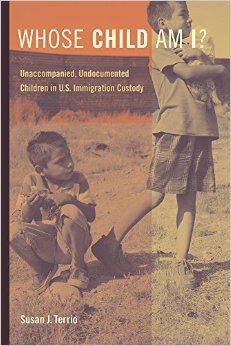
As reported by The Seattle Times, a senior Justice Department official in the state of Washington is arguing that 3- and 4-year-olds can learn immigration law well enough to represent themselves in court, taking an unconventional position in a growing debate over whether immigrant children facing deportation are entitled to taxpayer-funded attorneys. The article quotes Susan J. Terrio, a Georgetown University anthropology professor, who said she has observed hundreds of children in various immigration court proceedings, many of whom couldn’t speak English, for her book Whose Child Am I? Unaccompanied, Undocumented Children in U.S. Immigration Custody. Some were as young as 10 years old. They “were incredibly passive,” she said, and “they responded with monosyllabic answers…It didn’t appear that they understood anything at all.”
Prisoners attending a prison concert which is meant to be a positive activity for them. Source: Noisey
Inmates take control in many Mexican prisons
Quartz reported on the rising trend of prisoner gangs being in control of prisons in Mexico with a reported nearly 60 percent of state prisons under “inmate self-rule.” Inmate groups run many aspects of prison life, including family visits, the use of phones, and food. This situation is partly related to overcrowding of prisons which in turn is due to “preventive jailing,” according to social anthropologist Elena Azaola, a researcher at the Center for the Investigation and Higher Education of Social Anthropology. “There are many innocent people [in prison] who have still not been proven guilty,” said Azaola.
Sorry, sort of
BBC News carried an article about the frequent use of the word “sorry” in the United Kingdom. A recent survey of more than 1,000 people found that a person in the U.K. says “sorry” eight times a day on average. The article mentions the research of social anthropologist Kate Fox on English culture and language. In her book Watching the English, Fox describes experiments in which she deliberately bumped into hundreds of people in towns and cities across England. She encouraged colleagues to do the same abroad, for comparison. She found that around 80 percent of English victims said “sorry” even though the collisions were clearly Fox’s fault. Similar experiments in other countries yielded a similarly high use of “sorry” only in Japan.
[Blogger’s note: my, generally unpleasant, experiences on the DC metro system during rush area often involve me in scrum-like situations; in many instances, I say “sorry” when someone is pushing me or claiming my space in a line. I think I am actually asking them to apologize to me…they rarely do. In other words, my “sorry” means: “I am sorry that you are behaving so badly and sorry that you are not even apologizing to me for your bad behavior.” Sorry is complicated].
“A new book by paleoanthropologist Sang-Hee Lee about human evolution is a best-seller in South Korea.” Photo by Hee-Joong Lee. Source: University of California
Anyone who has ever wondered how humans became meat eaters, why so many adults are lactose-intolerant, or the physiological impacts of walking upright will find intriguing answers in a new book by University of California, Riverside, paleoanthropologist Sang-Hee Lee.
But you will have to wait a while for the English translation.
Written in Korean, “Human Origins” (ScienceBooks, Seoul, Korea) has captivated a broad spectrum of readers in South Korea and turned Lee into something of celebrity. Published in September 2015, “Human Origins” was named Science Book of the Year by SisaIN, an influential Korean media outlet, and has been on the respected Kyobo Bookstore’s Best Seller list since publication.
Although not written as a textbook, two Korean universities have adopted “Human Origins” for anthropology courses, an elementary school made it required reading for all sixth-graders, and mothers have brought their daughters to public lectures to meet and be photographed with Lee.
All of which has caught the UCR associate professor of anthropology by surprise.
“The response has been very rewarding,” Lee said. “For any of my published research papers, maybe 10 people will read them. With ‘Human Origins,’ people are writing about it on their blogs, and people coming to my talks have said it changed the way they look at life.” Continue reading “Anthropologist pens a best-seller in South Korea”→
BBC News reported on results from a long-term study of changes in food consumption in the U.K. since the 1970s: Pasta is rising, tea is down, skim milk is up. The article quotes Emma Jayne Abbots, lecturer in social and cultural anthropology and heritage at the University of Wales Trinity Saint David, on milk. The decline of consumption of whole milk and the rise of skim milk suggests that public health messages had an impact on consumption. Abbots is quoted as saying: “Switching to skimmed milk was heavily promoted in the late 1990s as part of a focus on heart health and cholesterol levels…It wouldn’t have been due to cost as full fat is the same price.” [Blogger note: I await findings broken down by region, class, ethnicity, and gender].
Alan Boraas, professor of anthropology at Kenai Peninsula College, published an op-ed in the Alaska daily News, addressing a bill introduced in the Alaskan Senate that would allow concealed weapons on all University of Alaska campuses. His motive is to counter the increase in campus shootings by allowing the student body and faculty to arm themselves. Another rationale is that prohibition of guns on campus is a violation of Second Amendment rights. Boraas writes: “We have created a false mythology that the gun is the answer. In the midst of an epidemic of intolerance, we will be better off trying to understand the causes and alternatives to violence rather than perpetuating the means to enact it.”
Countries that have past or current evidence of Zika virus transmission as of January 2016. Source: Wikipedia.
Zika spurs abortion rights debate in Latin America
The Washington Post carried an article about how the surge in microcephaly cases in Brazil has reignited a debate on abortion and the reproductive rights of women in Latin America. The article quotes Debora Diniz, professor of anthropology at the University of Brasilia who is spearheading the right-to-terminate campaign: “Women should not be forced to go through with a pregnancy where serious birth defects are still not fully known…They should not be penalized for a government’s failing policies because it has been negligent in the handling of an epidemic.” She said the campaign’s argument rests with women having the right to choose whether to have the child and the right to specialized prenatal care and social assistance if they choose to have the child.
Medical students without borders
National Public Radio (U.S.) reported on the widespread health care roles of medical students from the U.S. who spend time in low-income countries as part of their training and who, while there, may carry out procedures for which they are not fully trained. Commentary from Melissa Melby, assistant professor of anthropology at the University of Delaware, commented in the piece, noting that at first she was pleased to hear a pre-med undergraduate excitedly describe participating in a brief medical outreach program in an impoverished Central American community — until the student proudly recounted how she had performed a pelvic exam on patients. Melby says: “No one here [in the United States] would allow you to perform medical procedures for which you’re not licensed…And that should not change when you cross international boundaries to developing countries.”
On eliminating Valentine’s Day in U.S. public schools
According to the Minneapolis Star Tribune, many schools in the Minneapolis area will not be marking Valentine’s Day or many other so-called “dominant holidays” in the interest of promoting diversity. An ongoing debate concerns what, if any, celebrations should take place in classrooms. The article quotes cultural anthropologist William Beeman, chair of the department of anthropology at the University of Minnesota, a “holiday supporter:” “It’s very difficult to eliminate all celebrations from human society, and finding a reason for celebration is a terribly important human function because it creates social solidarity…And we don’t want our schools to be a grim place, where there’s never any fun, never any community building.”
In Argentina: Culture of police violence vs. human rights
Complicated Connection: President Macri and his family meeting the Pope. The declaration of a national security emergency does not fit with a Francisan approach to social justice. Source: Wikimedia.
An article in the Argentina Independent discusses the “tough on crime” approach of President Mauricio Macri who assumed office in December and has already decreed a national public security emergency. The article expresses concern about the culture of police violence that continues to plague Argentina. It quotes Maria Victoria Pita, anthropology professor at the University of Buenos Aires: “There is a historical tradition of confrontation and violence between civil society and the police…It is a very complicated issue because it has to deal with the basis of cultural development and political conditions.”
Cultural anthropologist William Murphy, lecturer in the department of anthropology at Northwestern University, published an op-ed in the Chicago Sun Times about how U.S. football turns a person into a commodity: “In football calculus, knocking a skilled player out of the game is sometimes (but not always) worth the penalty for some form of unnecessary roughness. Some players specialize in this tactic, and are rewarded by fans and coaches when they get away with it. Unnecessary roughness is necessary in this calculus.” He draws on Homer, Simone Weil, and others to connect the violence of war and U.S. football with dehumanization.
U.S. football pride: It hurts not being first
Source: Creative Commons
An article in the San Diego Union Tribune reported on the decision to keep San Diego’s football team, the Chargers, for at least another year. The article quotes Seth Mallios, professor of anthropology at San Diego State University and the author of multiple books on San Diego history: “In terms of our collective psyche…we feel like we are in L.A.’s shadow. Los Angeles has two NBA teams, and one of them is one of our former teams. And look at the difference between the Dodgers’ payroll and the Padres’. When you start thinking about the giant money donations they can get up there, we can feel a little inferior.”






 As
As 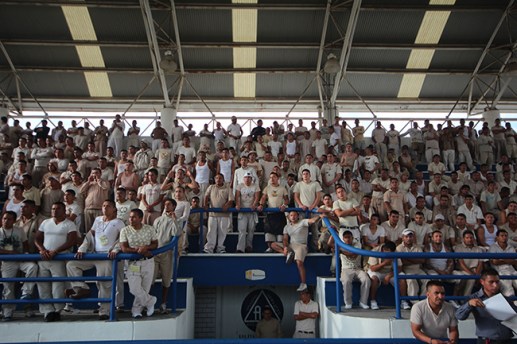
 BBC News carried an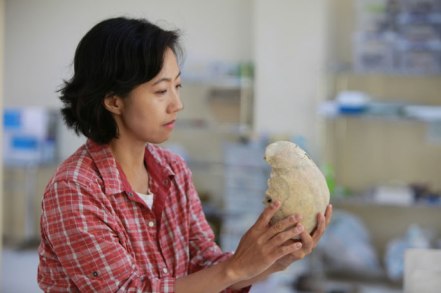







 anthropologyworks