The event will feature some of the book’s key contributors, who will share their expertise and ideas on the three main themes of the book, discussing how the term “sustainability” should be measured, how we can attain it, and how we can prepare if we fall short.
Speakers will include:
Worldwatch President Robert Engelman and Project Co-directors Erik Assadourian and Tom Prugh
Contributing authors Jennie Moore of the British Columbia Institute of Technology, Pat Murphy of the Arthur Morgan Institute for Community Solutions, and science fiction author Kim Stanley Robinson
The symposium will take place from 1:30 to 5:00 p.m. on April 16 at 1400 16th Street, NW, Washington, DC 20036. A reception with food and refreshments will follow the event. Space is limited, RSVP here . You can also pre-order a copy of the book here.
Email Grant Potter at gpotter@worldwatch.org if you have any questions.
From the Haitian earthquake to Superstorm Sandy, recent years have presented many “teachable moments” about the need for greater resilience in the face of disaster. To date, much of the conversation on resilience has focused on making infrastructure more robust—by, for example, building seawalls to protect against storm surges. But resilience has social dimensions that are at least as important. Social factors largely determine the extent to which people and communities respond to and recover from changes in the environment, whether gradual (such as climate change) or more abrupt (such as hurricanes). This panel will explore the social dimensions of resilience, including the role of equity–especially gender equity–and inclusive governance. Panelists will present research and initiatives that link reproductive health to climate adaptation, and showcase current projects in Malawi, Bangladesh, the Philippines, and the Caribbean that take a holistic approach to cultivating resilience.
Location: Woodrow Wilson Center at the Ronald Reagan Building, 1300 Pennsylvania Ave., NW, Washington, D.C. (“Federal Triangle” stop on Blue/Orange Line). A map to the Center is available at WilsonCenter.org/directions. Note: Photo identification is required. Please allow additional time to pass through security.
Western Carolina University in Collowhee, North Carolina, invites applications for a visiting assistant professor of sociocultural anthropology with a specialization in environmental anthropology, beginning August, 2013. Applicants should have a PhD in Anthropology (in hand by time of appointment) from an appropriately accredited institution. The successful candidate will have ethnographic experience and will be qualified to teach an upper-level course in environmental anthropology as well as other courses focused on their regional or topical interests. Application details are available here.
Mention the Maldives to many Europeans and most of them will think of a string of paradise islands. Along with other countries in the Indian Ocean like Mauritius and the Seychelles, the Maldives is renowned as a honeymoon destination replete with 5-star hotels and luxury spas. In fact, like Mauritius and the Seychelles the country derives most of its foreign currency from tourism.
Unlike secular Mauritius and the Seychelles, however, Islam is the official religion of the Maldives and public practice of other religions is forbidden. In order to exercise social and cultural control over relationships between the indigenous population and foreign visitors, authorities in the Maldives permit the development of tourist resorts on unpopulated parts of the territory, which consists of 1192 islands stretching 230 miles from south-west India. So far, this strategy has worked very well.
View of the Maldives. Flickr/nicadlr
After 30 years of autocratic rule, the Republic of Maldives became a multi-party democracy in 2008, headed by President Mohamed Nasheed. The newly-elected leader has been praised by other members of the international community for his achievements, especially in creatively publicising the effects of climate change and rising sea levels on low-lying island states in the Indian Ocean and elsewhere. He has also indicated that he intends to open up the inhabited islands of the Maldives to tourists in order to attract more visitors from the new growth economies of China and elsewhere. “We’ve segregated ourselves in these little islands for too long,” President Nasheed told foreign journalists last year. “The tourists don’t get to see the real Maldives and Maldivian culture. In the past there was a desire to segregate the Maldives from certain influences, but it also kept us from ideas and knowledge. Maldivians are Muslims but modern. The time has come to end the segregation from the outside world.”
Now comes the news that Reporters Without Borders new press freedom index 2011-2012 ranks the country at 73 compared with its previous position of 51 in 2010. The reason for the drop? The NGO claims that the “rising climate of religious intolerance” in the country has had a significant impact on freedom of expression.
Like many other relatively closed Islamic societies that are opening up, the Maldives government, which is attempting to steer a middle course and maintain community cohesion, has found it hard to come to terms both with moderate and fundamentalist Islamic critics. Last September, in an attempt to wrong-foot opposition groups the Government issued new “religious unity” regulations, which prevents the media from producing programmes or disseminating unlicensed information that might be designed to “humiliate Allah or his prophets or the holy Quran or the Sunnah of the Prophet (Mohamed) or the Islamic faith.”
While this policy is relatively easy to enforce with traditional media like television, radio and newspapers the Maldives, like all governments, has found new media platforms much harder to control. Nevertheless, in November, the Islamic Ministry ordered that the website of Ismail “Hilath” Rasheed, a moderate Sufi Muslim, was being blocked on the grounds that it was a threat to the “Maldives’ young democracy.” On December 14, Rasheed was arrested and detained before being released on January 6 without charge after his involvement in a “silent protest” in the capital Male when he called for religious tolerance. The protest designed to coincide with Human Rights Day on December 10 was deemed by the country’s police as “unconstitutional,” although Amnesty International was quick to make Rasheed a “prisoner of conscience.”
On January 20, the Maldives police arrested Sheik Imran, a prominent Muslim cleric and leader of the opposition conservative Adhaalath Party (Justice Party). He had accused President Nasheed of encouraging “anti-Islamic waves” and to the “shores” of the Maldives called for the implementation of full Shari’a law. Interestingly, two days previously, the Maldives government issued a statement and warned foreign embassies that it was extremely concerned that “Islamic fundamentalism” could threaten the social fabric of the Sunni-dominated society, as well as the visitor economy, which contributes around 30 per cent or $1.5 billion to GDP.
On the page devoted to “culture” on the Maldives Tourism Board website –- the country’s tagline is “Always Natural” — the final paragraph reads: “Maldivians are quite open to adaptation and are generally welcoming to outside inspiration. The culture has always continued to evolve with the times… Most Maldivians still want to believe in upholding unity and oneness in faith, but recent waves of reform in the country have created a whole new culture of new ideas and attitudes. The effects of the modern world are now embraced, while still striving to uphold the people’s identity, traditions and beliefs.”
The Maldives, like many societies organized on the basis of kinship and religious faith, is attempting to solve the conundrum of how to allow measured social and cultural change that maintains community cohesion and generates economic growth when many of the drivers for those changes — secular and religious ideologies — lie outside its borders and therefore beyond its control.
So now we know. Mary Portas, the high profile retail expert commissioned by U.K. Prime Minister David Cameron and his deputy Nick Clegg, has just issued her review of the high street after a seven-month consultation. Portas became a household name after appearing in the BBC TV show Mary Queen of Shops in 2007.
She issued a grim warning that around a third of all U.K. high streets are “degenerating or failing.” Three reasons for the decline are:
• the expansion of out-of-town shopping parks by about one-third over the last decade, which has acted as a magnet for consumers keen to avail themselves of free parking;
• the expansion of the major supermarkets into areas like pharmacy and optical services, which were traditionally the preserve of the high street and town center.
• and the growth in Internet shopping.
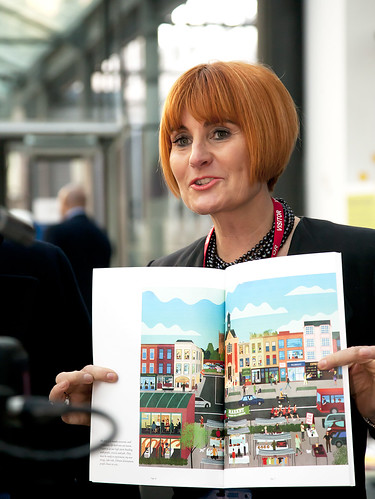
Mary Portas, pictured here at the Department for Business, Innovation & Skills - has published her review of the future of high street. December 2011. Flickr/bisgovukWith a “Town Centre First” strategy, Mary Portas, the coalition government’s retail czar makes 28 recommendations, including plans for a “National Market Day”, which would allow budding entrepreneurs to try out a retail concept with the buying public (“Why not rent out tables for a tenner and get everyone involved?”), a relaxation of the rules making it easy to set up street stalls, mentoring of small shopkeepers by larger retailers, and an army of volunteer “Town Rangers” to protect high street areas from anti-social behavior and shoplifting.
Portas wants betting shops to be classified separately by planning authorities so that numbers can be monitored more readily. “I believe the influx of betting shops, often into more deprived areas, is blighting our high streets,” she said. Other ideas include transforming long-term unused retail spaces into gyms, bingo halls and crèches.
As one might expect, the responses are mixed.
Some are very positive. For example, James Daunt, CEO of Waterstone’s, a predominantly high street-based book chain, who recently denounced online retail giant Amazon as a “ruthless, money-making devil” was clearly voting for his own tribe when he commented: “I’ve always believed that booksellers should be at the heart of the communities they serve, and that is exactly what we are doing with Waterstone’s. Mary Portas obviously has a similar, strongly held philosophy and her report holds much sense.”
Others like Evening Standard journalist Anthony Hilton are more critical: “Tomorrow belongs to the internet. Web-based purchases are growing by the day. The car is being displaced by the armchair. Retail parks are struggling, let alone the high street.”
Oxford High Street. Flickr/FlickrDelusionsSomewhere in the middle are the puzzled retail experts, who are trying to work out the dynamics of the interface between physical shopping experiences and purchases made through the Internet. “While there is much discussion of the death of the high street in recent years, ultimately, people want to touch and see things and this is borne out by the growth of Apple’s retail outlets across the UK, for example,” said Anton Gething, co-founder and product director at social commerce experts nToklo. He went on to cite the physical eBay store in central London as well as an interesting experiment by the House of Fraser store in Aberdeen “that has no products, simply free coffee and assistants with iPads.”
Other commentators think that worrying about the fate of the High Street is a waste of time. For example, Margareta Pagano, business editor of The Independent on Sunday, anticipated Mary Portas’s report by suggesting that the proper focus should be on high-value “i-street” employment rather than the defence of traditional, physical retailing space. She argues: “What’s more, the U.K. is actually one of the most sophisticated markets in the world for online retailing, leading the way with the technology as well as the software design and distribution; so we shouldn’t be too worried by the switch from bricks and mortar to online as it’s also creating new jobs.”
The Prime Minister, who accompanied Mary Portas on a walkabout of Camden Markets in north London on Tuesday, announced that the government will respond to the high street review next spring rather than make an instant judgment on its virtues. This is an astute move in a politically fluid situation caused by a sharp disagreement between the two coalition partners –- Cameron’s Conservatives and Clegg’s Liberal Democrats — over Britain’s use of the veto at the recent EU summit on economic integration. The feeling is that the rupture in relationship makes a general election in the U.K. a genuine possibility in the not too distant future.
David Cameron would certainly not want to make an enemy of a high profile TV personality possessing considerable cultural capital if the campaign trail beckons.
Stuart Kirsch, anthropology professor at the University of Michigan, shared a link to a Huffington Post editorial updating the human rights situation there. Written by the Lowenstein International Law Clinic at Yale University, the essay highlights land grabbing and controversial development plans in the West Papua rain forest. The Clinic will be producing a full report in near future.
In addition to Cernea’s excellent recommendations, I would add a plea that any and all heritage projects in the MENA region, and elsewhere, pay special attention to participatory approaches and, particularly, inclusion of women in leadership and income-generating positions.
Canada’s Tsilhqot’in Nation is going to court to block Taseko Mines Ltd. from doing preparatory work on its controversial New Prosperity mine in British Columbia’s Cariboo region.
In a petition filed with the B.C. Supreme Court, the First Nations group is asking the court to halt drilling, excavation, timber clearing, road construction and the like while reviewing provincial approvals for the work on a revised mine plan.
Chief Joe Alphonse, tribal chairman of the Tsilhqot’in National Government, said the decision affects the group’s rights and culture: “The province refused to acknowledge these impacts, no matter what we say; it is more concerned with handing over approvals,” Alphonse said in a statement. “We’ve gone to court before, we’ve stood in front of the federal panel, we have proven over and over again how important these lands are to our people and our culture — but the province never seems to get the message.”
Several First Nations oppose the project because the mine proposal would mean the destruction of a lake considered culturally significant to them.
For those of you (including me) who enjoy watching TV cooking contests, we know that the worst that can happen is that an aspiring winner is perspiring, or the presentation was chaotic, or the judges made nasty comments about the taste of one of the dishes.
For millions of women who cook family meals, especially in developing countries, the challenges are quite different. There is no panel of judges and no “time’s up” called out to arrest the work of the contestants in their well-equipped stainless-steely kitchen. Rob Bailis speaks at the Elliott School of International Affairs, Nov 3, 2011.
Instead, there is a “killer in the kitchen” which calls time’s up for mothers and children who spend a lot of time inhaling cook stove fumes.
On November 3, Rob Bailis, assistant professor of environmental social science in the department of Forestry and Environmental Studies at Yale University, gave a CIGA seminar entitled, “Arresting the Killer in the Kitchen: The Promises and Pitfalls of Commercializing Improved Cookstoves.”
Bailis took the audience on a rich and insightful tour of how improved cook stoves could have a major positive impact on women, children, and the environment. His talk drew on knowledge about the effects of various types of fuel for daily cooking on the cooks and the wider environment.
His slides included maps of types of household fuel in various regions of the world. He brought together data from the fields of environmental studies, public health, and local surveys.
He discussed the “energy ladder hypothesis” which says that as people get wealthier, they use cleaner fuels. As I was listening, I was thinking: okay, this doesn’t sound good for the earth, given the way the economy is going.
Another point to share is this: Bailis said that Western development experts have been pushing improved cook stoves for three decades but there is very little evidence about their effectiveness in terms of reducing health risks for cooks/children and reducing deforestation and other environmental problems.
China is the country to watch on improved cook stoves. Of the 200 million improved cook stoves in the world, 80 percent are in China. Let’s hear about the “best practices” there and how they might be replicated elsewhere.
Thirty years is a long time, especially without much to say in terms of what works. Time to switch channels and get back to the cooking throw-down.
Maybe we need a TV show about what works in development?
Update from Professor Rob Bailis:
In fact, there is evidence that some improved stoves certainly improve quality and, based on that, we can justifiably hypothesize that if families adopt such stoves and use them regularly, then their air quality will improve and their health risk will be reduced. More importantly, there is evidence of this – just last week (about a week after my presentation) a paper was published in the Lancet by Kirk Smith and his team. This reports the results of the first randomized control trial based on improved cookstove adoption. They found that the stoves they promoted reduced the incidence of severe forms of respiratory infection by around 30%. So the evidence exists. What is lacking is program-specific follow-up to understand whether a given intervention is resulting in effective and long-term stove adoption. But, like I hinted at in my talk, the carbon markets are having an interesting influence on project monitoring by creating elaborate protocols to make sure stoves are actually used.
August 9 is the International Day of the World’s Indigenous Peoples, and Cultural Survival joins the world in recognizing and honoring of the strength, resilience, dignity, and pride of Indigenous Peoples around the world. Despite our long histories of struggle, we continue to weave our stories, our songs, our rituals and ceremonies into rich, colorful, textured, and beautiful tapestries that portray landscapes of our Indigenous experience and indigeneity.
We continue to pray and give thanks in sacred places for the knowledge and materials offered to us from this earth, and for all the relations that keep us connected to the heavens, earth, each other, and all beings.
We seek to speak our language to our children so that they speak to their children of this ancestral knowledge. We seek to be recognized as Indigenous Peoples with inherent rights, and we fight for those rights. As Indigenous Peoples we stand up and survive and weave our futures.
That spirit is honored each year on the International Day of the World’s Indigenous Peoples, and this year Cultural Survival is marking the day by launching a new campaign to support the Telengit people of Russia. Telengit man from Russia. Courtesy of Cultural Survival
The Telengit are resisting the building of a natural gas pipeline from Siberia to China that will cross their lands, undermine their way of life and spiritual traditions, and threaten the delicate ecosystem that has supported their lifeways. The pipeline would bisect the sacred Ukok Plateau and the Golden Mountains of Altai UNESCO World Heritage Site in Russia, and the Kanas National Park in China, all of which are home to endangered wildlife that includes the snow leopard, argali mountain sheep, the black stork. The construction will destroy the sacred lands where the Telengit People have journeyed for thousands of years to give offerings to the spirits of the heavens, the mountains, and the waters, and where they conduct ceremonies to bury their dead.
Your letters and financial support can help the Telengit people defend their lands, their traditions, and their rights. To learn more and support the Telengit click here.

 On Tuesday, April 16, the Worldwatch Institute will release the latest edition of its annual flagship publication, State of the World 2013: Is Sustainability Still Possible?, in Washington, D.C.



 anthropologyworks