Upcoming events at UMass

Please see below for details on two upcoming activities of the University of Massachusetts Amherst Center for Heritage and Society

Why Does the Past Matter? Changing Visions, Media, and Rationales  in the 21st Century: May 4-7, 2011
This conference includes almost 200 speakers from 34 countries. The goal of this conference is to bring together a wide range of academics, public officials, planners, educators, heritage professionals, and community leaders to examine the practical value of the past—by means of a rigorous humanities and social science reexamination through five distinct thematic lenses: identity, culture, economics, ecology, and civil society. For more information, please visit: http://www.whydoesthepastmatter.org.

International Heritage Online Studies: 3 Summer Sessions
For more information about our Summer Online Program of professional training courses on digital, intangible, and community-engaged heritage, as well as courses in collaboration with the International Coalition of Sites of Conscience, please visit: http://www.umass.edu/chs/courses/online.html.

Response, recovery and social dimensions of the disaster in Japan

Mayumi Sakamoto on left. Credit: FEMA.
Mayumi Sakamoto on left, New Orleans, La., March 3, 2011. Credit: FEMA.

Guest post by Mayumi Sakamoto

As of March 18, the situation is very serious in Fukushima prefecture due to the nuclear power plant problem. The complex after-effects of the tsunami are disturbing the entire S&R (search and rescue) efforts and related disaster response activities, as well as creating problems for economic activity, agriculture, the environment and people’s lives.

DRI
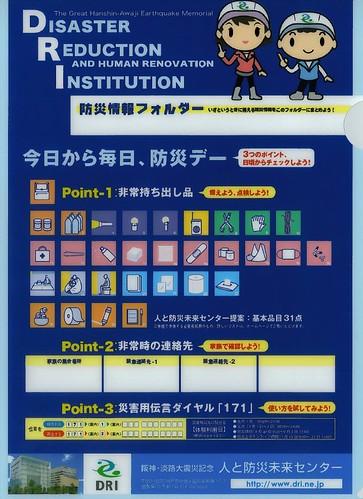
DRI brochure for children.

In Fukushima, many people are making amazing efforts, in spite of clear health risks to themselves, in order to prevent the situation from worsening.

The DRI dispatched our expert team on Monday to Miyagi prefecture to support the local government. We will continue our operation for the next several weeks.

So far, the recovery of infrastructures is just amazing. After one week, electricity, water-supply, roads and the banking system are recovering. In terms of resilience of infrastructure I would say we are very resilient.

On the other hand, the many evacuated people are in a severe condition, and these displaced people will face many long-term challenges.

The disaster-affected area in Japan is one of the most well prepared area for tsunami. But planning was based on reasonable estimates which, in this case, nature has exceeded. So how can one be prepared for such massive destruction?

The DRI believes we have to pay keen attention to social impact of the disaster and find a way to establish some framework to analyze it. I am collecting information regarding to this disaster in national level and also trying to establish archives for this disaster. I am also interested in learning about relevant experiences from other post-earthquake/disaster situations to learn about how to address the social impact including many displaced persons.

Mayumi Sakamoto, who holds a Ph.D. from Kyoto University, specializes in disaster recovery assistance (particularly in Aceh during the 2004 tsunami) and international cooperation at Japan’s Disaster Reduction and Human Renovation Institution.

Anthropology and Japan’s triple disaster

Aerial of damage to Wakuya, Japan. Flickr/U.S. Navy.

The three-way hit from the major earthquake, tsunami and nuclear meltdown has created a situation beyond what even the most prepared country could manage. Entire villages were swept into the massive wave. Hundreds of bodies are now washing back to the shore. Nuclear plants are melting down. People are evacauting their home areas by the thousands to avoid radiation exposure.

Three questions for anthropologists:

  1. What do anthropologists have to say about the massive loss of lives from so-called natural disaster? The most obvious recent example is Haiti after the earthquake of January 2010. Readers, please share references and insights.
  2. What do anthropologists know about life in a nuclear melt-down zone? Read this: Adriana Petryna‘s amazing study, Life Exposed: Biological Citizens after Chernobyl. Her study of the making of “biological citizens” has much relevance to northern Japan. Can readers please offer other sources of knowledge?
  3. What do anthropologists know about people’s perceptions of risk and security around the world? Many anthropologists are addressing these important questions. The course syllabus for a graduate seminar I taught in spring 2009 on Culture, Risk and Security (embedded below) includes some ideas for reading and further thought.

This university-based blogger sends her heartfelt wishes to everyone in Japan and to those in any way related to people in the affected regions.

Anthropology 222 course syllabushttp://www.scribd.com/embeds/50953048/content?start_page=1&view_mode=list(function() { var scribd = document.createElement(“script”); scribd.type = “text/javascript”; scribd.async = true; scribd.src = “/javascripts/embed_code/inject.js?1300351301”; var s = document.getElementsByTagName(“script”)[0]; s.parentNode.insertBefore(scribd, s); })();

Call for AAA panel participants on health care reform

American Anthropological Association Annual Meeting November 16-20, 2011 Montreal, Canada

Co-chairs: Fayana Richards, Michigan State University; Julie Armin, University of Arizona

With the recent passage of the Patient Protection and Affordable Care Act in the United States comes a variety of strategies for bringing marginalized groups into to the public-private health care system. The act will expand health care coverage to an additional 32 million uninsured people with claims of reducing health disparities and increasing the quality of health care. Scheduled to be implemented over the next three years with a projected completion date in 2014, patients, providers, and policy makers have already begun to experience the law’s effects. For this panel, they welcome papers that explore what it means to “reform” health care in the United States. They hope to examine historical efforts to reform health care, discursively analyze reform policies and their ideological underpinnings, and explore the Patient Protection and Affordable Care Act ethnographically.

We seek to address:

1. patients, providers and policy makers’ understandings of health care reform and the effects of newly implemented policies;

2. historical efforts at reform, such as the implementation of public programs or the increased application of managed care in health care settings;

3. how the intersection of policies shape reform efforts (e.g. public funding of abortions and the expansion of publicly funded insurance); and

4. neoliberal efforts to privatize state programs, including discussions of the “individual mandate” and the Affordable Care Act’s effects on private industry growth.

Please send your abstract (250 word maximum), as a Word attachment, to Julie Armin (jarmin@email.arizona.edu) and Fayana Richards (richa749@msu.edu) by March 20, 2011.

Summer forensic anthropology courses

The University of Northern Colorado and the Southern Institute of Forensic Science are delivering 3 courses/workshops in Forensic Anthropology this July in New Orleans, Louisiana. These applied, practical courses can be taken for CEU professional development credit, or for undergraduate college credit. Registration is capped for these hands-on courses so register soon to reserve your seat.

Forensic Anthropology — July 11–16

Fragmentary Osteology, Bone Trauma, and Basic Bone Pathology — July 18–23

Facial Reconstruction: Combination Method Workshop — July 25–30

Course content questions: edwaldrip@msn.com

Registration questions: (800) 232-1749 or esinfo@unco.edu

Upcoming WAPA event

March 2011 Happy Hour

When: Tuesday, March 15 at 6:30pm
Where: Beacon Bar & Grill

The group can usually be found at the tables next to the large windows, near the servers’ station. Hope to see you there!

Note: The Beacon has nice happy hour specials on food and drink until 7:00 pm, so arriving early is strongly encouraged. Also, some servers at the Beacon won’t do separate checks, so paying with cash is much appreciated. Sorry for the inconvenience.

More information: March 2011 Happy Hour

Upcoming event at GW

Targeting Arab Cities: Military and Architectural Expertise and the Moralization of the Politics of Empire

Ahmed Kanna, Assistant Professor of Anthropology, University of the Pacific School of International Studies

When: Thursday, March 10, 2011 at 6:00 p.m. – 7:30 p.m.
Where: Room B17, 1957 E Street NW
The Elliott School of International Affairs
The George Washington University

Free and open to the public

Dr. Kanna will discuss a contemporary, post-neoliberal and Global War on Terror conjuncture in which the issue of urbanism and, in particular the global south city, is becoming a central object expertise. In particular, cities in the Middle East and South/Central Asia have become central in Western, and particularly U.S., discourses of security, neoliberalism, and cultural representation. The first decade of the 21st century seems to have created two Middle Eastern archetypes in the imaginations of Western military and architectural experts: Dubai and Baghdad/Gaza, or, the urban blank listslate/architectural laboratory versus the city as object of military discipline. He will look at the ways in which cities, or the image of cities, do “cultural work” in the moralization of the politics of U.S. and neoliberal empire.

Sponsor: IMES Lecture Series

Research opportunity for undergraduates

The White Mountain Apache Tribe Heritage Program and the University of Arizona announce opportunities for student participation in the second season of the Western Apache Ethnography and GIS Research Experience for Undergraduates field school, a National Science Foundation-supported program, June 6-July 15, 2011.

Students participating in this REU will contribute to the creation of a Western Apache cultural and historical Atlas. Participants will learn field research techniques that will include:
• Creating research plans and documenting research efforts;
• Conducting archival, interview, survey, and participant-observation research;
• Identifying the locations of historical sites and land modification areas from archival maps, photographs, and land inspections;
• Collecting and conducting initial analysis of qualitative and quantitative data relating to historical and cultural use of landscapes and natural resources;
• Applying Geographic Information Science (GIS) and Global Positioning Systems (GPS) tools and technologies to mapping and field data collection.

For more information please contact REU Director Dr. Karl Hoerig at khoerig@fortapachearizona.org. This announcement and application form also available online.

Upcoming event at GW

Women Working for Women

In honor of the International Women’s Day Centenary, this panel will explore the diverse experiences of women working for women’s empowerment.

When: Monday, March 7, 5:30-6:45pm
Where: 1957 E Street NW, 6th floor, Lindner Family Commons
The Elliott School of International Affairs
The George Washington University

Panelists:
Cybèle Cochran, USAID/Conflict Management and Mitigation
Rachel Flynn, International Medical Corps
Megan Foster, Rape, Abuse and Incest National Network (RAINN)
Abigail Greenleaf, USAID/Global Health
Monica Suber, US Peace Corps
Laura Van Voorhees, AED

Moderator:
Afeefa Syeed, Senior Culture and Development Advisor
Asia and Middle East Bureaus
U.S. Agency for International Development

Opening Remarks:
Barbara D Miller, Director, Global Gender Initiative

Light snacks will be provided – Free and open to the public
Please RSVP here, requested but not required

Sponsors: The Returned Peace Corps Volunteers of Washington DC and the Global Gender Forum. The Global Gender Forum is sponsored by the Global Gender Initiative of the Elliott School of International Affairs and its Institute of Global and International Studies

Anthropologists for women 2011

March 8 is the 100th anniversary of International Women’s Day. Hundreds of organizations and thousands of individuals worldwide are making plans for celebrating IWD.

Today, a list of 100 individuals working for women was published by Women Deliver. The list includes major international political leaders, activitists, and some scholars. Not a single anthropologist as far as this blogger can tell. A bit odd that Paul Farmer didn’t make this list!

How about working together on a list of 100 anthropologists working for women?

Send in your nominations and brief rationale through the “comments” button below!