Ideological dogmatism and United States policy toward Haiti

Guest post by Alex Dupuy

Testifying before the United States Senate Foreign Relations Committee on March 10, 2010, former US President Bill Clinton, who is now serving as Special Envoy to Haiti for the United Nations, said that the trade liberalization (aka neoliberal) policies he pushed in the 1990s and that compelled Haiti to remove tariffs on imported rice from the US “may have been good for some of my farmers in Arkansas, but it has not worked. It was a mistake…  I had to live everyday with the consequences of the loss of capacity to produce a rice crop in Haiti to feed those people because of what I did.”

Unloading Rice delivered from the United States Credit: US Marine Corps, Creative Commons License on Flickr
Delivery of US rice to Haiti in February 2010
Credit: US Marine Corps, Creative Commons License on Flickr

Two weeks later, Haitian Prime Minister Jean-Max Bellerive appeared in front of the Haitian Senate to present the government’s post-earthquake recovery plan known as the Action Plan for the Reconstruction and National Development of Haiti.  The Action Plan, originally conceived by the US State Department and co-chaired by former President Clinton and Haitian Prime Minister Jean-Max Bellerive, called for the creation of an Interim Haiti Recovery Commission (IHRC) charged with deciding on and implementing the programs and projects for the reconstruction of Haiti for 18 months after the Haitian Parliament ratifies it.

When questioned by members of the Haitian Senate that Haiti in effect surrendered its sovereignty to the IHRC, PM Bellerive responded candidly that “I hope you sense the dependency in this document. If you don’t sense it, you should tear it up. I am optimistic that in 18 months… we will be autonomous in our decisions. But right now I have to assume… that we are not.”

These admissions by high-ranking public officials representing the two sides of the international community-Haiti partnership express succinctly the dilemma that Haiti faces in rebuilding its shattered economy in the wake of the massive destruction caused by the January 12, 2010 earthquake.

As accurate as PM Bellerive’s statement about Haiti’s dependence on and subordination to the international community is, that did not originate with the creation of the IHRC, and it is not as temporary as Bellerive suggests. Rather than recounting the long history of foreign involvement and dominance in Haiti, we can consider the 1970s as having marked a major turning point in understanding the factors that created the conditions that existed on the eve of the earthquake and contributed to its devastating impact.

Continue reading “Ideological dogmatism and United States policy toward Haiti”

Nuclear news, nuclear fears and the role of science

Guest post by Barbara Rose Johnston

I received last week copies of two very different publications reporting on outcomes from the scientific assessment of life in a nuclear warzone. These studies consider, first, the health experience of resident populations living in areas contaminated by nuclear weapons fallout, and, second, the health of people as affected by the low-level radiation that accompanies modern warfare.

The first is a set of eight papers published in the August 2010 issue of the journal Health Physics and reflects conclusions from US-government sponsored science about radiation and cancer risks.

The second, a study conducted by an international and independent team of scientists published in the International Journal of Environmental Research and Public Health, is about the health effects of war on the local population of Fallujah, Iraq.

Appropriate reading, since much news in the past few days has focused on the ceremonies surrounding the 65th anniversary of the bombing of Hiroshima and Nagasaki, and the human suffering associated with nuclear war.

Nuclear worries and concerns have been a major feature in world news for years, but especially so in this first decade of a new century.

A review of today’s global headlines finds reports of fear and accusations over the development of a nuclear weapon in Iran, as well as fears of nuclear war on the Korean peninsula and in Kashmir, the Himalayan territory that lies between Pakistan and India. Fidel Castro’s first address in four years to the Cuban Parliament warns of an imminent nuclear war if the US follows through on its threat of retaliation against Iran for not abiding nuclear-arms sanctions.

There are also hopeful reports on political promises and the potential progress in the struggle to further abolish nuclear weapons. Unfortunately, there are also reports on the lack of progress – for example, the news that the US Senate has again delayed its hearing on a new START Treaty.

The nuclear news also includes “peaceful uses” of atomic energy. The US is reportedly finalizing a nuclear cooperation agreement with Vietnam that would allow enrichment. There are reports of numerous proposals or approved plans for new nuclear power plants in Germany, Egypt, the US, Canada, the Philippines, India, Serbia, Bulgaria, and the UK.

Continue reading “Nuclear news, nuclear fears and the role of science”

What lies beneath

Possibly trillions of dollars worth of mineral deposits lie untouched beneath the surface in Afghanistan. A recent New York Times report generated a flurry of discussion about whether this subterranean wealth would help Afghanistan and its people or prove to be a “resource curse” that instead brings more violence.

One thing is certain, if the minerals are to be mined, there will have to be substantial infrastructure development (asphalted roads) and security for the mining companies. I can just see Halliburton written all over this, and taxpayer dollars supporting the US military to protect business interests.

A less gloomy and much more informed view than mine comes from long-term expert on Afghanistan, Thomas Barfield, professor of cultural anthropology at Boston University.

Don’t let the sun catch you crying

Journalist and filmmaker Sebastian Junger says that he wanted to make you feel like you are actually there in a remote combat outpost in Afghanistan in Restrepo. He and his partner Tim Hetherington, succeeded. After the documentary’s powerful 90 minutes, people in the packed AFI theater in Silver Spring, Md., on Friday June 28 were in shock and awe and tears.

Junger (right) and Tim Hetherington (left). Creative Commons Licensed

Restrepo will remain embedded in my heart and mind for the rest of my life.

The film chronicles the daily lives, and sometimes deaths, of a small platoon of American soldiers tasked with pushing against Taliban control of the Korangal Valley. The soldiers, all men, are very young — 19 years old, many of them, pimply some of them, and proud to be serving their country in fighting “the enemy.” Also, over time, bored, thrilled, scared and sad.

Occasionally, the film provides footage of local villagers. They appear to be mostly scared by what is happening in their valley as they experience the counter-pressures of the Americans and the Taliban. But sometimes proud and dignified as male elders attempt to gain compensation for a cow who died as a result of entanglement with wire fencing surrounding the outpost.

The film brilliantly and effectively interweaves footage from the combat zone with tight-shot interviews with eight soldiers conducted in Italy four months after they had left Afghanistan. So one minute you are in the outpost Restrepo, named after a fallen comrade, with all the noise and smoke from artillery and helicopters. The next minute you are up close and personal listening as a young soldier quietly talks about what it was like to be in the combat zone and what it is like to be dealing with not being there. One says that he doesn’t want to go to sleep because of the nightmares. He has tried five different kinds of sleeping pills, but none works to allow him a peaceful night’s sleep.

Each of the eight men gets very close to tears.

An excellent panel discussion following the film was skillfully moderated by Lara Logan, chief foreign correspondent with CBS News, and included Sebastian Junger as well as one of the film participants, Major Dan Kearney, who made it possible for the film team to work with his combat team.

In the discussion, Sebastian Junger commented that the interviews really “make” the film. What you don’t see, he pointed out, is that the person interviewing the soldiers — Junger — is also fighting back the tears. Junger noted that soldiers cannot show emotion, especially in a combat zone. Instead, when death happens, especially the death of your buddy, you mourn for a minute or two and then get back out there and kill the enemy who took his life.

Once they leave combat, the men have to try to process all that they have been through in the previous 15 months. Many do not succeed in readjusting to civilian life. Junger hopes that the film will help with the re-integration process by promoting understanding of the challenges they face. He said that many of the men will end up going back into combat, leaving behind their wives who feel rejected. They go back, he thinks, because for many 19-year-old men in the United States civilian life does not offer a satisfying role, identity or sense of belonging. The combat zone does that in spades. Many soldiers, he says, become addicted to the male bonding, the brotherhood that is forged in the daily routine of a harsh life and possible death. It is an intoxicating form of solidarity, stronger than friendship, that trumps all differences and disagreements and provides an emotional security that overrides concerns about physical security.

Combat, says Junger, is a small, closed, male world. His film offers a peek through a keyhole into that world. Restrepo is an ethnographic film of the highest order. (Junger has a B.A. in cultural anthropology and it shows). Although Junger wasn’t with the troop for the entire 15 months — he visited five times — he and his camera were not obviously intrusive. But they must have created an extra layer of life and death?

In the question and answer period, no one asked Junger how he is dealing with re-entry to the civilian world. It can’t be easy for him, either. I believe I saw tears in his eyes at several points during the panel discussion.

Update: Tim Hetherington tragically was killed April 20th, 2011 while on assignment in Libia.

Just walk away…

Jeffrey Cohen, associate professor of cultural anthropology at Ohio State University, is an expert on Mexican-U.S. migration. In an interview published in his university’s faculty and staff newspaper, he critiques Arizona’s new immigration law, SB1070.


U.S.-Mexican border, by Flick user Nathan Gibbs, creative commons licensed.

Cohen argues that such a law is unjust, inefficient and actually irrational given the demand for labor in the United States.

On this side of the fence, Cohen says that U.S. citizens who support SB1070 have to walk away from thinking that immigrants are all bad news.

Memorial Day: It’s okay to wear white shoes now

While out running errands this morning on Connecticut Avenue in the far northwest part of Washington, D.C., I was struck by how quiet it was — even compared to other Sundays — in terms of low traffic density. And quietness.

Then I heard it: the noise of several Harleys in unison moving south on the avenue.
Memorial Day in the United States was established to remember the service of Americans who died while serving in the military. It started after the Civil War. It is one of those “eggwhite” rituals, to use the term of British cultural anthropologist Tristram Riley-Smith, that pulls together many people in this diverse country. (See my “Must Read” review of his book, The Cracked Bell.)

“Whites.” Creative commons licensed photo from Flickr user Niklas Hellerstedt.

I emailed Riley-Smith this morning about Memorial Day, commenting to him that D.C. seems to be marked by a mass exodus of many people to the beach and in influx of Harley-riding bikers at the same time. Responding from Guernsey in the Channel Islands, where he has been launching his book, he sent me the following material which is similar to his writing about “Rolling Thunder ” in his book:

This is a nation all too often disappointed when those it seeks to liberate fail to show their appreciation, but with Vietnam the American people blamed returning draftees for the disastrous conduct of the war. They blamed draftees who had been sent into a battle they neither wanted nor approved of, all too often being pushed into the front line to protect the regulars.

The “Ride to the Wall” on Memorial Day, also known as Rolling Thunder, was initiated by these unhappy outcasts who felt the government wasn’t doing enough to recover the POWs and the remains of the dead abandoned in Indo-China. This protest has now been absorbed into the mainstream. On the Sunday before Memorial Day, the highways into D.C. become choked with convoys of Harley-Davidsons, with silencers removed, heading for the Mall and the Vietnam Memorial, where one is likely to encounter a huge, wild-eyed vet in grey pony-tail, studs, tattoos and leather biker’s gear being embraced by a young, uniformed, close-shaven Marine.

The Gold Star Mums are there to heal the wounds as well, “to give these poor outcasts the hugs they never had,” as one put it, “when they returned home.”

The Vietnam-American war (as it is called in Vietnam) took many, many lives, both American and Vietnamese. It irreparably damaged many more lives, here and there. Following the war, a new term appeared in the Diagnostic and Statistical Manual of Mental Disorders (DSM) that lists and classifies Western psychiatric diagnoses. The new term was Post-Traumatic Stress Syndrome.

It also created deep rupture lines in anthropology; cultural anthropologists doing fieldwork in Southeast Asia often had knowledge of which villagers were sympathizers with the U.S. enemy. Some anthropologists took it as their duty, as American citizens supporting their country’s war efforts, to submit the names of such people to the U.S. military. Those people were killed.

Other anthropologists decried this complicity of anthropologists with the military and the abuse of people’s trust in someone who was supposedly a scholar seeking only to learn about their lives in order to write a book about it someday.

Out of this painful rupture grew the Code of Ethics of the American Anthropological Association, likely the first such code in any social science discipline anywhere that put as its first research commandment: do no harm. That means, among the people with whom you are doing research, do the very best you can to make sure that your research does not harm them, and if you have any concern that you might do them harm, stop doing your research immediately and find another topic or population to study. Do no harm to their lives or else get out of their lives.

Back to Memorial Day. Riley-Smith is right when he says, in his book, that more than Veterans Day, Memorial Day “is wired into America’s martial traditions” (p 195). It will likely be celebrated for a long time to come since we seem to keep waging war.

Riley-Smith also rightly notes the secular importance of the holiday: public swimming pools open, people go on picnics, and — something from my era — women can now wear white, especially as in shoes which you just couldn’t do before Memorial Day (The New York Times acknowledged the enduring nature of the white clothing rule in its style section today).

Under blue skies as brilliant as those on 9/11, here in Washington, we have a perfect day for a picnic, for remembering the pain of war and for a fervent wish for a rule that there can be no war after Memorial Day, or before it. Every year, on end.

What are women leaders good for?

On April 15, a panel at the United States Institute of Peace in Washington, DC, focused on a newly released study, “Progress Report on Women in Peace and Security Careers: U.S. Executive Branch.” Jolynn Shoemaker, Executive Director of Women in International Security (WIIS) presented highlights from the report. Major findings include: the situation for women in security careers is less difficult than in the previous generation due to the decline in overt discrimination, but the lack of role models and mentors/sponsors and problems with workplace-life balancing persist.

During the discussion, the question was raised about the effects of having more women in leadership positions in peace and security institutions. Ms. Shoemaker responded that we haven’t yet reached the critical mass in many U.S. security institutions to address the question.

This question is both important and researchable in many areas of leadership. A danger arises, however, in essentializing gender, just as with race, ethnicity or any other social category. Since when, for example, has Clarence Thomas made a decision to benefit the majority of African Americans? And what has Condaleeza Rice done specifically for women of any race/ethnicity?

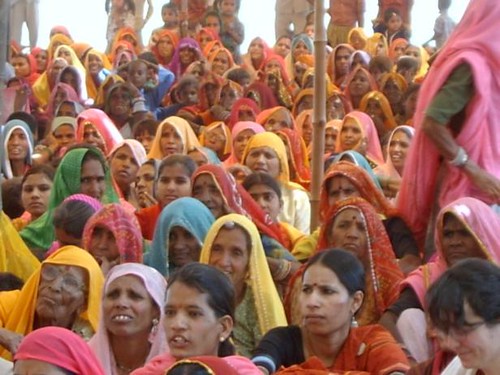
Having issued that warning, I invite you to consider what local level data from rural India reveals. Some background: since the mid-1990s, one-third of Village Council head positions have been reserved for women, and Village Councils make decisions about the provision of many important public goods.

This study used a dataset of 265 Village Councils in Rajasthan, located in India’s northwest adjacent to Pakistan, and West Bengal, located in the east adjacent to Bangladesh. The survey compared investments in Village Councils that contained reserved positions for women and those that did not.

The finding: the gender of the politician does influence policy in rural India. In both states, when the Village Councils have women members, there are significantly more investments in drinking water as opposed to investments in roads and education.

This post is the first of several to pursue the question of gender and leadership. Your comments and contributions are most welcome.

Image: “India04_tilonya_mela-womensday2” from flickr user thaddeus, licensed with Creative Commons.

The Insecure American: Book Reading and Signing

Please join the Department of Anthropology and the College of Arts and Sciences of American University for the following special event:

The Insecure American: Book Reading and Signing
With co-editor Hugh Gusterson
and authors Susan Hirsch, Roger Lancaster, Janine Wedel, and Brett Williams

Thursday, February 25, 7-9pm
Hughes Formal Lounge
American University Main Campus, Washington, DC
Refreshments will be served

Directions: http://www.american.edu/maps; Questions: 202-885-1830

The Insecure American: How We Got Here and What We Should Do About It:
Americans are feeling insecure. They are retreating to gated communities in record numbers, fearing for their jobs and their 401(k)s, nervous about their health insurance and their debt levels, worrying about terrorist attacks and immigrants. In this innovative volume, editors Hugh Gusterson and Catherine Besteman gather essays from nineteen leading ethnographers to create a unique portrait of an anxious country and to furnish valuable insights into the nation’s possible future. With an incisive foreword by Barbara Ehrenreich, the contributors draw on their deep knowledge of different facets of American life to map the impact of the new economy, the “war on terror,” the “war on drugs,” racial resentments, a fraying safety net, undocumented immigration, a health care system in crisis, and much more. In laying out a range of views on the forces that unsettle us, The Insecure American demonstrates the singular power of an anthropological perspective for grasping the impact of corporate profit on democratic life, charting the links between policy and vulnerability, and envisioning alternatives to life as an insecure American. [University of California Press, 2009]

Steps toward rebalancing Haiti

In the late 1970s, Haiti’s rural population was 80 percent of the total population, while today it is 55 percent. This rapid shift has led to Haiti being “terribly out-of-balance” as Robert Maguire testified (PDF transcript) before the Subcommittee on International Development, Foreign Assistance, Economic Affairs and International Environmental Protection of the U.S. Senate Committee on Foreign Relations on Feb. 4.

Robert Maguire is associate professor of international affairs and director of the Haiti Program at Trinity College in Washington, D.C., and Jennings Randolph senior fellow at the United States Institute of Peace. He first went to Haiti in 1974. His most recent visit ended on January 10, 2010, two days before the earthquake occurred.

In his testimony, Maguire laid out five points:

  1. Decentralization: help people displaced from Port-au-Prince to stay in rural areas
  2. Create a National Civic Service Corps
  3. Strengthen state institutions through partnership
  4. Get money into the hands of poor people
  5. Support institutions, businesses, and leaders who work toward inclusion, less social inequality, and socially responsible investment strategies

Image: “Rural life is hard work,” a scene of rural Haiti. Creative commons licensed content by Flickr user danboarder.

Follow the aid

Despite an abundance of aid materials and the good intentions of relief agencies, relief efforts in Thailand following the December 2004 earthquake/tsunami were afflicted by skewed distribution.

Jin Sato, associate professor in the Institute for Advanced Studies on Asia at the University of Tokyo, analyzes the factors that skewed relief good distribution in an article in Development in Practice. He discusses how the political and economic turmoil caused by relief efforts themselves constitute an additional risk for victims.

Sato also notes that while the social ramifications of relief efforts are substantial, yet they are often overlooked for three reasons:

  • most “disaster management” experts are engineers
  • social analysis requires time
  • relief organizations are poorly coordinated which prevents the generation of lessons for the future

His recommendations for more effective responses, based on lessons from the 2004-2005 tsunami relief efforts, are:

  • the selection of goods and distribution mechanisms are of paramount importance
  • aid efforts should not only supply goods but should focus on strengthening institutional resources that allow recipient communities to more effectively absorb the goods and distribute them fairly
  • relief agencies should co-ordinate with each other after the emergency stage to develop ways to reduce pre-existing inequalities or dominance

After reading his article, I decided to contact Professor Sato to learn more about him and his involvement in disaster response work. Here is my email interview with him:

Q: What is your background in terms of academic training?

A: My B.A. from the University of Tokyo was in anthropology, and I have a master’s degree in both international relations and public policy from the Kennedy School at Harvard University. My Ph.D. was in international studies (interdisciplinary) at the University of Tokyo, and my dissertation topic was on natural resource governance and politics in Thailand. I did a post-doc at the Agrarian Studies Program at Yale University under Jim Scott in 1998-1999.

Since my student years, I have been interested in natural resource governance and foreign aid. The article is a spin off from my interest in the latter.

Q: When you worked as a policy advisor to the Ministry of Natural Resources and Environment of Thailand, what were your major responsibilities?

A: I was there to advise on the formulation (and prioritization) of the Environmental Policy 5-year plan, particularly about citizen participation and the role of international assistance (especially that of the Japanese government).

Q: Where were you when the tsunami hit, and what role if any did you play in responding to the tragedy?

A: As you might remember, the Tsunami hit on Dec. 25. I was taking a vacation in Samui Island in Thailand. Since my duty was to advise on environmental policy, I was not sure what to do, but I contacted the JICA office to offer assistance since I could speak the language. They put me on the first assistance survey team to develop livelihood assistance strategy from Japan. But Japanese assistance was too slow, and I don’t think we had any impact at all.

Q: Can you comment on the current situation in Haiti, in terms of how your findings about Thailand might relate to that context?

A: Since I have not been to the field, it is hard to comment. But judging from the news, there was more order and discipline in Thailand where people could wait in lines to receive aid goods. The tsunami hit only the coastal zone and other parts remain intact (unlike the earthquake). This is a huge difference in terms of the availability of assistance and speed of recovery. I suspect that there will be some structural concentration in either damage or assistance due to pre-existing resource inequity.

Image courtesy of Jin Sato.