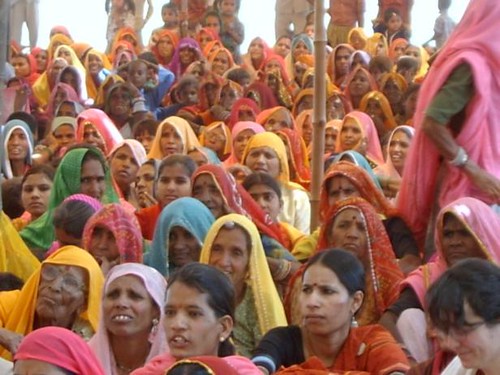
Dishonorable killings

So-called honor killings take the wind out of a form of cultural relativism that I refer to as absolute cultural relativism. According to absolute cultural relativism, anything that goes on in a particular culture, and is justified within that culture, cannot be questioned or changed by insiders or outsiders. For insiders, such questioning is cultural heresy; for outsiders it is ethnocentrism.

An antidote to absolute cultural relativism is critical cultural relativism, which promotes the posing of questions about practices and beliefs by insiders and outsiders in terms of who accepts them and why, and who they might be harming or helping. In other words: Who benefits, who loses? [Note: I present these terms in my cultural anthropology texts as a way to get students to think more analytically about the very important concept of cultural relativism.]

Image: Flickr creative commons licensed content. If only India, and indeed the whole world, was a domestic violence free zone.

When death, torture and structural violence are involved, it’s time to relegate absolute cultural relativism to the sidelines and bring to the fore critical analysis and discussion among insiders and outsiders. As far as I know, murder is not legal in any country in the world, including murder of one’s own kin for purposes of protecting family honor.

An article in The New York Times describes an alleged honor killing of a young unmarried Hindu woman in her family home in Jharkhand state, eastern India.

The article links the possible murder to Hindu caste values, which forbid marriage of woman to a man of a lower caste category — in this instance, the woman was of a Brahmin family and was engaged to a man of the Kayastha category, which is lower. Not only that, she had apparently engaged in premarital sex, another serious problem from the point of view of family honor.

What the article doesn’t say is that honor killings of daughters and wives by family members occur among people of other religions as well, including Christianity, that are not driven by caste purity. More deeply than particular religious values is the widespread existence of lethal patriarchy: male dominance in all domains of life — economic, political, social, sexual — that it justifies, even actively supports, murder of women and girls.

There can be no way, in this world, that anyone can get away with murder by saying that “it’s part of our culture” to kill a daughter or wife who breaks cultural rules. As if it’s their right and duty to kill.

Unfortunately, local police and the judicial system are often on the side of the killers.

Amnesty International now keeps track of so-called honor killings, but it’s likely that cases are severely under-counted. Nevertheless, any and all efforts to keep shining a very bright light on the problem of honor killings and related forms of patriarchy are essential.

See also this post on the blog Women Against Shariah.

Don’t let the sun catch you crying

Journalist and filmmaker Sebastian Junger says that he wanted to make you feel like you are actually there in a remote combat outpost in Afghanistan in Restrepo. He and his partner Tim Hetherington, succeeded. After the documentary’s powerful 90 minutes, people in the packed AFI theater in Silver Spring, Md., on Friday June 28 were in shock and awe and tears.

Junger (right) and Tim Hetherington (left). Creative Commons Licensed

Restrepo will remain embedded in my heart and mind for the rest of my life.

The film chronicles the daily lives, and sometimes deaths, of a small platoon of American soldiers tasked with pushing against Taliban control of the Korangal Valley. The soldiers, all men, are very young — 19 years old, many of them, pimply some of them, and proud to be serving their country in fighting “the enemy.” Also, over time, bored, thrilled, scared and sad.

Occasionally, the film provides footage of local villagers. They appear to be mostly scared by what is happening in their valley as they experience the counter-pressures of the Americans and the Taliban. But sometimes proud and dignified as male elders attempt to gain compensation for a cow who died as a result of entanglement with wire fencing surrounding the outpost.

The film brilliantly and effectively interweaves footage from the combat zone with tight-shot interviews with eight soldiers conducted in Italy four months after they had left Afghanistan. So one minute you are in the outpost Restrepo, named after a fallen comrade, with all the noise and smoke from artillery and helicopters. The next minute you are up close and personal listening as a young soldier quietly talks about what it was like to be in the combat zone and what it is like to be dealing with not being there. One says that he doesn’t want to go to sleep because of the nightmares. He has tried five different kinds of sleeping pills, but none works to allow him a peaceful night’s sleep.

Each of the eight men gets very close to tears.

An excellent panel discussion following the film was skillfully moderated by Lara Logan, chief foreign correspondent with CBS News, and included Sebastian Junger as well as one of the film participants, Major Dan Kearney, who made it possible for the film team to work with his combat team.

In the discussion, Sebastian Junger commented that the interviews really “make” the film. What you don’t see, he pointed out, is that the person interviewing the soldiers — Junger — is also fighting back the tears. Junger noted that soldiers cannot show emotion, especially in a combat zone. Instead, when death happens, especially the death of your buddy, you mourn for a minute or two and then get back out there and kill the enemy who took his life.

Once they leave combat, the men have to try to process all that they have been through in the previous 15 months. Many do not succeed in readjusting to civilian life. Junger hopes that the film will help with the re-integration process by promoting understanding of the challenges they face. He said that many of the men will end up going back into combat, leaving behind their wives who feel rejected. They go back, he thinks, because for many 19-year-old men in the United States civilian life does not offer a satisfying role, identity or sense of belonging. The combat zone does that in spades. Many soldiers, he says, become addicted to the male bonding, the brotherhood that is forged in the daily routine of a harsh life and possible death. It is an intoxicating form of solidarity, stronger than friendship, that trumps all differences and disagreements and provides an emotional security that overrides concerns about physical security.

Combat, says Junger, is a small, closed, male world. His film offers a peek through a keyhole into that world. Restrepo is an ethnographic film of the highest order. (Junger has a B.A. in cultural anthropology and it shows). Although Junger wasn’t with the troop for the entire 15 months — he visited five times — he and his camera were not obviously intrusive. But they must have created an extra layer of life and death?

In the question and answer period, no one asked Junger how he is dealing with re-entry to the civilian world. It can’t be easy for him, either. I believe I saw tears in his eyes at several points during the panel discussion.

Update: Tim Hetherington tragically was killed April 20th, 2011 while on assignment in Libia.

Blood ties: a father forsaken

Patricide, or the murder of one’s father, is often associated with political intrigue at high levels: a son seeks his father’s throne and doesn’t want to wait for his father’s natural death.

The reported murder of an Iraqi man by his son and a nephew because he worked for the U.S. military as a translator is a tragic case of how kinship ties, supposedly involving love and avoidance of harm, can be over-ridden by other powerful interests and motivations with deadly results.

If you use the two search terms “killing” and “father” in Google, you will find many entries for so-called honor killings in which a father kills a daughter for perceived transgressions such as pre-marital sex or marrying someone of the wrong caste or other kinship category. These murders are all too common and the murderers all too often go free.

In this case, a father was killed because he chose to work for the “wrong” people. An honor killing of a different sort, but just as dishonorable and heinous. A son and nephew are in custody. Another son is being pursued.

My deep condolences to the victim’s widow.

One of the most famous literary references to patricide is portrayed in Gustave Moreau’s Oedipus and the Sphinx (1864). Creative commons licensed.

Where did our love go?

Vice President Al Gore and Tipper Gore, married for 40 years and an iconic couple of marital endurance against high odds, are quietly separating. I am sure that thousands of other people join me in wishing them both the best as they move on into new directions.

While the media buzz about the separation, I note the absence of insights from any cultural anthropologists. An article in today’s New York Times Style section, for example, includes comments from psycho-physiologist Robert Levenson of UC Berkeley, neuroscientist Bianca Acevedo of UC Santa Barbara, marriage historian Stephanie Coontz of Evergreen State College and economist Betsey Stevenson of the University of Pennsylvania.

Hello anthropology?

A quick scan of my library’s Anthropology Plus database of journal articles (going back to 2005) revealed nothing by cultural anthropologists on marriage in the United States. And nothing on marriage resilience or durability anywhere in the world.

“Marriage and the family” were core topics of cultural anthropology when I went to college, though typically the subject matter was “other” cultures. Nevertheless, as cultural anthropology has, since then, included in its purview cultures everywhere, including industrialized contexts, it seems to have missed out on love among the Nacirema.

It seems cultural anthropologists have yet to study the shadow (both positive and negative) cast by marriage. Image: “Love and Marriage” by Flickr user hammer51012, creative commons licensed.

Anthro in the news 5/17/10

• Africa is not a big country
In a letter to the editor of The New York Times concerning an article on the global war on AIDS, Steve Black zings it for totalizing “Africa.” He writes, “Now just imagine what would happen to investment in the United States if articles did not distinguish between the United States and Colombia and discussed “American drug lords”?” Black spent a year in Durban, South Africa, while pursuing a Ph.D. in anthropology. See also this.

• The tragedy of trachoma
Infectious trachoma is widespread among the indigenous peoples of Australia. Some eye care specialists argue that services in remote areas to provide eye care should be increased. Peter Sutton, an anthropologist, responds that spending more on services is questionable when much of the burden of trachoma could be prevented by improved facial hygiene.

• Let’s face it
A French proposal to ban full face veils for women has prompted much media discussion. The Daily Star (Lebanon) quotes Abdelrhani Moundib, a professor of sociology and anthropology at Mohammed V University in Rabat, Morocco: “The West has the right to preserve its secularism … As a Moroccan Muslim, I am against the burqa. I see nothing in it that relates to Islam or chastity.”

• Talk to me
Just hearing your mother’s voice can raise levels of oxytocin, the “cuddle hormone,” according to an experimental study conducted by biological anthropologist Leslie Seltzer of the University of Wisconsin-Madison.

• Jaws are us (guys)
Human males have thicker jaw bones than human females. The interpretation of this difference, provided by biological anthropologist David Puts of Penn State University, is based in evolution. Physically superior males were more attractive to females as mates, and male jaw bones were part of the selective mix: “Males have thicker jawbones, which may have come from men hitting each other and the thickestboned men surviving,” he said. “Things are different for us now in many ways.” Blogger’s note: I hope he’s right about things being better now.

• Makerere University drops archaeology B.A. degree
Scrapped programs on the main campus of Makerere University, Uganda, include the B.A. in archaeology. In all, 20 programs were dropped including the bachelor’s degrees in dance, tourism and wildlife health and management, and the master’s program in ethics and public management.

One day for mothers


“Mother’s Day Paint Job,” creative commons licensed on Flickr.

One day out of 365? Not good enough.

Anthropologists have analyzed some annual holidays such as Mardi Gras in the West and Holi among Hindus in South Asia. They often involve “inversion.”

In Mardi Gras, people have a riotously good time in ways not normally accepted. Sexuality is emphasized. Some participants cross-dress.

During Holi, people get smashed on bhang, a powerful hash milkshake. In villages, low caste people pour buckets of urine on high caste people. Women beat their husbands with brooms.

Interestingly, these important holidays, like Mother’s Day, occur in the spring. Some aspects of Mother’s Day indicate that it is a ritual of reversal, though of a more quiet kind that Mardi Gras or Holi.

The functional theory of reversal rituals or holidays relies on the model of a pressure cooker. The pressure cooker model says that a reversal ritual allows a period of time, often just a day, within which people get a break from their normal roles and routine. Having experienced a release from the pressure, they go back to the same old same old for another 364 days.

My casually collected evidence for how Mother’s Day is marked in the United States reveals aspects of reversal in gift-giving, especially taking mom out for a meal, remembering her with a greeting card or a long distance phone call if you can’t visit her. These gifts constitute important reversals in terms of two core aspects of motherhood around the world: meal provision and care through communication.

Does Mother’s Day, as celebrated in the United States at least, fit the pressure cooker model? Such may be the unconscious hope of many children: okay, mom, I took you out for brunch and gave you a card, so be happy.

My hope is that all of us, born of a mother who cared for us, know that a ratio of 1/365 is not good enough by half. While further research is needed, my hunch is that the expectations for Mother’s Day is the bottom line. You have to do something–at least make a phone call. If not you are in deep trouble.

But that which is necessary is by no means sufficient.

Blogger’s note: Wikipedia’s entry on Mother’s Day around the world is worth a visit.

Thinking outside the pill box

The latest issue of the Journal of Women’s Health includes three articles describing health risks of women in the United States related to social exclusion and cultural factors. They all demonstrate that good health is about a lot more than medical care.

The first article looks at three factors associated with cardiovascular disease–hypertension, elevated cholesterol, and diabetes–among 733 uninsured, low-income rural women in West Virginia aged 40-64 years.  The women were participants in the Well-Integrated Screening and Evaluation for Women Across the Nation (WISEWOMAN) program.  West Virginia has a high percentage of people 50 years and older, the highest rate of angina and coronary heart disease in the United States, and is tied with Kentucky for first place in prevalence of heart attacks.  Prevalence of hypertension, elevated cholesterol, diabetes, and obesity, are also among the highest in the nation. The study found that large proportions of the women are at risk for cardiovascular disease because of untreated hypertension and high cholesterol. They lack access to regular health care due to the limited availability of health services in rural areas. Women who are less educated, a likely proxy for poverty, are particularly likely to have these untreated chronic conditions.

The second article is about emergency care for women who have been sexually assaulted. According to the National Violence against Women Survey, 18 percent of white women, 19 percent of Black women, 24 percent of mixed race women, and 34 percent of American Indian/Alaskan Native women report a rape or sexual assault at some time in their lifetime. This article reports on findings about the “incident history” of sexual assault from 173 women who sought care in an Emergency Department in an unidentified city (possibly in Mississippi since the lead author is assistant professor in the School of Nursing at the University of Southern Mississippi).  Of the total, 58 percent of the women were black and  42 percent white.  Weapons were much more likely to be involved in assaults on black women, and black women were more likely to be assaulted in the city rather than the suburbs. Substance abuse occurred in about half of the assaults; black women were more likely to report use of illicit drugs while white women were more likely to report alcohol use before the assault.

The third study reports on an evaluation of a community-based pilot intervention in New York City that combined cervical cancer education with “patient navigation” to improve rates of cervical cancer screening among Chinese American women.  In the United States, Chinese American women have higher rates of cervical cancer than white women.  The study compared an intervention group and a control group.  Eighty women received the intervention: two education, sessions,  open discussion with a Chinese physician, educational videos,  and navigation assistance in identifying and accessing low-cost services. The control group of 54 women received two education sessions delivered by Chinese community health educators and written materials on general health and cancer screening. Twelve months later, screening rates in the intervention group were 70 percent compared to 11 percent among the control group. An important factor in the intervention group was greater perception of the severity of the disease.

Continue reading “Thinking outside the pill box”

Equal play for girls and women

The US Department of Education has repealed a 2005 Bush-era policy that made it easy for high schools and colleges to avoid compliance with a federal law mandating equal opportunities for female students in schools and colleges that receive federal aid, specifically in terms of athletics.

One way to comply with Title IX was to use a survey to assess the interest and ability of girls and women to participate in athletics. Schools could use their survey results to document a lack of interest or ability and, just like that, they were off the hook for another year.

An event at the George Washington University today, April 20, marked not just Equal Pay Day but also the “Title IX Announcement” with Vice President Joe Biden, Jr., Secretary of Education Arne Duncan, Senior Advisor Valerie Jarrett, and Joy Cheek, Duke University basketball player and former intern in Vice President Biden’s Office.

Secretary Duncan mentioned a recent cross-state analysis by Betsey Stevenson of the Wharton School of the University of Pennsylvania which shows several positive effects of girls’ participation in high school athletics: being an athlete is associated with about one more year of schooling, higher labor force participation rates, higher earnings, and higher participation in male-dominate jobs and mixed-gender jobs compared to female-dominated jobs. These findings about the effects of athletic participation hold true in spite of the potential bias created by self-selection into athletics.

Vice President Biden delivered an impassioned, off-the-prompter speech in which he noted that while statistics are important, they don’t tell the whole story. Making Title IX  “as strong as it can possibly be is the right thing to do.” In spite of the great progress that has been made since 1972, “we have a long way to go” to “take away every barrier that exists.” The bottom line is: “empower, empower, empower women to take control of their own lives.”

SOURCE: Betsey Stevenson, Beyond the Classroom: Using Title IX to Measure the Return to High School Sports. The Review of Economics and Statistics May 2010, 92(2):284-301.

Upcoming event at GW

To our Washington-area readers out there, the Culture in Global Affairs Program and the Global Women’s Forum at the Elliott School of International Affairs are hosting our final event of Spring 2010 this Thursday evening:

Working the Night Shift:
Women in India’s Call Center Industry

Dr. Reena Patel

Drawing from her newly released book, Working the Night Shift, Reena Patel will talk about how call center employment affects the lives of women workers, mainly as it relates to the anxiety that Indian families and Indian society have towards women going out at night, earning a good salary, and being exposed to western culture. From remarks such as “Call center job equals call girl job!” to concern about how night shift employment will affect a woman’s worth on the arranged marriage market, Patel explores the ironic and, at times, unsettling experiences of women who enter the spaces and places made accessible through call center work.

Thursday, April 22, 2010
7:00 pm – 8:30 pm

1957 E Street NW, Room 505

To RSVP, click here.

What are women leaders good for?

On April 15, a panel at the United States Institute of Peace in Washington, DC, focused on a newly released study, “Progress Report on Women in Peace and Security Careers: U.S. Executive Branch.” Jolynn Shoemaker, Executive Director of Women in International Security (WIIS) presented highlights from the report. Major findings include: the situation for women in security careers is less difficult than in the previous generation due to the decline in overt discrimination, but the lack of role models and mentors/sponsors and problems with workplace-life balancing persist.

During the discussion, the question was raised about the effects of having more women in leadership positions in peace and security institutions. Ms. Shoemaker responded that we haven’t yet reached the critical mass in many U.S. security institutions to address the question.

This question is both important and researchable in many areas of leadership. A danger arises, however, in essentializing gender, just as with race, ethnicity or any other social category. Since when, for example, has Clarence Thomas made a decision to benefit the majority of African Americans? And what has Condaleeza Rice done specifically for women of any race/ethnicity?

Having issued that warning, I invite you to consider what local level data from rural India reveals. Some background: since the mid-1990s, one-third of Village Council head positions have been reserved for women, and Village Councils make decisions about the provision of many important public goods.

This study used a dataset of 265 Village Councils in Rajasthan, located in India’s northwest adjacent to Pakistan, and West Bengal, located in the east adjacent to Bangladesh. The survey compared investments in Village Councils that contained reserved positions for women and those that did not.

The finding: the gender of the politician does influence policy in rural India. In both states, when the Village Councils have women members, there are significantly more investments in drinking water as opposed to investments in roads and education.

This post is the first of several to pursue the question of gender and leadership. Your comments and contributions are most welcome.

Image: “India04_tilonya_mela-womensday2” from flickr user thaddeus, licensed with Creative Commons.