President Obama: What would your mother say?

Guest post by Eben Kirksey

President Obama turned his back on Indonesia recently — canceling his visit there for the second time this year. His mother, Ann Soetoro, was a cultural anthropologist who spent much of her adult life helping economically-marginalized people of Indonesia. If she were still alive, she might well be disappointed in her son.

As President Obama turns his attention to the oil spill in the Gulf, the U.S. Congress is reminding him of other important issues in a seemingly remote corner of Indonesia. A resolution introduced by Rep. Patrick Kennedy (H.Res. 1355) calls attention to the human rights problems in West Papua [Google map], the half of New Guinea that was invaded by Indonesia in 1962.


Image: West Papua has idyllic scenes like this one, but also significant human rights problems. “Asmat boat.” Creative commons licensed content on Flickr.

In the President’s autobiography, Dreams from My Father, he recalls a conversation with Lolo Soetoro, his step-father who had just returned home after a tour of duty with the Indonesian military in West Papua. Obama asked his step-father: “Have you ever seen a man killed?” Lolo responded affirmatively, recounting the bloody death of “weak” men.

Ann Soetoro never spoke out publicly about Indonesian atrocities in West Papua, but she divorced her husband shortly after he came back from the frontlines of this war.

Papuan intellectuals and political activists, kin of the “weak” men killed by Lolo Soetoro, have read Obama’s autobiography with keen interest. They still embrace the message of hope from the Presidential campaign and the slogan, “Yes We Can.”

At a moment when many Americans are questioning whether Obama will be able to fulfill his campaign promises, when everyone is wondering if he can reign in the hubris of the corporate executives who produced the disaster in the Gulf, it is worth considering these enduring hopes in West Papua.

Perhaps it is time for those of us who were drawn in by the slogan “Yes We Can” to remind the President that grassroots political movements still have power.

Many people, including some anthropologists, do not know the difference between West Papua* and Papua New Guinea. The subject of several classic anthropology books — from Margaret Mead’s Growing Up in New Guinea to Marilyn Strathern’s Gender of the Gift — the independent nation of Papua New Guinea is familiar to almost anyone who has taken an introductory anthropology class. Indonesia is also well known among academics who study culture or politics. Cultural anthropologist Clifford Geertz told us tales of Balinese cockfights and Javanese religious systems, and political scientist Benedict Anderson famously wrote about imagined communities and power in Indonesia.

At the edge of national and scholarly boundaries, West Papua, in contrast, falls through the cracks.

Anthropologists and scholars in allied disciplines should join human rights advocates and others in noticing West Papua. Amnesty International is currently working with Representative Kennedy’s office to pass his Resolution which calls attention to many pressing problems:

    “Whereas Amnesty International has identified numerous prisoners of conscience in Indonesian prisons, among them Papuans such as Filep Karma and Yusak Pakage, imprisoned for peaceful political protests including the display of the ‘‘morning star’’ flag which has historic, cultural, and political meaning for Papuans…

    “Whereas a Human Rights Watch report on June 5, 2009, noted ‘‘torture and abuse of prisoners in jails in Papua is rampant’’;

    “and Whereas prominent Indonesian leaders have called for a national dialogue and Papuan leaders have called for an internationally-mediated dialogue to address long-standing grievances in Papua and West Papua.”
    If passed, this Resolution would give President Obama some issues of substance to talk about with Indonesian leaders once he does make a return trip to Southeast Asia. Resolutions are non-binding acts that convey the sentiments of Congress.

Amnesty International, and the other human rights groups advocating for this resolution, are up against powerful forces. Transnational companies have been lobbying for stronger military ties with Indonesia. The same company that brought us the disaster in the Gulf of Mexico, BP, has a huge natural gas field in West Papua called Tangguh. Starting this year, BP is scheduled to start shipping super-cooled gas from this site (liquid natural gas or LNG) to North America where it will be piped into the homes of millions in California, Oregon and other westerns states.

BP has been a major donor to the U.S.-Indonesia Society, an organization committed to educating congressional staff and administration officials about the “importance of the United States-Indonesia relationship.” The U.S.-Indonesia Society is also supported by Freeport McMoRan, a company that operates one of the world’s largest gold and copper mines in West Papua.

The American public is starting to reign in the irresponsible behavior of companies like BP that have created domestic disasters. American must also reckon with the foreign entanglements of the companies supplying the U.S. natural resources and should question the politicians who have led the United States into a series of environmental catastrophes and debacles on foreign soil.
Continue reading “President Obama: What would your mother say?”

Why are some wars worse for women?

Guest post by Laura Wilson

The United State Institute of Peace recently presented the second part of its program on The Other Side of Gender: Masculinity Issues in Violent Conflict. Panelists Elisabeth Wood, Professor of Political Science at Yale University, and Jocelyn Kelly, Research Coordinator with the Harvard Humanitarian Initiative, drew on their diverse experiences in conflict zones worldwide to answer the question: Why are some wars worse for women than others?

Wood compared gender-based violence (GBV) in conflict zones in Sri Lanka, El Salvador, Guatemala, and Israel/Palestine. She finds that rape is not an inevitable by-product of war. Combatants in different war-zones, on different sides of a conflict, or even within the same group take markedly different approaches to rape and violence against women. To effectively challenge rape as a tool of war, it is essential to understand why GBV is rare in some conflict zones. The fact that soldiers in some wartime situations respect human rights indicates that all combatants can and should be held accountable for their actions.

Wood argues that the cultural setting of war is the primary determinant of GBV.  She highlights the importance of institutional norms within combatant groups:  Does the military hierarchy punish, tolerate, or promote GBV?  Is GBV a war-time innovation, or does it represent a pre-war phenomenon? Is the chain of command well-managed?

Generally, GBV is less prevalent in settings where the top-down repression of GBV is high and where religious and socio-cultural norms inhibit rape as a tactic. This pattern provides insights into how to address the high rates of GBV in other contexts.

Jocelyn Kelly focused on one message: jobs.  During her interviews with Mai Mai rebels in the DRC, combatants expressed a strong desire to demobilize if provided with job opportunities and livelihoods.

The Mai Mai originally formed to protect Congolese villages and minerals from the Rwandan Interhamwe. Many young men without economic opportunities joined the rebels who make their living scavenging and stealing from local communities. Life as a rebel soldier cuts young men off from social interaction and marriage prospects. But many yearn for the chance to start a normal family life. Within this context, soldiers may rape out of bitterness or a psychological “war fog.”  While professionalizing the rebel groups, or incorporating them into the national army, might lower the risk of GBV during conflict, Kelly asserts that economic empowerment would have the greatest impact in de-militarizing the Congo and bringing combatants back into everyday life.

The presentations thus forcefully raised this question: Is the best way to prevent GBV during war to change the culture of war or improve livelihoods through development?

In his new book Tearing Apart the Land: Islam and Legitimacy in Southern Thailand, Duncan McCargo, professor of politics at the University of Leeds, provides insight with a story. Walking through a Malay village in Southern Thailand shortly after the kidnapping and murder of two marines, McCargo noticed Thai soldiers digging holes in front of each house. He learned that the soldiers were creating fish ponds in order to bring “economic empowerment” to the village to prevent further violence.

McCargo asks: would a fish pond have saved the lives of the two marines? Some (fish) food for thought.

Laura Wilson is a candidate for an M.A. degree in international development studies at The George Washington University with a focus on gender, human rights and development. She received a B.S. degree in foreign service from Georgetown University in 2007. She is currently the program assistant for the International Development Studies program.

Image: “Mother & baby wait…” from Farchana Refugee Camp in Chad, photo by Lin Piwowarczyk, from Flickr user physiciansforhumanrights, licensed with Creative Commons.

Laura Wagner’s report from Haiti

If you still think that “all Haitians” are trapped in “voodoo worship” please read Laura Wagner’s description of her experiences in Haiti following the earthquake. Laura is a PhD candidate in anthropology at the University of North Carolina at Chapel Hill, and she has been in Haiti conducting research on human rights.

Her report doesn’t mention anything about Haitians turning to “voodoo” in the days following the earthquake. If “voodoo” is so pervasive a force in all Haitians lives, funny that she didn’t notice it and document. She’s a trained cultural anthropologist, so I take her description as meaning that people were living their lives in a fairly voodoo-free way.

Instead, Wagner describes what she saw, including the “fierce generosity”  of the Haitian people with whom she interacted. Her essay paints a picture of a moral high ground that I am not confident I would find following such a crisis in my home town of Washington, DC. True, the Washington Post carried an article over the weekend about how neighbors in one part of DC got together following our double snowstorm to help those without power and the elderly.

Today’s Post carried no articles about Haiti in the first section, but it did provide substantial coverage about how Washington area residents are fed up with being stuck at home and how they just want to get back to their normal routines.

Being stuck at home in a place where earthquakes don’t happen would be a blessing to thousands and thousands of Haitians.

Image: “Haiti Earthquake,” from flickr user IFRC, licensed with Creative Commons.

Support the Chagossians

The following is a message from David Vine, Assistant Professor of Anthropology at American University:

You can immediately assist the Chagossians by signing the petition by Friday, February 12, to support the rights of the Chagossians and protect the environment in the Chagos Archipelago.  Click here for the petition: http://www.marineeducationtrust.org/petition/protect-chagos

The British Government is currently considering the establishment of a “Marine Protected Area” in Chagos.  While the idea of protecting the environment in Chagos sounds like a good one, the British Government is using “environmental protection” as a way to further cement the ban on Chagossians returning to their homeland.  They are using the name of environmentalism to compound and cover up a grave human rights abuse.

The creation of a protected area in Chagos is a good idea, but it should be done in consultation with the Chagossians.  To now, the Chagossians have been completely excluded from the planning process.  Elsewhere around the, communities coexist with environmental protection areas.  As the Chagossians have long said, if they would be allowed to return to their homeland, they could serve as the best protectors of the local environment, helping to monitor and enforce a Marine Protected Area.

Please sign the petition organized by the Marine Education Trust and supported by the Chagossians (and the UK Green Party, among others) calling on the British Government “to protect both the marine ecosystem of the Chagos archipelago and the rights of its exiled community.”

For more information, go to http://www.chagossupport.org.uk/

Please encourage others to sign  and thanks for supporting the Chagossians’ struggle!

Image: “Sunset at Turtle Cove”, from flickr user Drew Avery, licensed with Creative Commons.

Anthro in the news 12/21/09

• Cultural anthropologist wins national award in Australia

A book critiquing public policy toward Australia’s aborigines over several decades has won the Manning Clark House Cultural Award 2009. The awardee is Peter Sutton, a cultural anthropologist and linguist and senior research fellow at the University of Adelaide and the South Australian Museum. His book, The Politics of Suffering: Indigenous Australia and the End of the Liberal Consensus, challenges the way successive governments have dealt with indigenous issues. According to the Canberra Times, it has polarized many readers in both academic and mainstream circles. The author says he has been surprised at the depth of feeling: “I’m touched by the fact that so many people are relieved by the book… It’s given them a certain cathartic release from silences and from being unable to think where they were heading.” He has, however, been upset by the “more personal attacks.”

• Ardi wins as top scientific breakthrough

Science magazine anointed Ardipithecus ramidus (its long-awaited description, not the discovery of the fossils since they were found over a decade ago) as the Breakthrough of 2009, and the mainstream media eagerly picked up on the announcement. According to Bruce Alberts, editor-in-chief of Science, the Ardipithecus research “changes the way we think about early human evolution, and it represents the culmination of 15 years of painstaking, highly collaborative research by 47 scientists of diverse expertise from nine nations, who carefully analyzed 150,000 specimens of fossilized animals and plants” (source). A special issue of Science was devoted to articles by various team members on the fossils and their significance.

• Anthropologists honored by AAAS

The American Association for the Advancement of Science (AAAS) announced its 531 new fellows. Seven are anthropologists: Susan M. Cachel, Rutgers University; Diane Zaino Chase, University of Central Florida; Katerina Harvati, Eberhard Karls University of Tübigen; Andrew Hill, Yale University; Gary D. James, Binghamton University; Ellen Messer, Brandeis University; Yolanda Moses, University. of California, Riverside; and Lynnette Leidy Sievert, University of Massachusetts, Amherst.

• Nancy Scheper-Hughes releases interview about Israeli illegal organ harvesting

In 2000, Nancy Scheper-Hughes, professor of anthropology at the University of California at Berkeley, conducted and taped an interview with Yehuda Hiss, former head of the Abu Kabir forensic institute near Tel Aviv. Hiss admitted that in the 1990s pathologists at Abu Kabir harvested skin, corneas, heart valves and bones from the bodies of Israeli soldiers, Israeli citizens, Palestinians and foreign workers, often without permission from family members. Hiss was removed from his post in 2004 when details about the organ harvesting were first reported, but he still works at Abu Kabir. According to the Guardian, Israel’s health ministry says that all harvesting in Israel is now done with permission and in accordance with ethics and Jewish law. The article is not clear as to why Scheper-Hughes decided to release the interview now.

• Rice as life in Japan

A feature article in the double holiday edition of the Economist about the importance of rice in Japan draws heavily on the insights of cultural anthropologist Emiko Ohnuki-Tierney, the William F. Vilas professor of anthropology at the University of Wisconsin, Madison. She is an authority on Japanese culture and author of many prominent books including Rice As Self: Japanese Identity through Time. She notes that the origin myths of many cultures focus on the origin of the universe, whereas Japan’s is “…about the transformation of a wilderness into a land of abundant rice at the command of the Sun Goddess, whose descendants, the emperors, rule the country by officiating at rice rituals.” These rituals are closely tied to Shintoism, Japan’s indigenous religion, which emphasizes the importance of subordination of self-interest to the well-being of the group. Rice is a major component of national identity: to be Japanese is to eat rice, specifically rice grown in Japan. But modernity threatens the centrality of rice in the diet as young urbanites increasingly opt for meals featuring meat, potatoes and bread. A growing movement, however, seeks to preserve Japan’s rice heritage. One such development is the establishment of an upscale restaurant in Tokyo called Kokoromai (“Heart of Rice”) which has more than 10 varieties of rice on the menu.

• The silent epidemic of childhood hunger in the U.S.

An article in The Washington Post addresses the challenges of widespread and growing childhood hunger in the U.S. and quotes medical anthropologist Mariana Chilton of Drexel University. Commenting on how the problem of child hunger is complex and subtle and cannot be solved by providing food alone, she says “Most people who are hungry are not clinically manifesting what we consider hunger. It doesn’t even affect body weight.” The lack of nutritious food is just one of several pressures facing low-income families including housing and energy costs. Chilton is part of Children’s Health Watch, a network of pediatricians and public health researchers in Philadelphia and four other U.S. cities, and she is organizer of the “Witnesses to Hunger Project” which has provided video cameras to 40 mothers to document the challenges they face and their efforts to feed their children. The videos will be used to lobby the U.S. government.

•Anthropology puts the people in technology engineering

Intel Labs’ People and Practices Research group (PaPR) has a vision of a more human-centered technology future. The group applies principles from “forward-looking anthropology” along with sociology and psychology to predict what people will require in the future. Ken Anderson, an anthropologist with PaPR, says, “We are trying to understand what people actually do in order to better design technology.” For example, because people frequently task switch when using technology, Intel is working on a new turbo boost feature that will be delivered early in 2010.

• Anthropology puts the people in public policy

The Dominion Post carried an article about a one-day seminar in Wellington led by Christian Bason (LinkedIn), head of the Danish thinktank Mindlab. The purpose was to talk about how to redesign public policy processes to take into account the people they are trying to help: taxpayers. Mindlab was established in Denmark to improve service delivery through understanding what people need. One example of success was reducing turnaround time for work injury cases. Bason said that anthropology has become “hip” in government service in Denmark: “instead of studying tribes in South America they are using anthropology to study taxpayers.”

• Anthropology puts the culture in skin care products

Tramayne Butler earned a PhD in cultural anthropology from the University of Michigan and is now founder and CEO of AnthroSpa Logic LLC, which produces natural skin care products. She started researching and developing her line while teaching part-time as an adjunct instructor and spending time at home with her two young children. Inspired by her fieldwork in Kenya and extensive world travels, she realized that skin care products could benefit from cross-cultural knowledge about medicinal and beauty practices and use of organic materials.

• Leprosy most old

The DNA of a 1st century CE man buried in a tomb in the Old City of Jerusalem reveals that he had leprosy, making him the oldest proven case of leprosy. The location of the tomb suggests that he may have been a priest or member of the social elite. The condition of his hair and the quality of the textile shroud he wore are further indications that he was not a social outcast, in spite of suffering from a disfiguring disease. Details of the research are published in PLoS ONE.

• Say it with flowers

Flowers placed near the head of a human buried during the Bronze Age is the first such evidence from that period. The grave is located south of Perth, Scotland. The findings are described by Kenneth Brophy of the University of Glasgow in the journal British Archaeology. BBC news quotes Brophy as saying that the discovery of the flowers brought home to him the human touch involved, that “actually these are people that you are dealing with.”

• Dancing to a different culture

Researchers in the Max Planck Institute for Evolutionary Anthropology, Leipzig, confirm the diversity of human cultures and human cognition. They asked a group of German children and a group of Namibian children to learn a dance. The German children and the Namibian children, however, consistently used different hand movement directions. Daniel Haun comments, “The human mind varies more across cultures than we generally thought.” The findings are published in the journal Current Biology.

• More evidence of chimp smarts

Primatologist Jill Preutz of Iowa State University has observed a group of savanna chimpanzees in Senegal for over nine years. Her latest discovery is that the chimpanzees understand how wildfires behave and can predict the movement of wildfire well enough to avoid it calmly. She feels that this finding sheds light on how early human ancestors may have learned to control fire. A paper co-authored with Thomas LaDuke of East Stroudsburg University, is published online in the American Journal of Physical Anthropology.

• Stone age pantry

Archaeologist Julio Mercader of the University of Calgary, with colleagues from Mozambique’s University of Eduardo Mondiane, has found the earliest direct evidence of extensive consumption of wild cereals. Dozens of stone tools, excavated from deep within a cave near Lake Niassa in Mozambique, were used to grind wild sorghum by Homo sapiens more than 100,000 years ago. Mercader comments that “inclusion of cereals in our diet is considered an important step in human evolution because of the technical complexity and the culinary manipulation required.” The findings are published in Science.

• Tough teeth for tough times

A team of researchers, including biological anthropologists Paul Constantino and Peter Lucas of The George Washington University, have shown that natural selection in three ape species favors those with teeth that can handle “fallback foods” during times of scarcity. Gorillas, orangutans and chimpanzees favor a fruit-based diet. But they all possess molars than can allow them to chew tough foods such as leaves and bark. The findings are published in Science.

• Development projects do not benefit India’s tribals

KIRTADS (Kerala Institute for Research, Training and Development Studies of Scheduled Castes and Scheduled Tribes) organized a national seminar to discuss tribal knowledge, biodiversity, intellectural property rights and the impact of modernity on livelihood sustainability. Vineetha Menon, professor and head of the anthropology department at Kannur University, says that modernity has disturbed the tribals’ livelihood systems and that poverty-eradication schemes have not helped them. K. N. K. Sharma, former director of KIRTADS, pointed to the negative effects of land alienation and expressed criticism of the government for not protecting tribal land rights.

• Nepali cultural anthropologist dies

Renowned cultural anthropologist Saubhagya Shah died as a consequence of a heart attack at the age of 45. Shah earned his doctorate in anthropology from Harvard University. He was a professor in Tribhuvan University’s sociology department and coordinator of its Conflict, Peace and Development Studies program. Shah’s interests focused on the state, democratization and development. In his chapter in the edited book, State of Nepal, he offers a critique of the burgeoning NGO sector in democratic Nepal and notes that both government and non-governmental sectors are competing for the same resources. In an essay titled “Democracy and the Ruse of Empire” (PDF file), Shah points out: “It is ironic that the more Nepal sinks into the abyss of violence and anarchy, the more it emerges as an attractive destination for all manners of gun runners, conflict managers, crisis entrepreneurs and democracy missionaries out to make a quick buck or a fast name.” We have lost a keenly insightful anthropologist and articulate champion of peace, human rights, and counter-imperialism.

• Still remembering L-S
British cultural anthropologist Adam Kuper has written a tribute to Claude Lévi-Strauss which received a full page in Nature (login required).

Accountability lost

by Barbara Miller

A category of local conflict in Peru is called conflictos mineros, mining conflicts. The existence of this specific term reflects the frequency of such conflicts in Peru following neoliberal economic reforms in the early 1990s. Fabiana Li, now a Newton International Fellow based at the University of Manchester, conducted research for her doctoral dissertation in anthropology at the University of California at Davis on mining accountability and conflicts in Cajamarca, Peru. In an article in PoLAR, she shows how the EIA (Environmental Impact Assessment) documents and its approval process skew the outcome in favor of the mining companies.

Public mechanisms of evaluation and record-keeping are supposed to hold corporations accountable to local people. Li describes and analyzes the proceedings of a public workshop and a public hearing about the expansion of the country’s largest gold mine. The EIA is intended to serve as an instrument through which risks are made visible to the public. The risks that are shared with the public, however, are those that engineers can manage with mitigation plans. Furthermore, the EIA entrusts companies to carry out background studies on the landscape and the “social component,” to establish the “baseline” characteristics of the site, and to conduct monitoring as the project progresses.

Such company-sponsored studies, not surprisingly, provide a carefully constructed partial picture, erasing or framing out problematic issues. In spite of its claims to public accountability and transparency, the EIA works in non-transparent ways to serve the interests of the mining companies and the neo-liberal state.

Popular participation is emphasized as part of the process. Company representatives listen to the people who appear at the meetings. They take notes for hours on end. A critique of such participation is that it is in fact disempowering because it provides the appearance of public approval. As Li notes, contesting the approval of an EIA is difficult, and only one mining project has ever been halted at the EIA stage.

Nonetheless, many people in Cajamarca and elsewhere in Peru are pursuing creative forms of activism including seeking other scientific opinions to produce “counter-information.” The playing field in terms of scientific expertise, however, is extremely uneven. EIAs, including baseline studies and environmental monitoring, “increasingly rely on the language and tools of large-scale, capital-intensive science.” The need for scientific counter-arguments places a heavy financial burden on NGOs and campesino groups.

The EIA documents and so-called “popular participation” transform “participants” into unwitting or unwilling collaborators who had their chance to speak up during the EIA process. The companies are protecting their interests, using legalized, scientific, and performative means. But even such encircling power doesn’t mean there will never be another Bougainville.

Photo, “Yanacocha Gold Mine”, from Flickr, Creative Commons.

India go back, India gobar

by Barbara Miller

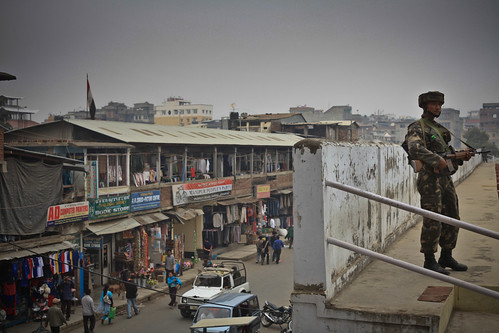
Poet and political activist Irom Chanu Sharmila has been protesting abuses by Indian military forces in Manipur, northeastern India, for ten years. Fasting unto death is her chosen, nonviolent method of protest. Indian law however now rules that fasting unto death is illegal.

Manipur, located in the northeastern region is India’s most war torn state. Forested, hilly, rainy, and the  home of many diverse tribal groups, it was forcibly incorporated into the Indian state in 1949 along with the other states in the northeast.

Sharmila is seeking the repeal of the Armed Forces Special Power Act (AFSPA) which allows the Indian army to detain, and sometimes kill, northeastern people. The UN’s human rights chief, Navi Pillai, has urged India to repeal the law. So far: no progress at all.

Getting rid of the hated AFSPA is an important step toward peace in the region. Greater political autonomy for all the northeastern states would also help reduce the violence and misery. India should wield a lighter hand rather than a heavier hand in the region. But of course, India has major strategic and resource interests in the area. While the central government pursues those interests, the local people suffer terribly.

What do Manipuris want? India out of Manipur.  Not likely.  But perhaps a less repressive presence would suffice?

So what is “gobar” (or “gober”)? It’s a Hindi word that refers to cow dung. Many years ago my college Hindi teacher, Professor Robert Swan, told me a story prompted by the appearance of the word “gobar”  in one of my readings. It was about colonial India’s reaction to the so-called Simon Commission which was charged in the late 1920s with reforming governance of the colony. The Commission did not include a single Indian member to participate in such important policy making.

Sir John Simon, head of the Commission, came to the subcontinent in 1928 to present the report. Everywhere on his tour, including major cities such as Mumbai (then Bombay) and Lahore, he was met with massive and vocal protests. The protestors chanted in English, “Simon go back!” [to Britain]. The many Indian protestors who didn’t know English picked up the chant, recasting it into what they thought they heard: “Simon gobar!” Twenty years later, India gained its independence from Britain. At the same time, it colonized Manipur.

For information on Manipur’s struggle for peace, go to the Manipur Freedom website.

Photo, “Imphal Encounter”, from Flickr and Creative Commons.

Why they killed: the micro-politics of Rwanda’s genocide

by Barbara Miller

One of the most unusual aspects of Rwanda’s genocide that continues to shock and puzzle, 13 years after the killings, is the high level of civilian participation. Other distinguishing characteristics are the speed of the civilian mobilization, the extensive geographic spread of the  killing throughout the country, the velocity of the violence, and the high percentage of the victim group killed.

Dr. Omar McDoom, Lecturer (Assistant Professor) in Political Science at the London School of Economics, spoke about these issues on September 17 in the Elliott School of International Affairs at the George Washington University. His talk was the first in the 2009-2010 CIGA Seminar Series. CIGA is the Elliott School’s Culture in Global Affairs Research and Policy Program.

McDoom spent a year doing intensive fieldwork in Rwanda including conducting over 300 interviews with two groups of Rwandans: those who had killed (they were in prison at the time of the interviews) and those who were related to people who had been killed. He also uses population census data to estimate the number of victims and GPS data to locate regional patterns of killing.

In his talk, McDoom linked macro and micro levels in explaining why the Rwandan genocide occurred and its distinctive patterns. For example, he ties the unusual strength of the Rwandan state to the speed and extensive of the violence. Rwanda, in contrast to many other post-colonial states, had enduring boundaries and longstanding coherence as a “state.” A strong state can accomplish good things more effectively than a weak state and also bad things more effectively than a weak state.

At the micro-level, McDoom’s interviews reveal that killers cluster in families. That is, if one brother had killed, it was likely that his brother would also kill. GPS data indicate regional patterns. Killings were more frequent in densely populated areas. Those who lived in remote regions were less vulnerable.

McDoom is not a “political ethnographer” in the sense of someone who learns the local language and lives with the local people for a long time doing everyday things with them. While he did spend a substantial period of time in Rwanda, he had to use an interpreter for his interviews with killers and victims. And, of course, he was not in Rwanda during the genocide doing “participant observation.” Nonetheless, it is clear that his research benefits immensely from his interviews with many people who were involved and in recording and analyzing their views. If there were an anthropological award for a non-anthropologist, I would nominate McDoom for consideration.

McDoom’s MA training in International Development Studies at GW and his exposure to anthropology during that time likely had a formative influence on how he defines research questions and goes about finding data to answer them. His PhD from LSE is also in Development Studies. Given his postgraduate credentials (that also include a law degree), I am not quite sure how he recrafted himself to look enough like a political scientist to be hired in the Political Science Department at LSE in a regular faculty line. It is, though, a hopeful sign for the discipline. And a hopeful sign for genocide studies and genocide prevention.

Photo by Anne Wernikoff, from the GW Hatchet.