The Herald (Zimbabwe) published a piece about recent CIA reports on Russian hacking by social anthropologist David Price, professor at St. Martin’s University in Washington State. He argues that the U.S. Central Intelligence Agency is a tool of American hegemony, not an unbiased source of information: “I remain agnostic in these matters and highly recommend others do too. While we know nothing about the truth of these reports, we know a lot about the messenger delivering this news, and what we know should give us pause before accepting news of a Russian electoral coup here at home. As a scholar with two decades of academic research studying the CIA, I think many on the American left are letting their dire fear of the damage Trump will surely bring to not fully consider how the CIA is playing these events. Many on the American left misunderstand what the CIA is and isn’t. It isn’t some sort of right wing agency, it is an agency filled with bright people with beliefs across the mainstream political spectrum…” [Blogger’s note: The article previously appeared in CounterPunch Magazine].
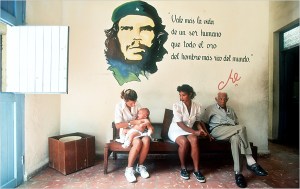
where health is a human right
Health clinic in Cuba. Source: Eric Weaver
An article in The Atlantic describes the success of Cuba in ensuring the people’s health according to its constitution which says health is a fundamental human right:“Cuba has long had a nearly identical life expectancy to the United States, despite widespread poverty. The humanitarian-physician Paul Farmer notes in his book Pathologies of Power that there’s a saying in Cuba: ‘We live like poor people, but we die like rich people.’ Farmer also notes that the rate of infant mortality in Cuba has been lower than in the Boston neighborhood of his own prestigious hospital, Harvard’s Brigham and Women’s.”
Quartz published an article about the changing use and meaning of the term tongzhi, “comrade,” in China. Originating in the early Qin Dynasty (221-206 B.C.E), the word tongzhi was a common form of address during China’s Communist Revolution of 1921-1949. The article quotes linguistic anthropologist Andrew Wong, associate professor at the University of California East Bay, who says that the term “signalled solidarity, equality, respect, and intimacy among the revolutionaries.” With the emergence of a market economy starting in 1978, the term’s popularity waned. In the late 1990s, Chinese gay people began to use tongzhi as a term of address, it is still in use today. Party rules published earlier in November outline stricter party governance, including the revival of the use of tongzhi to promote an atmosphere of social equality. In the meantime, complications will arise given the ongoing and widespread use of the term among gay people. [Blogger’s note: for related reading, see Tiantian Zheng’s ethnography, Tongzhi Living: Men Attracted to Men in Postsocialist China].
well worth revisiting
The Philadelphia Inquirer carried a review of a two-volume, edited set of works by Loren Eiseley. Eiseley, who died in 1977, was the Benjamin Franklin Professor of Anthropology and the History of Science at the University of Pennsylvania. The Library of America and editor William Cronon have presented his work in Collected Essays on Evolution, Nature, and the Cosmos that “serves as a treasure trove of 20th-century science writing.” The review goes on to say that Eiseley had “a singular voice in American letters, one well worth revisiting.”
I rarely blog about my personal peeves. I try to keep it all professional. So excuse me if I rant a little bit here. It’s about words that annoy me. I am sure you have your favorites, too.
More than a decade ago, the word “issue” moved from teen talk (“You got an issue with that?”) to my academic world. I first noticed it when called to serve on an ad hoc committee about an “issue” between a department chair and a faculty member. They had a problem, a big problem. But we all referred to it as an “issue.”
I have seen issue take over, since then. We, at least in my academic world, rarely talk about problems. Only issues. A student has an issue with her grade. A student has a health issue. In our curriculum, we teach about issues. Interpreting the meaning, and impact if any, of this circumlocution is outside my area of expertise. I have noted its existence for many years and, may I say, its robustness.
Trident II D5 Fleet ballistic missile (FBM). Source: Lockheed Martin
So let’s talk about the word “robust.” This word seems to have had a surge a few years ago, in my experience at least, as related to annual reporting on such matters as my blog readership and twitter following: robust. Robust is still with us; it conveys muscularity, strength, and growth, everything capitalism loves.
Well, I want my social media impact to continue to grow in numbers and quality, don’t I? So, I want my social media numbers to be robust. Indeed, I want my textbook sales to be more robust. But “robust” has a limited use, for me. … I want my teaching to be engaging, not robust … and in terms of my own body weight, something less robust would be welcome (but that’s another issue).
And now, we have “boost,” as in “boost phase” which comes from rocketry and refers to a particular stage of a ballistic missile, a missile that carries a warhead. I am no rocket scientist so I could be wrong on this — I just checked Wikipedia on “boost phase.” Boost phase may also apply to non-weapon bearing rockets. And, more benignly, having been around little kids, I do know about “booster chairs” which allow small children to enjoy adult company at the dining table.
Nor am I a linguist, but note the similarity between robust and boost … consonant “b” followed by a vowel or vowels, then ending with “st.” Perhaps that combination in English conveys a sense of positive force, strength, growth, and optimism — all dearly held values of capitalist culture (and maybe that’s why “sustainability” has proved to be so robust in the language of green approaches to our future).
Wires, including Internet, at a Beirut hotel. Flickr/Markus Hündgen
This essay is prompted by my seeing, this morning, the use of “boost” in a World Bank statement about a new project in Lebanon. The report begins with this description: “A new World Bank Group project will boost Lebanon’s mobile Internet systems and create quality jobs for a high-skilled labor force to help reverse the spiraling trend of unemployment especially among youth and women.”
On a positive note, I end this commentary by arguing that the phrase “to boost” is preferable, in spite of its likely origins in the world of war, to the extremely awkward phrase “to grow” — prevalent during the Clinton era when “to grow the economy” was a sacred mantra. If “to grow” replaced “to boost” in the World Bank statement, it would read:
“A new World Bank Group project will grow Lebanon’s mobile Internet systems and create quality jobs for a high-skilled labor force to help reverse the spiraling trend of unemployment especially among youth and women.”
Intense prayer among some Christians can become an addiction, as described by Tanya Luhrmann, professor of cultural anthropology at Stanford University, in an op-ed for The New York Times.
'Praying Hands' by Dürer/Wikipedia
She has learned that when people use prayer to enhance their real-world selves, they feel good. But when it disconnects them from the everyday, they feel bad. Luhrmann points to an anthropological study of the popular Internet game World of Warcraft for insights about when the supportive use of communicating with a different world veers into something less healthy.
The anthropologist Jeffrey G. Snodgrass and his colleagues found that some people were relaxed and soothed by their play: “Sometimes I just log on late at night and go out by myself and listen to the soothing music.” Others felt addicted: “Once I start playing it’s hard to tell whether or not I’ll have the willpower to stop.”
What made the difference was whether people found their primary sense of self inside the game or in the world. When play seemed more important than the real world did, they felt addicted; when it enhanced their experience of reality outside the game, they felt soothed. Prayer, Luhrmann suggests, works in similar ways. When people use prayer to enhance their real-word selves, they feel good. When it disconnects them from the everyday, as it did for the student, they feel bad.
He explores big pharma’s rebranding practices, suggesting that it constitutes deliberate deception. The piece mentions the work of Daniel Moerman, emeritus professor of anthropology at the University of Michigan-Dearborn.
Moerman has written about the placebo effect of medical practices and drugs, including how the very shape and color of a pill can change its effectiveness.
The Globe and Mail (Canada) carried an article based on a lunch conversation with Jim Yong Kim, medical doctor, medical anthropologist, and former university president, marking the end of his first year as president of the World Bank. The article discusses the pros and cons of targets. Targets, even wildly improbable ones, can inspire action and achieve change, even if the target is not achieved. Or they can create embarrassment when failure is seen as the outcome.
The World Bank in Washington, D.C. on April 16, 2013. Flickr: Simone D. McCourte/World Bank
Kim explains his dedication to a new World Bank target of eliminating extreme poverty worldwide by 2030. He is quoted as saying, “What would be really frightening to me is if people like me, people like the World Bank staff, were so concerned about their own lives that they would not grab the opportunity to set a bold target … It took a very long time to convince people that we should have this target, but now that we do, I just see it as a huge gift…”
[Blogger’s note: no one would argue that eliminating poverty, especially extreme poverty, is not a laudable goal. The question arises, though, of the chosen policy pathways toward the goal. Unfortunately for many small scale communities in developing countries, Kim plans to promote large dam construction and hydroelectric development which will destroy such people’s livelihoods].
• World Bank in Africa on the decline?
The New York Times published an op-ed on the declining importance of World Bank loans to Africa in spite of new World Bank efforts, especially in the Democratic Republic of the Congo. The authors argue that: “The World Bank has done important work in promoting good governance and evaluating reform efforts. But its latest pledge of aid to the Democratic Republic of the Congo sends a very mixed message, coming at a time when the International Monetary Fund has been cutting its loan programs to the country because of concerns about poor governance.”
World Bank Pres. Kim and UN Secretary-General Ban Ki-moon laugh in Kinshasa. But the Bank's loan programs in Africa are declining. Flickr/World Bank Photo Collection
World Bank Director Jim Yong Kim is quoted as saying: “There are always going to be problems and downsides with the governance of places that are fragile [but he adds that through investment and aid]…we can both reduce the conflict and improve governance.” The authors point out that Kim’s argument assumes that more World Bank spending means better government. Despite the billions in aid the D.R.C. has already received, however, “Kinshasa has not felt compelled to improve. It’s not clear why the bank’s new effort will be different.”
Mark Schuller, assistant professor of anthropology and NGO development leadership at Northern Illinois University, contributed an article in The Haitian Times in response to the question: What’s going on in Haiti? How is the progress, after three and a half years and billions of dollars?
One thing going on in Haiti: rendering of Port-Au-Prince Marriott, scheduled to open in 2014/NY Times
After a recent trip there, he comments that it’s particularly difficult to respond: “…when you get off the plane, there are signs of progress. The airport has been renovated. The roads around Port-au-Prince are being repaired. For those in bright t-shirts on their way to the provinces, travel times have been considerably reduced. Stopping en route in a guarded, air conditioned restaurant or supermarket offers the appearance of relative affluence with customers stopping to inspect shelves full of packaged imported food. If one has the funds, a private vehicle and the inclination to go to a night club or restaurant in the affluent Pétion-ville, the trip home is safer…”
Schuller considers the president of Haiti, Michel Martelly, who as a popular musical performer was known as “Sweet Micky,” and says that “…as head of state, he is performing progress (as noted anthropologist and artist Gina Athena Ulysse puts it)”..and: “The performance appears to be working..” given positive reviews from development agencies, NGOS, foreign governments, and some members of Haiti’s poor majority who have gotten jobs.
An unidentified Ixil Mayan in a mass grave. Photo/AP, Daily Mail
The Ixil came under the spotlight after a Guatemalan court found former dictator Efrain Rios Montt guilty of genocide on May 10 for the scorched-earth policies used against them during his rule in the 1980s. The conviction was annulled 10 days later following a trial that did nothing to change their lives of the Ixil people.
Byron Garcia, a social anthropologist who has worked in the area for a decade and who now lives in the Guatemalan capital, said Ixil Maya live in the same poverty as always: “People have been relegated to less productive places, places where you can’t grow food, to the mountains made of stone…The young people who can, sow plots of land. And when they can’t, they migrate.”
And, further, he said that victims feel a need to tell their stories, to be heard, to be indemnified, to find the bodies of their loved ones and be able to bury them. [Blogger’s note: the Daily Mail article includes some amazing photographs]. Continue reading “Anthro in the news 7/8/13”→
A distribution of the Tsetse fly./ Wikimedia Commons.
The Boston Globe highlights the research of an economist/doctor on the role of the tsetse fly in African poverty and illness and mentions the influence of medical anthropologist Paul Farmer on her work. Marcella Alsan, who recently completed her Ph.D. in economics at Harvard University, may have solved a puzzle that has long challenged scholars, development specialists, and policy makers: Why is the land-abundant, resource-rich continent of Africa so poor? The answer comes out of Alsan’s graduate research on the tsetse fly’s effect on poverty in Africa. Using geospatial mapping software to mine data gathered by missionaries and anthropologists in the 1800s, Alsan found that the fly, which exists only in Africa and is lethal to livestock, drove precolonial Africans to use slaves instead of domesticated animals for farming, limiting crop yields and ability to transport goods.
• Jim Kim on climate change
Jim Kim, anthropologist and president of the World Bank, wrote that global policy makers must confront climate change, in an article in The Huffington Post:
“To help our clients prepare for the risks of a warming planet, we asked the scientists at the Potsdam Institute for Climate Impact Research and Climate Analytic in Germany to examine the impacts of climate change on three tropical regions: Sub-Saharan Africa, South Asia and South East Asia. Yesterday, we published the results of that study.
Modeling a scenario of 4°C warming, the study reconfirms a climate picture we know well: extreme storms, prolonged heat waves, critical food and water shortages and widespread social and economic disruption. These impacts will interact to generate powerful climatic events, such as a significant sea-level rise and intense cyclones, which will cause intense and widespread damage. This is a future of enormous suffering.”
The article includes a video. A link to the World Bank study is here.
• Occupy movement update
David Graeber/ Wikimedia Commons, David Graeber.
The New Statesman carried an article on the “democracy project”/Occupy movement, noting cultural anthropologist David Graeber‘s key role. A memorable quotation in the article: “The sole piece of evidence we had at the time that the Occupy movement was important was the clear determination of various world governments and much of the mainstream press to erase it from existence. It was not enough for the camps to be torn down and the protesters evicted, not enough that thousands of people, most of whom had done nothing more egregious than dare to question austerity in public, were beaten and gassed and arrested and imprisoned.”
• “New” language “discovered”
A “new” language has been discovered in a remote indigenous community in northern Australia according to Science Daily. The new language, called Light Walpiri, has developed from a combination of elements from other languages. It is documented by University of Michigan linguist Carmel O’Shannessy and reported on in the journal Language (not open access). Light Walpiri speakers are found in one community called Lajamanu where speakers readily switch between languages — from Warlpiri to English and Kriol (an English-based creole). In the 1970s and 1980s, children internalized this switching as a separate linguistic system, and began to speak it as their primary code, one with verb structure from English and Kriol, and noun structure from Warlpiri as well as new structures that can be traced to Warlpiri, English and Kriol, but are no longer the same as in those source languages. As these children grew up they taught the new language to their own children, and it is now the primary code of children and young adults in the community.
Marking the 20th anniversary of the Lavender Language Conference, the program will feature an array of special events celebrating two decades of scholarship and activism in LGBTQ languages and linguistics.
Lavender Languages and Linguistics Conference at American University
Dates: Friday, February 15 through Sunday, February 17
Location: 6th Floor, Butler Pavilion, 4410 Massachusetts Avenue NW, Washington, DC
To register, visit the American University website.
Join language advocates for this annual grassroots gathering founded by the National Alliance to Save Native Languages and leadership from the National Indian Education Association. This year’s summit, Promoting Indigenous Language Rights in Practice: Language Rights Advocacy Day on Capitol Hill aims to educate each member of the U.S. House and Senate appropriations committees about Native American language leaders who are using extremely limited federal funding for urgent local tribal language revitalization projects. You can help reach out to congressional appropriators: Read more.
From the official press release:
Among the presenters are your AMIA-list associates Jennifer Jenkins, University of Arizona; Ross Lipman, UCLA Film & Television Archive; J. Fred MacDonald, and Paul Spehr.
The NHF Summer Symposium is a multi-disciplinary gathering devoted to the history, theory, and preservation of moving images. Registration is open to the public and to media professionals, teachers, and students. The evening programs and day-long sessions provide the opportunity to exchange opinions and insights with participants from all over North America, including students from the NYU Moving Image Archiving and Preservation Program.
The event will begin for registrants on Thursday, July 22 with a reception and screening of Wabanaki Film and Video, archival selections from Northeast Historic Film. The closing session on Saturday afternoon is Language Keepers, a National Science Foundation-funded Documenting Endangered Languages Program. The Language Keepers series captures current conversations in Passamaquoddy-Maliseet at the Pleasant Point Reservation in Eastport, Maine. grams to an online dictionary.
Symposium organizers are Snowden Becker, School of Information at the University of Texas, Austin; and Janna Jones and Mark Neumann, School of Communication, Cinema and Visual Culture Program at Northern Arizona University.



 The Philadelphia Inquirer


 anthropologyworks