Anthro in the news 1/28/13

• “Invisible cultural anthropologist” Jim Kim in the news

Anthro in the news picked up on two mentions of Jim Kim, medical anthropologist, physician, humanitarian development expert, and current president of the World Bank.

Jim Yong Kim, president of The World Bank
World Bank President Jim Yong Kim/Moritz Hager, Wikipedia

First, his op-ed, “Make Climate Change a Priority,” appeared in the Washington Post opinion section in which he wrote: “As economic leaders gathered in Davos this week for the World Economic Forum, much of the conversation was about finances. But climate change should also be at the top of our agendas, because global warming imperils all of the development gains we have made. If there is no action soon, the future will become bleak. The World Bank Group released a report in November that concluded that the world could warm by 7.2 degrees Fahrenheit (4 degrees Celsius) by the end of this century if concerted action is not taken now.”

Second, an article in an economic/trade-focused forum discussed Kim’s visit to Tunisia to promote private sector development: “World Bank Group President Jim Yong Kim today concluded a two-day visit to Tunisia during which the Group’s private sector arm, the International Finance Corporation, announced a $48 million investment to support the growth of private entrepreneurs. Kim met the country’s leadership and civil society to discuss the reform agenda and Tunisia’s progress two years after its popular uprising. ‘We are here as strong supporters of the Tunisian revolution,’ said Kim. ‘[The people of Tunisia] went through some very difficult times, but in doing what you’ve done, you’ve inspired the entire world. [Now] we’ve got to make sure that Tunisia is successful in showing that Islam and democracy go together, that you can have economic development that includes everyone.'”

Kim emphasized ongoing World Bank Group support for Tunisia’s aspirations through programs that address improved governance and accountability, opportunities for women and youth, private sector job-creation and investments in interior regions.
Continue reading “Anthro in the news 1/28/13”

Anthro in the news 12/24/2012

• Hopes dashed for Chagossians

Aw’s Sean Carey published two articles in The Independent about the recent consideration of the Chagossians‘ claim for a right to return to their homeland.

Chagos
Chagos. Source: refusingtokill.net
In his first piece, he reviews the marathon battle that began in 1998 in the British courts, led by electrician Olivier Bancoult, the newly appointed leader of the Chagos Refugees Group. Although all of the judges in the lower courts unanimously found in favor, in 2008 the Law Lords decided against the Chagosssians’ right of return by a narrow 3-2 majority. The islanders are supported by the former British High Commissioner to Mauritius, David Snoxell, novelist Philippa Gregory and conservationist Ben Fogle.

In his second article, Carey reports on the decision: “Yesterday, there was huge disappointment amongst Chagossian communities in Port Louis, Mahe, Crawley, Manchester, Geneva and Montréal. A seven-judge chamber of the European Court of Human Rights decided by majority that the case regarding the right of return of the exiled islanders was inadmissible. Geographically and legally, it has been a long journey with many twists and turns for the islanders, the descendants of African slaves and Indian indentured labourers. The decision by the Strasbourg court means that they continue to be barred from returning to their homeland in the Chagos Archipelago, after their forced removal by the British authorities between 1968 and 1973, so that the US could acquire Diego Garcia, the largest and southernmost island, for its strategically important military base.” After eight years, a decision of inadmissable.

• Declining monkhood in Thailand

In Thailand, Buddhist temples grow lonely in villages as consumer culture rises and there is a shortage of monks. According to an article in The New York Times, monks in northern Thailand no longer perform one of the defining rituals of Buddhism, the early morning walk through the community to collect food. The meditative lifestyle of the monkhood offers little allure to the distracted iPhone generation. Although it is still relatively rare for temples to close down, many districts are so short on monks that abbots here in northern Thailand recruit across the border from impoverished Myanmar, where monasteries are overflowing with novices.

”Consumerism is now the Thai religion,” said Phra Paisan Visalo, one of the country’s most respected monks. He continues, ”In the past people went to temple on every holy day,” Mr. Paisan said. ”Now they go to shopping malls.” William Klausner, a law and anthropology professor who spent a year living in a village in northeastern Thailand in the 1950s, describes the declining influence of Buddhist monks as a ”dramatic transformation.” Monks once played a crucial role in the community where he lived, helping settle disputes between neighbors and counseling troubled children, he wrote in his book, Thai Culture in Transition. Klausner says that today most villages in northern Thailand ”have only two or three full-time monks in residence, and they are elderly and often sick.”
Continue reading “Anthro in the news 12/24/2012”

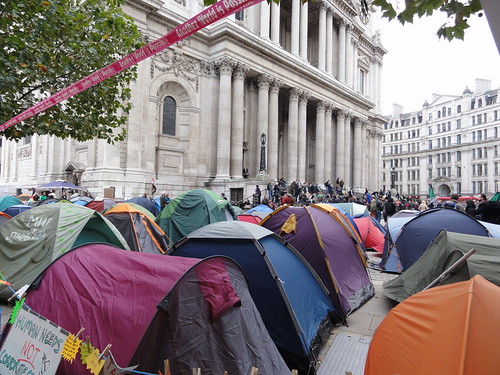
St. Paul’s anti-capitalist protest: Location, location, location

By contributor Sean Carey

“My congratulations to the encampment outside St Paul’s for sending almost the entire British establishment into a tizzy every bit as confused as some of the protesters themselves,” writes Andrew Rawnsley in the Observer. The left-leaning newspaper’s award-winning chief political commentator goes on to express his amazement about the massive impact a small group of young, middle-class men and women equipped with nylon tents and hastily-made banners can have on the country as part of an anti-capitalist protest which has now spread to around 900 cities worldwide.

He continues:

“You have brought a frown to the forehead of the prime minister, hyperbolic froth to the lips of Boris Johnson [the Mayor of London], attracted the disdain of a pomposity of pontificators and thrown the state church into something approaching a constitutional crisis. It is twisted knickers time among pundits, politicians and prelates.” Perhaps mindful that Hallow’een was imminent, Rawnsley mischievously adds: “Imagine what might be achieved if this movement can get really serious and starts taking its protest more directly to the avaricious bankers, corporate larcenists and crony capitalists who are the central source of their discontent with how we live now.”

Were the various beneficiaries of global capitalism identified by Rawnsley quaking in their boots or enjoying a nice round of golf before a traditional Sunday lunch somewhere in the Home Counties on a pleasant autumnal day? Despite the protests, life probably went on as usual. Nevertheless, as Rawnsley rightly observes, something is going on, but what exactly?

Capitalism is Crisis tents at St Paul's in London. Flickr/zoer

Another intriguing question is why the encampment in the churchyard of St Paul’s is causing so many social actors so many problems and causing the chattering classes to chatter quite so much.

Believe me, the U.K. mainstream media — newspapers, radio and television and its digital equivalent blogs, Facebook, YouTube and especially twitter — are full of stories about the encampment outside the Church of England cathedral, designed by Sir Christopher Wren after the great Fire of London, and seat of the Bishop of London.

Last Thursday the current occupant, Dr Richard Chartres, who has been at the receiving end of criticisms from those on both sides of the argument, felt obliged to say: “The Church’s own role in this has now inevitably come under scrutiny. Calls for the camp to disband peacefully have been deliberately interpreted as taking the side of Mammon, which is simply not the case. The original purpose of the protests, to shine a light on issues such as corporate greed and executive pay, has been all but extinguished – yet these are issues that the St Paul’s Institute has taken to heart and has been engaged in examining.”

Continue reading “St. Paul’s anti-capitalist protest: Location, location, location”

22 July, 2011. Oslo

Guest post by Thomas Hylland Eriksen

It was only a matter of hours between the blast in central Oslo and my most extensive and exhausting engagement with international media since I started out as an anthropologist in the 1980s. Between Friday night and Wednesday, I spoke on radio, on television (via a mobile phone), to newspapers and magazines from China to Chile, and wrote articles for nearly a dozen publications in five countries.

My priorities shifted in a matter of hours. Our holiday house was turned into a makeshift media centre, and the computer was online almost 24/7.

Thomas Hylland Eriksen
Thomas Hylland Eriksen in Cuba, 2007. Courtesy of the author.
My engagement with the terrorist attack on Norway is easy to explain. First, although rightwing extremism is not my field of research, cultural diversity in Europe and Norway is, as well as nationalism and ethnicity. Second, I have first-hand experience of the new, Islamophobic kind of nationalism, having been on the receiving end of relatively unpleasant attacks from these quarters for several years.

Actually, I am the only contemporary intellectual mentioned by the terrorist in his writings and YouTube video – a symbol of everything that went wrong with Norway. I have asked YouTube to remove the video.

A few words about the articles: The earliest piece, for OpenDemocracy, was an initial attempt to make sense of the catastrophe and to begin reflecting on the consequences for Norwegian society. It overlaps substantially with articles in Sydsvenska Dagbladet and Information, which, respectively, cover southern Sweden including Lund and Malmö, and a smallish, but select left-leaning audience in Denmark. The title of these Scandinavian-published articles, “Men who hate social democrats,” plays on the Scandinavian title of the first novel in Stieg Larsson’s trilogy (Men Who Hate Women).
Continue reading “22 July, 2011. Oslo”

On the politics of exile

Guest post by Majid Razvi

If “monk-politician” strikes you as somewhat of a contradiction… well, you might be right. Meet Samdhong Rinpoche, Prime Minister of the Tibetan Government-in-Exile. His title contains within it a sad reminder of the current plight of the Tibetans.

On July 14, the Culture in Global Affairs Research and Policy Program of the Elliott School of International Affairs at the George Washington University hosted Samdhong Rinpoche as a speaker in the CIGA Seminar Series.

Samdhong Rinpoche discusses the politics of exile at the Elliott School of International Affairs, GW, July 14, 2011. Photo courtesy of Bradley Aaron.

Rinpoche began with an apology for his English skills, which proved to be better than many native speakers. He then declared that he was “not comfortable” with politics. (I am reminded of Plato’s hypothetical philosopher-kings, who would likely be not at all interested in the political position. Perhaps reluctance should be a prerequisite for public office!)

His lecture delved into the history of Tibet and its people. What struck me most, however, was Rinpoche’s constant reiteration of His Holiness the Dalai Lama’s longstanding position: what is important is not political autonomy, but cultural and religious freedom.

“We are not concerned with who is ruling Tibet,” said Rinpoche, “but how they are ruling Tibet.”

During the Q&A session, a reporter asked how Samdhong Rinpoche felt about President Obama’s failure to meet with the Dalai Lama. With that blend of rigorous logic and holistic wisdom that so-perfectly characterizes Buddhism, Rinpoche pointed out that ascribing such a “failure” to the President before His Holiness had left the country was premature.

Two days later, at the White House:

His Holiness the Dalai Lama with President Barack Obama, July 16 2011. Flickr, Creative Commons

Majid Razvi received his B.A. in 2011 from Virginia Commonwealth University where he majored in Philosophy and Religious Studies. He has a strong interest in Tibetan epistemology, logic, and argumentation. He intends to pursue graduate study in philosophy.

Caste matters in Mauritius

By contributor Sean Carey

Around 20 years ago, I paid a visit to the Mahatma Gandhi Institute (MGI) in Mauritius to consult the records of Indians who were brought from the subcontinent to work as indentured labourers in the sugar plantations after slavery was abolished in 1835.

Before examining any documents, I was invited to meet one of the island’s leading experts on Indo-Mauritian culture. During our conversation, I raised the subject of caste and its contemporary significance among different groups of Hindus in Mauritius. “It doesn’t exist any more,” the scholar said. “Even in the village where I come from caste is not important — people marry who they like.” The scholar paused before declaring: “The only people who use caste are the politicians at election time.”

A group of Brahmins from the Parbu Caste in Bombay in the 1870s. Flickr/Museum of Photographic Arts

I was doubly surprised at these remarks. First, because among my fellow academics there is an ethic of not hiding sensitive or embarrassing facts. Second, on the basis of having made several trips to the Indian Ocean island, I was convinced that caste among the Hindu population is an important principle of social and cultural organization. Indeed, the big questions from an anthropological perspective were: how important and what were the variations, say, between towns and villages?

Continue reading “Caste matters in Mauritius”

Anthro in the news 6/27/2011

• The trauma of war and rape
In the first of a two-part story, CNN highlights the work of cultural anthropologist Victoria Sanford, whose research has involved listening to victim narratives of Maya women in Guatemala since her doctoral studies at Stanford University in the early 1990s. A Spanish speaker who had worked with Central American refugees, she befriended the few Maya in the area. “I was moved by their stories, but even more so because they were intent on someone hearing them,” she said, “And no one was listening.” She joined the nonprofit Guatemalan Forensic Anthropology investigative team and went to Guatemala. Sanford talked to the women, who told other women about her, and soon she was recording their stories. Over time, and after hearing many stories, Sanford suffered from a kind of “secondary trauma” including paralysis.

• Conflict in Uganda and a possible love complication
The New York Times quoted Mahmood Mamdani, professor anthropology and government at Columbia university, in an article about an ongoing bitter personal rivalry in Uganda that involves President Musaveni and his rival and former friend, Kizza Besigye. Things may be complicated, the article suggests, by a woman, Winnie Byanyima, who is married to the president’s rival but who may have had a romantic involvement earlier with the president. Other matters are likely part of the story as well. Mamdani comments that the government is “clueless” about how to deal with Besigye’s opposition movement. He didn’t comment on the love factor.

• Culture and asthma
Cultural context and behavior shape the diagnosis and treatment of asthma according to David Van Sickle, medical anthropologist and asthma epidemiologist of Reciprocal Labs in Madison, Wisc. Van Sickle’s fieldwork in India revealed that physicians were hesitant to diagnose patients with asthma because of social stigma.

• Treating autism: two cases in Croatia
Drug Week covered findings from a study conducted in Osijek, Croatia, which discusses the treatment of autism in a boy and a girl with risperidone. K. Dodigcurkovic and colleagues published their study in Collegium Antropologicum.

• Profile of a forensic anthropologist
The Gainesville Sun carried a profile of Michael Warren, an associate professor of anthropology and director of the C.A. Pound Human Identification Laboratory in the Department of Anthropology at the University of Florida. He has conducted hundreds of forensic skeletal examinations for the state’s medical examiners and has participated in the identification of victims of mass disasters and ethnic cleansing, including the attacks on the World Trade Center, Hurricane Katrina and the recovery and identification of the victims found within the mass graves of the Balkans. He recently testified in the Casey Anthony murder trial.

• Medieval persecution
The remains of 17 bodies found at the bottom of a medieval well in England could have been victims of persecution, new evidence suggests. DNA analysis indicates that the victims were Jewish. They were likely murdered or forced to commit suicide. The skeletons date to the 12th-13th centuries, a time of persecution of Jewish people in Europe. Professor Sue Black leads the research team. She is a forensic anthropologist in the University of Dundee’s Centre for Anthropology and Human Identification.
Continue reading “Anthro in the news 6/27/2011”

Row over corn rows hairstyle

By contributor Sean Carey

An 11 year-old African-Caribbean boy was refused entry to a Roman Catholic secondary school in North London in 2009 because he was wearing ‘corn rows’ (braided hair close to the scalp). Two years later, he has won a significant victory in the High Court.

Cornrow mohawk
Cornrow mohawk. Flickr/J Daniel Gonzalez.
The decision by St. Gregory’s Catholic Science College in Harrow to exclude him was ostensibly based on two reasons.

  1. His hair style contravened the school dress code. Boys are obliged to wear their hair in a military-style “short back and sides.”
  2. His hair style might encourage separatism, and possibly a “gang culture,” within the institution.

The judge ruled that the school’s decision was “unlawful” and encouraged “indirect discrimination” by not taking into account an individual’s cultural background and heritage.

“There are a number of Afro-Caribbeans for whom cutting their hair and wearing it in corn rows is a matter of their cultural background,” he said, “and can work against them on the basis of their ethnicity.”

Sewing in the braids. Flickr/Samantha Steele
The case is unusual in the U.K., although exceptions have been made in the case of male Sikhs. Because of their religious tradition of wearing turbans, they are exempt from wearing crash helmets while riding motorcycles and scooters.

But the new ruling on corn rows was based on secular customary behaviour — in this instance, family and a wider cultural tradition amongst some African-Caribbeans (and Black Africans).

A spokesperson for St. Gregory’s said that it is “naturally disappointed” (press release PDF) with the ruling and is considering taking the case to the Court of Appeal.

Dishonorable killings

So-called honor killings take the wind out of a form of cultural relativism that I refer to as absolute cultural relativism. According to absolute cultural relativism, anything that goes on in a particular culture, and is justified within that culture, cannot be questioned or changed by insiders or outsiders. For insiders, such questioning is cultural heresy; for outsiders it is ethnocentrism.

An antidote to absolute cultural relativism is critical cultural relativism, which promotes the posing of questions about practices and beliefs by insiders and outsiders in terms of who accepts them and why, and who they might be harming or helping. In other words: Who benefits, who loses? [Note: I present these terms in my cultural anthropology texts as a way to get students to think more analytically about the very important concept of cultural relativism.]

Image: Flickr creative commons licensed content. If only India, and indeed the whole world, was a domestic violence free zone.

When death, torture and structural violence are involved, it’s time to relegate absolute cultural relativism to the sidelines and bring to the fore critical analysis and discussion among insiders and outsiders. As far as I know, murder is not legal in any country in the world, including murder of one’s own kin for purposes of protecting family honor.

An article in The New York Times describes an alleged honor killing of a young unmarried Hindu woman in her family home in Jharkhand state, eastern India.

The article links the possible murder to Hindu caste values, which forbid marriage of woman to a man of a lower caste category — in this instance, the woman was of a Brahmin family and was engaged to a man of the Kayastha category, which is lower. Not only that, she had apparently engaged in premarital sex, another serious problem from the point of view of family honor.

What the article doesn’t say is that honor killings of daughters and wives by family members occur among people of other religions as well, including Christianity, that are not driven by caste purity. More deeply than particular religious values is the widespread existence of lethal patriarchy: male dominance in all domains of life — economic, political, social, sexual — that it justifies, even actively supports, murder of women and girls.

There can be no way, in this world, that anyone can get away with murder by saying that “it’s part of our culture” to kill a daughter or wife who breaks cultural rules. As if it’s their right and duty to kill.

Unfortunately, local police and the judicial system are often on the side of the killers.

Amnesty International now keeps track of so-called honor killings, but it’s likely that cases are severely under-counted. Nevertheless, any and all efforts to keep shining a very bright light on the problem of honor killings and related forms of patriarchy are essential.

See also this post on the blog Women Against Shariah.