Anthro in the news 1/18/10

• Symbols of trauma and spirituality in ruins in Haiti
Rebuilding symbolic structures and spaces are an important part of helping Haiti recover from the earthquake disaster. In Port-au-Prince, the National Cathedral, the presidential palace, the parliament building, the United Nations headquarters, and local churches have collapsed or are in ruins. An article in the National Post comments that the collapsed presidential palace in particular is now a potent symbol of a country in deep distress. But it’s a complicated symbol. Douglass St. Christian, associate professor of anthropology at the University of Western Ontario, Canada, is quoted as saying, “The presidential palace is a source of great pride, but it’s also a reminder of the absolute horror of Duvalier’s (dictatorial) rule…So the Haitians are, on the one hand, going to be traumatized by the ruin of something that’s come to represent their emergence from that regime, and on another hand, glad that it’s gone.” More clearly traumatic is the loss of so many churches, since 90 percent of Haitians practice Catholicism. St. Christian urges that, during the reconstruction phase, international attention be given to restoring meaningful structures and spaces to help the social and psychological healing process.

Grief and trauma counseling: one size does not fit all
Medical sociologist Ethan Watters, in a radio interview on KCBS, comments that mental health support in Haiti offered by Western organizations needs to take care to pay attention to the cultural specifics of the Haitian people. Most research on trauma and PTSD, he says, has been done on Americans and it drives the assumption of mental health experts that this knowledge is universally applicable: “Anthropologists know that there are great differences around the world in how to think about trauma, the meaning you attach to trauma…Those experiences are simply not the same the world over. We could do great damage and harm when we rush into another culture with our notions of PTSD and our notions of healing.” He recommends that counselors study the culture before they try to help and that they provide support to existing systems.

• Iranian political culture shifting
In an article in the Los Angeles Times, William Beeman, professor of cultural anthropology at the University of Minnesota and expert on Iran, explains the growing momentum in Iran for political change:  “Iran is a hierarchical society. Folks in the superior position must care for those in the inferior position or they will be toppled. The folks in the lower position will cease to support them — in fact will work to undermine them.”

• In the army now

An article in the National Defense Magazine notes that the army’s anthropology teams are in demand. So far, 27 teams have been developed and fielded. Col. Mark Crispi, director of project development for the program says: “The mission of the human terrain system is to support the combat unit.”


Continue reading “Anthro in the news 1/18/10”

“Tough love,” hold the love

Guest Post by Samuel Martínez

David Brooks’ New York Times op-ed, “The Underlying Tragedy,” debates a major truth: there is no such thing as a “natural disaster,” only natural adversities for which humans are better or worse prepared to cope. He spins so many mistruths from that insight, however, that the “tough love” approach that he seems to recommend for Haiti seems destined to produce a lot of toughness (and most of that verbal) with little “love.”

We’ve already seen it multiple times that hurricanes leave vastly disproportionate damage from one island in the Antilles to the next. And we’ve seen that poverty coefficient do its ghastly math specifically in Haiti as recently as 2008 when four hurricanes caused thousands of deaths there while taking a much lower toll in human life in neighboring Cuba, where severe storm damage also happened.

No doubt about it: people in countries where poverty reigns, communication infrastructure is deteriorating, and state institutions are weak are unjustly vulnerable to seeing their lives and families wrecked by natural disasters.

And the fact that we’ve seen such disparities be manifested many times before (albeit on a smaller scale of destruction than Tuesday’s quake) also raises questions about why Haiti was so badly prepared.
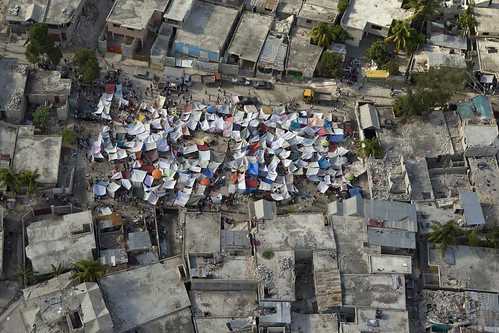
That said, it is an obscenity for Brooks to blame the magnitude of the disaster on Haitian culture at the very moment when these, ostensibly culturally-impaired people are literally throwing their shoulders to concrete in a last effort to save loved ones, neighbors and even strangers, for whom the rescuers care for no reason other than they all are human.

As a cultural anthropologist I could talk for hours about the Rove-esque dimensions of attacking Haiti precisely at its culture, the one area where it is generally understood to be “rich.”

But just what is the point of Brooks’ blanket denunciation of an entire people’s way of life?

Surely, in response to a disaster of this magnitude there must be blame enough to go around. How about apportioning some criticism also to the Western governments that have pledged billions in recent years to Haitian reconstruction while actually giving much less?

The answer (to Why blame the culture?) becomes more clear as Brooks goes on and likens what he styles as Haiti’s patho-cultural syndrome to Black inner-city teenagers suffering from diminished expectations and habits of blaming others for their own shortcomings. Nothing matches up in Brooks’ linkage of Harlem and Port-au-Prince — the comparison is a total clunker — nothing matches up, that is, other than a discourse of veiled white supremacy designed to blame Blacks for whatever ill God and man throws their way and to provide a white-dominated state with a standing excuse for doing too little, too late.

And now that we’re on the topic of disaster, avoidable human costs, and blame, does the name “Katrina” mean anything to Mr Brooks?

Is there no decency? Is there no sensitivity to race-baiting among the editorial staff of our nation’s leading news outlet? Of course there isn’t and never has been in relation to Haiti. I can’t even so help thinking that Brooks’ “The Underlying Tragedy” is one more sign of how coarse the political right’s discourse has gotten in just the last year. With all the racially-coded vitriol of the last months still in the air, should we be surprised that blame is the only thing right-wing commentators will say Haitians deserve in plenty?

Samuel Martínez is an Assistant Professor in the Department of Anthropology at the University of Connecticut.

Image: “Haiti Earthquake” by Flickr user United Nations Development Programme, licensed by Creative Commons.

Upcoming event: Theological Jihad in Bin Laden’s Audiotape Library

For those of you in the D.C. area, our friends at the GW Institute for Middle East Studies (IMES) are hosting a very interesting talk next week:

IMES Research Colloquium

Theological Jihad in Osama Bin Laden’s Audiotape Library

by
Flagg Miller
Cultural anthropologist and associate professor of religious studies
University of California, Davis
&
Resident Fellow at the Woodrow Wilson International Center for Scholars
Monday, January 25th, 2010
3:00 p.m. – 4:30 p.m.

IMES Conference Room
Suite 512, 1957 E Street, NW
George Washington University
Washington, DC

**Coffee will be served**
For a copy of the paper,
RSVP to rsvpimes@gwu.edu by Wednesday, January 20th

Email   imes@gwu.edu  •  Web  http://www.gwu.edu/~imes

Top 25 North American dissertations in cultural anthropology 2009

My scan of “Dissertation Abstracts International” (not an international list by any means, but mainly U.S.) for 2009 dissertations in cultural anthropology was both heart-warming and heart-breaking. The good news is that so many excellent dissertations were completed in 2009. As these dissertations demonstrate, anthropologists are increasingly producing knowledge that the world needs.

The bad news is that the job market, including academic and non-academic possibilities, is so bad. What are all these, and other, new Ph.D.s going to do? What will become of their rich and extensive research findings? What about all the people who shared their time and insights with the researchers — will they have get anything back if only a copy of the book about them?

Explanatory note: my search was not comprehensive by any means. I used the search terms health, development, gender and environment. And apologies to the authors for snipping just a few sentence from their abstracts to present here.

  1. Psychosocial Liberia: Managing Suffering in Post-Conflict Life by Sharon Alane Abramowitz, Harvard University. Advisor: Arthur Kleinman
    This study focuses on humanitarian interventions in mental health and trauma healing during Liberia’s post-civil war recovery (2003-2008). Using interviews, participant observation, and focus groups, as well as archival evidence, public media and expert interviews, I chart the emergence of mental health as a vector for social engineering in post-conflict humanitarian enterprises.
  2. Shiv Sena Women and the Gendered Politics of Performance in Maharashtra, India, by Tarini Bedi, University of Illinois at Chicago. Advisor: Mark Liechty
    I explore performance and the subject through the study of female party-workers in Shiv Sena, a militant political party in Western India. Findings show that particular gendered performative practices are important to the personal, political aspirations of women in political parties and to the dynamics of local politics in India’s urbanizing regions.
  3. Understanding Childhood Malnutrition in a Maya Village in Guatemala: A Syndemic Perspective by Elaine Marie Bennett, University of Connecticut. Advisor: Pamela Erickson
    I examine the social, political ecological, economic and cultural context of childhood malnutrition in a Maya village in the western highlands of Guatemala. The complex set of interactions of many factors related to childhood malnutrition is best approached from a syndemics orientation. This orientation can promote publicly owned, systemic changes that provide both short-term, stop-gap solutions and long-term, sustainable ways to prevent childhood malnutrition.
  4. Yu Get Fo Liv Positiv: HIV, Subjectivity and the Politics of Care in Post-conflict Sierra Leone by Adia Benton, Harvard University. Advisor: Arthur Kleinman
    I focus on the relationships between HIV-positive individuals and HIV/AIDS associations in Sierra Leone. Reflecting on medical anthropological inquiries that have located AIDS activism within discussions of citizenship based on biological status, I argue that vertically funded and administered HIV/AIDS programs have marginalized the illness from existing systems of care and reduced the government’s capacity to respond to more pressing problems that also negatively affect health and well being.
  5. Microbial Matters: An Anthropology of Pandemic Influenza in the United States by Carlo Caduff, University of California, Berkeley. Advisor: Paul Rabinow
    I explore the recent scare over the threat of pandemic influenza from the perspective of an anthropology of the contemporary. With a virus that is ever-evolving and a knowledge that is ever-shifting it is unlikely that the day will come when scientists will finally know what pandemic influenza is. The crucial question in terms of ethical practice, therefore, might be the following: What form of preparedness would be adequate to a scientific discourse which recognizes the inevitable possibility of error, both biological and epistemological?
  6. “Looking Good”: Women’s Dress and the Gendered Cultural Politics of Modernity, Morality, and Embodiment in Vanuatu by Margaret Cummings, York University (Canada).
    I use women’s dress as a lens through which to focus on the relationship between gender, modernity and morality, and I show the ways in which all three are condensed and embodied in the moral and aesthetic imperative for women to “look good.” Young ni-Vanuatu women’s often-frustrated efforts to look good are productive of new and provisional yet hopeful imaginings of the nation.
  7. Nashta: Rotating Credit Associations and Women “Being Active” in Syria by Lindsay A. Gifford, Boston University. Advisor: Augustus Norton
    Rotating credit associations known as jama`iyyat are popular among Damascene women. Analysis of meeting structure and the discourse that develops in them indicates that women who participate in jama`iyyat are concerned with more than economic gain. Jama`iyyat build social capital that benefits not only women but husbands and children, projecting reputations of respectability onto the kin unit. This social capital can be used for future transactions and negotiations, such as the start-up of a new credit association or marriage.
  8. Working through Skin: Making Leather, Making a Multicultural Japan by Joseph Doyle Hankins, The University of Chicago, 2009. Advisor: Susan Gal
    My dissertation focuses on how the Buraku liberation movement conducts politics in this changing situation. I examine what the Buraku political organization mobilizes around, how they mobilize, and how they justify their claims. I articulate a theory of the labor of multiculturalism to characterize the current Buraku situation and speculate on the co-constitution of multiculturalism and neoliberal capitalism.
  9. A History of Marginality: Nature and Culture in the Western Himalayas by Shafqat Hussain, Yale University. Advisors: Michael Dove and Kalyanakrishnan Sivaramakrishnan
    I trace the history of the dialectical relationship between centre and margins in a remote mountainous region of Hunza, northern Pakistan, exploring the politics of representation over time. Through history, the people of Hunza have played a role in the maintenance and relative play (rigidity and permeability/flexibility) in these boundaries from their own cultural logic. The interactions between them and the centers have had different consequences depending on how the act of boundary making and boundary breaking was perceived by the outsiders and the magnitude of transgression.
  10. Keeping Hope: Encountering and Imagining the National State in a North China Village by Zongze Hu, Harvard University. Advisor: James Watson
    This historical ethnography examines the complicated ways in which ordinary villagers have made do with, perceived, and imagined the national state in a North China village. It also shows how their views of the state and its local agents have changed particularly in the past seven decades. Villagers hate and dread, yet also love and embrace, the state which is abstract and concrete at the same time. Locals dislike the state’s interference in the areas like funerary rituals, yet remain hopeful for its involvement in development projects.
  11. Continue reading “Top 25 North American dissertations in cultural anthropology 2009”

Your advice is sought

This blog came into being in late August 2009. Four months later, about 1,000 people visit per month from 70 countries. The United States provides the largest number, about half. Of those, most live in and around Washington, D.C. Canada is next, followed by the UK. Happily, there are visitors from so many other countries, but the numbers are still small.

In August 2009, we launched the companion twitter site, @anthroworks. The handle now has nearly 500 followers, and has been listed by 45 other handles.

First, a big thanks from me to everyone at GW who brought me into the world of blogging and tweeting, especially Menachem Wecker and Jacci Schiff, who were the early catalysts, site designers and coaches. Also to Graham Hough-Cornell who works to make it all happen every week, and Stacy Groff and Grant Schneider who provide encouragement and ideas.

Second, thanks to everyone who visits the blog, offers comments and steps up to write a guest post.

Last, thanks to my fellow anthro-bloggers around the world who have welcomed Anthropologyworks and to my twitter followers and fellow-tweeters who add so much to my life every day.

Together, we are making progress in spreading the word about the value of anthropology (and related fields) to important world issues.

Now, here is the advice sought part of this message: how can Anthropologyworks improve? Content ideas? More posts? Shorter posts? Favorites features? Additional features? Expanding reach to more countries? Please post suggestions here or email us. My team and I will do our best to follow up on them in 2010.

Image: “The Thinker” by Flickr user elkit, Creative Commons licensed.

More support for Pres. Obama to take Anth 101

After President Obama’s visit to Oslo to accept the Nobel Peace Prize, I sent out a tweet on December 10 saying his speech was dynamite, but that I wished he had taken Anthropology 101 so he would know that war did not begin with “the first man.” Francis Moore Lappe, legendary author of Diet for a Small Planet, is on the same page (maybe she saw my tweet?). See her essay on Huffington Post.

Cultures of Piracy: Call for Essays: Special Issue of Anthropological Quarterly

Here’s a call for essays on a great topic from a GW journal, courtesy of Long Road blog:

Anthropological Quarterly is seeking submissions for a special issue exploring “piracy” defined broadly, from copying CDs to Captain Hook, from biopiracy to the coast of Somalia. Authors may consider one of the following, making sure that their work draws upon ethnographic research, and/or engages anthropology as a discipline:

  • How do practices labeled “piracy” differ from other sorts of extraction, expropriation, borrowing, and theft?
  • How does piracy conflict with or affirm narratives of law and governance? What, for instance, are piracy’s critical and utopian impulses?
  • How is piracy mediated through various forms of public culture, and what are the components of its circulation within various publics?
  • What are the spatial and temporal features of piracy – its histories and geographies?
  • What are piracy’s economic and political entailments?
  • What specific localities (the Straits of Malacca, Somalia and the Caribbean) or activities (p2p file-sharing and fishing) are in part constituted by notions of piracy?

Authors have considerable freedom; essays can be short (3,000 words) or long (10,000 words), grounded in ethnographic data, or purely theoretical. One of Anthropological Quarterly’s goals is to give ethnographers a range of possibilities for scholarly writing.Our deadline for abstracts and titles is August 1st, 2010.
We request the completed work by October 1st, 2010.

Email submissions to aqsubmissions@gmail.com (preferably in .doc file format) and mail two hard copies to:

Alexander S. Dent – Associate Editor
Anthropological Quarterly
The George Washington University
2110 G St. NW
Washington, DC 20052

Email questions to asdent@gwu.edu

Image: “Arrrgh! | Pirates” via Flickr user Joriel “Joz” Jimenez licensed by Creative Commons.

Call for papers: Special issue of Behemoth on Epidemic Orders

In the past few years, epidemic events, both actual and virtual, have made a spectacular comeback. Emerging and re-emerging infectious diseases such as avian and swine flu have generated great anxiety the world over, resulting in a pervasive sense of vulnerability, insecurity, and uncertainty. A powerful spirit of urgency, based on a genuine concern for human health and well-being, overdetermined by a variety of scientific, political, and economic interests, engendered a real flurry of action. In the epic battle against germs, the biopolitical state mobilized material and symbolic resources at an unprecedented scale.

In the shadow of the emerging infectious disease threat, significant shifts in public health, medical care, and scientific research have occurred. The aim of this special issue of Behemoth is to offer an initial set of diagnostic accounts. What are the domains in which fundamental shifts have occurred over the past few years? Who are the actors involved and what are the underlying logics animating these shifts in public health, medical care, and scientific research? The key aim of this issue is to draw analytic attention to recent reconfigurations and to identify the kind of epidemic orders that are taking shape today at the heart of the biopolitical state.

Please send abstracts for this special issue of Behemoth to the editor, Carlo Caduff (carlocaduff@access.uzh.ch) and to Kathrin Franke (behemoth@rz.uni-leipzig.de).

Deadline for abstracts: 30 January 2010.

Carlo Caduff is in the Department of Social and Cultural Anthropology at the University of Zurich.

Behemoth is a peer-reviewed journal published by the Akademie Verlag, Berlin

Decolonizing African-American cuisine

by Barbara Miller

Food is a hot and rising topic in cultural anthropology, related fields from literature to political science, and in popular culture as well. Besides the wealth of publications about food in recent years and a spike in interest from my students, I know this to be true for another reason: For decades, the short article on food (with a couple of recipes) in the weekly New York Times Magazine recently moved up near the front of the magazine, no longer relegated to its traditional placement way at the end near the crossword puzzle.

This post highlights an intriguing article by Stephan Palmié, associate professor of anthropology at the University of Chicago, published in a special edition of the journal African Arts devoted to the topic of “hybrid heritage.”

He draws on the longstanding theme in the anthropology of food and cuisine that specific foods and ways of preparing them serve as emblematic markers of cultural identities. He builds on this foundation to examine how particular culinary “recipes” demarcate social boundaries especially when they become objectified and of value as intellectual property or intangible cultural heritage.

Palmié draws on a variety of secondary sources to reveal the links in the United States between African food and racism. Over time and in different ways, it has either erased the importance of African foodways through de-authentication or appropriated it through identity theft or culinary colonialism. On the upside, he recommends to us a “fascinating monograph of culinary history that doubles (or triples!) as cookbook and gastropolitical manifesto”: Diane Spivey’s The Peppers, Cracklings, and Knots of Wool Cookbook. Spivey turns the table and provides an Africentric view of human food from our prehistoric origins in Africa to how African foodways have shaped French and Chinese cuisine. Her book is definitely on my holiday reading list!

Image from SUNY Press.