Must Read: Memorial Mania by Erika Doss

Guest post by Tristram Riley-Smith

Memorial Mania: Public Feeling in America
by Erika Doss, University of Chicago Press (2010)

At the end of William Faulkner’s masterpiece, The Sound and the Fury, the castrated idiot, Benjy Compson, weeps when his black carer walks him the wrong way past the memorial to the Confederate soldier in Oxford, Miss. Honor-rites have been flouted, and through Benjy’s tears we sense the pent-up emotions of a defeated yet defiant, impotent yet proud, South.

Memorial Mania
Credit: University of Chicago Press

This vignette points to a wider truth. Memorials carry enormous emotional and symbolic freight, providing clues as to how people feel about their society. This is the subject of Erika Doss’s scholarly and readable book, Memorial Mania.

In responding enthusiastically to this work, I must admit to sitting in the center of its target audience “sweet spot.” As an anthropologist of art (having conducted doctoral research among the Buddhist “god-makers” of the Kathmandu Valley), I am partial to books that focus on the place of material culture in society. And in my recent incarnation as an anthropologist of America, I relish work that reveals new aspects of this complex and fascinating society.

But I believe Memorial Mania will appeal to a wide audience – both inside and outside academia – given the quality of the writing and the presentation of the material. The book is packed with information and insight as it documents the growing phenomenon of memorialization in America; and 160 illustrations can only enhance the reader’s understanding and appreciation of the subject. Doss also has an ear for the well-turned phrase: she describes memorials, for instance, as “archives of public affect” and “repositories of feelings and emotions.”

The author adds depth and structure to her work by examining her subject in relation to different feelings. Under “fear,” for instance, Doss explores the proliferation of terrorism memorials, linked to security narratives (with an interesting digression into the narrative of national innocence). Under “shame,” she describes memorials recalling racism, slavery and war relocation; she focusses this chapter on Duluth’s Lynching Memorial in Minnesota, that recollects a horrific act of mob violence from the 1920s that was new to me. Continue reading “Must Read: Memorial Mania by Erika Doss”

Unknown unknowns in our nuclear world

Safety. Flickr/Jonathan Warner.
Barbara Rose Johnston, an environmental anthropologist at the Center for Political Ecology at the University of California in Santa Cruz, prompts us to consider what we mean by “safe” when it comes to radiation and the nuclear industry.

She says:

As the world’s nations reassess nuclear power operations and refine energy development plans, now — more than ever — we need to aggressively tackle this question: How do we define the word “safe”?

Here is a link to her full article, “In this nuclear world, what is the meaning of ‘safe’?

Anthro in the news 3/14/11

• Bedouin warriors not motley
Not just a “motley army of poorly armed civilian volunteers,” most of the Libyan opposition fighters are descendants of a long line of warriors. Philip Carl Salzman, professor of cultural anthropology at McGill University, makes this point in a letter to Canada’s National Post: “In the current uprising against the Gaddafi regime, we see a resurgence of the tribes and the reactivation of traditional Bedouin mobilization and martial values.”

• Rethinking tribal power in Libya
Another view, from Khalil Ali Al-Musmari, a retired professor of anthropology, says that foreign media have misrepresented tribal power in Libya. Educated, urban Libyans make their own decisions. In the desert outposts, however, tribes play an important role as villagers decide whom to fight.

• Another big drug from the San
Cultural anthropologist Sean Carey of Roehampton University published an article in the March issue of African Business about an anti-depressant herb known to the San people of southern Africa. The San prozac herb could be more financially successful than diet drug made from hoodia. Follow the money and hope the San get major financial rights and do a good job using the money for their own welfare.

• Last Neanderthals in Greece
Two sites in the Pindos Mountains, dated to between 50,000-35,000 years ago, contain hundreds of stone tools that may have been used by the last Neanderthals in Greece and perhaps Europe.

• Our southern African roots
An extensive genetic study of foraging populations of southern Africa supports the view that modern human origins lie in southern Africa. BBC news cites a co-author of the new study, Brenna Henn of Stanford University and Chris Stringer of the Natural History Museum in London (not involved in the study). The paper appears in the Proceedings of the National Academy of Sciences.

• Basques in Boise, Idaho
A DNA study published in the American Journal of Physical Anthropology reports on the loss of genetic diversity among Basques in Boise due to the founder effect (being descended from a small number of individuals).

• Bonobos: give peace a chance
More on our hippie relatives from Brian Hare of Duke University and Vanessa Woods. Hare and Woods report on our peaceful ancestors who now, sadly, live in the war-torn Congo. We humans should give them a chance.

• Darwin on the hand
Charles Darwin’s assertion that the human hand evolved as a result of tool is supported by experimental research. Stephen Lycett, senior lecturer in human evolution at Kent University, and Alastair Key, of the department of anthropology at Kent University, published their findings in the Journal of Archaeological Science.

• In memoriam
Mahmoud Rouh Alamini, a leading figure in establishing cultural anthropology in Iran, died on March 8 at the age of 82 years. He is the author of several books including Old Rites and Fests in Today Iran, Quest with a Lamp, Roots of Culture Studies, On Culture and Swear by Your Shakhe Nabat. He received a B.A. in social sciences in 1960 from the University of Tehran. He received a Ph.D. degree in 1968 from Sorbonne University.

New book on Haiti by professor Erica James

Erica James, associate professor of anthropology at Massachusetts Institute of Technology, who spoke on a panel I moderated last January, has generously allowed AnthropologyWorks to post the preface to her important, new book, Democratic Insecurities: Violence, Trauma, and Intervention in Haiti (University of California Press).

Preface to “Democratic Insecurities: Violence, Trauma, and Intervention in Haiti” by Erica James (MIT): Cal… http://d1.scribdassets.com/ScribdViewer.swf?document_id=46742018&access_key=key-1zluwxau9z7z3vmku311&page=1&viewMode=list

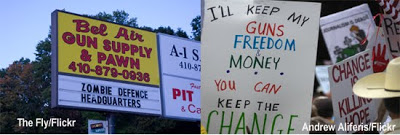
Guns don’t kill people: Bullets kill people

Guest post by Charles Fruehling Springwood

Worldwide, perhaps a billion guns? Where do guns come from? Who makes them? Who sells them? What kinds of guns do Colombian drug lords buy? Marxist guerillas in the Philippines? A middle-class doctor in Finland, where some 15 million Fins own guns? A poor farmer in southern Mexico? An American situated on the U.S.-Mexican border, sporting binoculars and a Glock pistol, scanning the horizon from atop his Winnebago RV? Who gives up or gives away guns?

Source: Flickr user Ayton, creative commons licensed.
Bullets. Credit: Flickr user Ayton, creative commons.

Questions such as these have concerned me for the past year, as I have conducted ethnographic research among gun-owners in the Midwestern U.S. In particular, I have been drawn to the prevailing meanings that highlight a growing movement encouraging the public “open carry” of pistols in addition to enhancing the right to carry concealed weapons.

Why do a growing number of gun owners in the U.S. seek to naturalize the visibility of a gun on a person in a growing number of public spaces? In unpacking this ‘penchant to pack,’ I have zeroed in on the desires for guns and how this fascination turns on the significance of the relationship of embodiment a gun has with its user, especially when the user “wears” her or his weapon? As cultural things — both material and semiotic in form — do guns become less an instrument of the mind and more a part of the mind and an extension of the self?

All of these questions assumed a new kind of urgency this weekend, when Jared Loughner attempted to assassinate Arizona Rep. Gabrielle Giffords (D-Ariz.), killing six bystanders and wounding 13 other people.

Arizona boasts one of the most liberal environments for gun ownership and usage, commonly allowing citizens to openly and publically carry guns on their person. I do not know if Loughner was exercising his right to open carry as he approached the Giffords public meet and greet event at the supermarket, but the gun he used for commit this horrific act was legally his.

As an anthropologist, I am especially interested in the “conditions of possibility” that surround events such as this shooting – those discourses, images, and actions – that fall short of causing such tragedies but clearly animate them and provide cultural scripts for their unfolding.

Continue reading “Guns don’t kill people: Bullets kill people”

Our guns, our selves

Archaeologists spend a lot of time analyzing weapons of our prehistoric past. Cultural anthropologists are more likely to study bananas, cars and wedding dress style. Commodity studies in cultural anthropology rarely address weapons.

No doubt one reason is that they are hard to study — people are less likely to want to share stories about their weapons than their cars or favorite food. A few brave anthropologists have ventured into gun studies. A few others provide contextual insights into U.S. culture and links to the love of guns among so many people.

Here are some recent sources (most are not publicly accessible, with my apologies) by anthropologists:

Journal articles from my AnthroPlus search via my university library:

  • Anderson, Leon, and Jimmy D. Taylor. 2010. Standing Out while Fitting In: Serious Leisure Identities and Aligning Actions among Skydivers and Gun Collectors. Journal of Contemporary Ethnography 39(1):34-59.
  • Crist, Thomas A. 2006. The Good, the Bad, and the Ugly: Bioarchaeology and the Modern Gun Culture Debate. Historical Archaeology 40(3):109-130.
  • Davidson, James M. 2008. Identity and Violent Death: Contextualizing Lethal Gun Violence within the African American Community of Dallas, TX (1900-1907). Journal of Social Archaeology 8(3):320-354.
  • Ibhawoh, Bonny. 2002. Stronger than the Maxim Gun: Law, Human Rights and British Colonial Hegemony in Nigeria. Africa: Journal of the International African Institute 72(1):55-83.
  • Johnson, Colin. 1982. Eastern India: The Plight of Ethnic Minorities – “He Who Lays Down His Gun Lays Down His Freedom”. International Work Group for Indigenous Affairs. Newsletter.no.31-32: 90-99.
  • Continue reading “Our guns, our selves”

Nuclear news, nuclear fears and the role of science

Guest post by Barbara Rose Johnston

I received last week copies of two very different publications reporting on outcomes from the scientific assessment of life in a nuclear warzone. These studies consider, first, the health experience of resident populations living in areas contaminated by nuclear weapons fallout, and, second, the health of people as affected by the low-level radiation that accompanies modern warfare.

The first is a set of eight papers published in the August 2010 issue of the journal Health Physics and reflects conclusions from US-government sponsored science about radiation and cancer risks.

The second, a study conducted by an international and independent team of scientists published in the International Journal of Environmental Research and Public Health, is about the health effects of war on the local population of Fallujah, Iraq.

Appropriate reading, since much news in the past few days has focused on the ceremonies surrounding the 65th anniversary of the bombing of Hiroshima and Nagasaki, and the human suffering associated with nuclear war.

Nuclear worries and concerns have been a major feature in world news for years, but especially so in this first decade of a new century.

A review of today’s global headlines finds reports of fear and accusations over the development of a nuclear weapon in Iran, as well as fears of nuclear war on the Korean peninsula and in Kashmir, the Himalayan territory that lies between Pakistan and India. Fidel Castro’s first address in four years to the Cuban Parliament warns of an imminent nuclear war if the US follows through on its threat of retaliation against Iran for not abiding nuclear-arms sanctions.

There are also hopeful reports on political promises and the potential progress in the struggle to further abolish nuclear weapons. Unfortunately, there are also reports on the lack of progress – for example, the news that the US Senate has again delayed its hearing on a new START Treaty.

The nuclear news also includes “peaceful uses” of atomic energy. The US is reportedly finalizing a nuclear cooperation agreement with Vietnam that would allow enrichment. There are reports of numerous proposals or approved plans for new nuclear power plants in Germany, Egypt, the US, Canada, the Philippines, India, Serbia, Bulgaria, and the UK.

Continue reading “Nuclear news, nuclear fears and the role of science”

Dishonorable killings

So-called honor killings take the wind out of a form of cultural relativism that I refer to as absolute cultural relativism. According to absolute cultural relativism, anything that goes on in a particular culture, and is justified within that culture, cannot be questioned or changed by insiders or outsiders. For insiders, such questioning is cultural heresy; for outsiders it is ethnocentrism.

An antidote to absolute cultural relativism is critical cultural relativism, which promotes the posing of questions about practices and beliefs by insiders and outsiders in terms of who accepts them and why, and who they might be harming or helping. In other words: Who benefits, who loses? [Note: I present these terms in my cultural anthropology texts as a way to get students to think more analytically about the very important concept of cultural relativism.]

Image: Flickr creative commons licensed content. If only India, and indeed the whole world, was a domestic violence free zone.

When death, torture and structural violence are involved, it’s time to relegate absolute cultural relativism to the sidelines and bring to the fore critical analysis and discussion among insiders and outsiders. As far as I know, murder is not legal in any country in the world, including murder of one’s own kin for purposes of protecting family honor.

An article in The New York Times describes an alleged honor killing of a young unmarried Hindu woman in her family home in Jharkhand state, eastern India.

The article links the possible murder to Hindu caste values, which forbid marriage of woman to a man of a lower caste category — in this instance, the woman was of a Brahmin family and was engaged to a man of the Kayastha category, which is lower. Not only that, she had apparently engaged in premarital sex, another serious problem from the point of view of family honor.

What the article doesn’t say is that honor killings of daughters and wives by family members occur among people of other religions as well, including Christianity, that are not driven by caste purity. More deeply than particular religious values is the widespread existence of lethal patriarchy: male dominance in all domains of life — economic, political, social, sexual — that it justifies, even actively supports, murder of women and girls.

There can be no way, in this world, that anyone can get away with murder by saying that “it’s part of our culture” to kill a daughter or wife who breaks cultural rules. As if it’s their right and duty to kill.

Unfortunately, local police and the judicial system are often on the side of the killers.

Amnesty International now keeps track of so-called honor killings, but it’s likely that cases are severely under-counted. Nevertheless, any and all efforts to keep shining a very bright light on the problem of honor killings and related forms of patriarchy are essential.

See also this post on the blog Women Against Shariah.

To thee I sing: sweet land of oil spill

European colonists came to North America seeking religious freedom and economic opportunity. They destroyed the very same for those who had lived here for centuries.

One person’s liberty often means someone else’s shackles. One group’s success often means another group is in ruins.

The boom and crackle of Independence Day fireworks in the United States are echoed in the gunfire in the war zones of Iraq and Afghanistan as outside forces vie for control of these strategic lands. Let freedom ring.

Allow me one more bit of gut gashing irony. In the 18th century, the American patriots fought hard to gain independence from the British. They succeeded.

What would those freedom fighters say about British Petroleum’s oil spill in the Gulf?

Image: “An American Flag on top of a fake oil derrick in Sapulpa, Oklahoma.” The derrick may be fake, but the questions the image raises are surely very real. Creative commons licensed Flickr content.

Don’t let the sun catch you crying

Journalist and filmmaker Sebastian Junger says that he wanted to make you feel like you are actually there in a remote combat outpost in Afghanistan in Restrepo. He and his partner Tim Hetherington, succeeded. After the documentary’s powerful 90 minutes, people in the packed AFI theater in Silver Spring, Md., on Friday June 28 were in shock and awe and tears.

Junger (right) and Tim Hetherington (left). Creative Commons Licensed

Restrepo will remain embedded in my heart and mind for the rest of my life.

The film chronicles the daily lives, and sometimes deaths, of a small platoon of American soldiers tasked with pushing against Taliban control of the Korangal Valley. The soldiers, all men, are very young — 19 years old, many of them, pimply some of them, and proud to be serving their country in fighting “the enemy.” Also, over time, bored, thrilled, scared and sad.

Occasionally, the film provides footage of local villagers. They appear to be mostly scared by what is happening in their valley as they experience the counter-pressures of the Americans and the Taliban. But sometimes proud and dignified as male elders attempt to gain compensation for a cow who died as a result of entanglement with wire fencing surrounding the outpost.

The film brilliantly and effectively interweaves footage from the combat zone with tight-shot interviews with eight soldiers conducted in Italy four months after they had left Afghanistan. So one minute you are in the outpost Restrepo, named after a fallen comrade, with all the noise and smoke from artillery and helicopters. The next minute you are up close and personal listening as a young soldier quietly talks about what it was like to be in the combat zone and what it is like to be dealing with not being there. One says that he doesn’t want to go to sleep because of the nightmares. He has tried five different kinds of sleeping pills, but none works to allow him a peaceful night’s sleep.

Each of the eight men gets very close to tears.

An excellent panel discussion following the film was skillfully moderated by Lara Logan, chief foreign correspondent with CBS News, and included Sebastian Junger as well as one of the film participants, Major Dan Kearney, who made it possible for the film team to work with his combat team.

In the discussion, Sebastian Junger commented that the interviews really “make” the film. What you don’t see, he pointed out, is that the person interviewing the soldiers — Junger — is also fighting back the tears. Junger noted that soldiers cannot show emotion, especially in a combat zone. Instead, when death happens, especially the death of your buddy, you mourn for a minute or two and then get back out there and kill the enemy who took his life.

Once they leave combat, the men have to try to process all that they have been through in the previous 15 months. Many do not succeed in readjusting to civilian life. Junger hopes that the film will help with the re-integration process by promoting understanding of the challenges they face. He said that many of the men will end up going back into combat, leaving behind their wives who feel rejected. They go back, he thinks, because for many 19-year-old men in the United States civilian life does not offer a satisfying role, identity or sense of belonging. The combat zone does that in spades. Many soldiers, he says, become addicted to the male bonding, the brotherhood that is forged in the daily routine of a harsh life and possible death. It is an intoxicating form of solidarity, stronger than friendship, that trumps all differences and disagreements and provides an emotional security that overrides concerns about physical security.

Combat, says Junger, is a small, closed, male world. His film offers a peek through a keyhole into that world. Restrepo is an ethnographic film of the highest order. (Junger has a B.A. in cultural anthropology and it shows). Although Junger wasn’t with the troop for the entire 15 months — he visited five times — he and his camera were not obviously intrusive. But they must have created an extra layer of life and death?

In the question and answer period, no one asked Junger how he is dealing with re-entry to the civilian world. It can’t be easy for him, either. I believe I saw tears in his eyes at several points during the panel discussion.

Update: Tim Hetherington tragically was killed April 20th, 2011 while on assignment in Libia.