Anthro in the news 4/19/10

The news from anthroland has thinned out a bit these days. Nonetheless we have some noteworthy items for you from tweets to eats. Read on!

• Be careful what you tweet
The US Library of Congress will permanently archive all public tweets starting with March 2006 when Twitter began. Several media have noted the vast opportunities for anthropological research in the Twitter archive in providing insights into people’s (read: tweeters’) perceptions of and reactions to events. Blogger’s note and query: In the wide world of cultural anthropology, tweeters are a tiny, tiny minority…how will analysts discern who are the tweeters and the non-tweeters in any given domain/discussion and what difference this makes in terms of the tweet content and intensity? LOC: great idea and a major challenge to researchers to figure out what to make of all the data.

• Donner family ate the family dog not the family
Those of us living in the DC area survived two snowstorms of unprecedented proportions this year. Some of my colleagues mentioned that they expected the Donner family to arrive at their door (it wasn’t that bad, really). A big news item this week was about new evidence that the Donner family ate their pet dog and did not practice “survival cannibalism.” Gwen Robbins, assistant professor of biological anthropology at Appalachian State University, is the lead investigator. She told MSNBC news that “there is no evidence for cannibalism.” She and her colleagues are writing a book to be published in 2011 by the University of Oklahoma Press.

• Cilantro hatred
An article in The New York Times examines why many people hate fresh cilantro, or coriander. Julia Child hated it. There is even a “I Hate Cilantro” Facebook page and blog. What’s this all about? Some experts argue that certain people may have a genetic disposition to cilantro, though systematic studies do not yet exist to support this claim. Cultural anthropologist Helen Leach of the University of Otago in New Zealand has traced negative comments about cilantro to English and French gardening books starting around 1600. Her research suggests that cilantro leaves and seeds, which were prominent ingredients in medieval cooking, were targeted by modernizing style snobs. The “new” European cuisine spurned cilantro in favor of new flavors. Could be. These things happen. Blogger’s note: taste/flavor implicates both culture and biology in complicated ways. On a personal note, I was a serious cilantro hater when I was younger–it made me nauseous, even when presented to me in succulent curries in India. Now, no problem, love it. Explain that.

• Anthropology vs. cooking throwdown: both sides win
Is there an emerging pattern here? Rick Bayless, leading edge chef of nouveau Mexican cuisine, studied anthropology at the University of Chicago as a doctoral student. Before completing his degree, he traded in his pen for a sauté pan and never looked back. Washington, DC now has Tim Miller, executive chef at Mie ‘N Yu restaurant in Georgetown. As an undergraduate archaeology student at the University of London, Miller “went on some really cool digs” in the British Virgin Islands. When a student, he supported himself by washing dishes in a local restaurant. By the time he was a senior, he was working 55 hours a week as kitchen manager. When it came time to choose between graduate school and a job, he chose the latter but with a twist. He entered the business world, working for a brokerage firm part-time while also pursuing a culinary degree. The latter led to a move from “the corporate world to kitchen freedom.” After working in two Marriotts in the US, he was hired at Mie ‘N Yu when it opened. The restaurant offers dishes from cultures along the Silk Road from Persia to India and China, so Miller does research on regional cultures and cuisine: “There’s never a dull moment…anthropology and the study of cultures fit into this job.”
Upcoming event at GW

To our Washington-area readers out there, the Culture in Global Affairs Program and the Global Women’s Forum at the Elliott School of International Affairs are hosting our final event of Spring 2010 this Thursday evening:

Working the Night Shift:
Women in India’s Call Center Industry

Dr. Reena Patel

Drawing from her newly released book, Working the Night Shift, Reena Patel will talk about how call center employment affects the lives of women workers, mainly as it relates to the anxiety that Indian families and Indian society have towards women going out at night, earning a good salary, and being exposed to western culture. From remarks such as “Call center job equals call girl job!” to concern about how night shift employment will affect a woman’s worth on the arranged marriage market, Patel explores the ironic and, at times, unsettling experiences of women who enter the spaces and places made accessible through call center work.

Thursday, April 22, 2010
7:00 pm – 8:30 pm

1957 E Street NW, Room 505

To RSVP, click here.

What are women leaders good for?

On April 15, a panel at the United States Institute of Peace in Washington, DC, focused on a newly released study, “Progress Report on Women in Peace and Security Careers: U.S. Executive Branch.” Jolynn Shoemaker, Executive Director of Women in International Security (WIIS) presented highlights from the report. Major findings include: the situation for women in security careers is less difficult than in the previous generation due to the decline in overt discrimination, but the lack of role models and mentors/sponsors and problems with workplace-life balancing persist.

During the discussion, the question was raised about the effects of having more women in leadership positions in peace and security institutions. Ms. Shoemaker responded that we haven’t yet reached the critical mass in many U.S. security institutions to address the question.

This question is both important and researchable in many areas of leadership. A danger arises, however, in essentializing gender, just as with race, ethnicity or any other social category. Since when, for example, has Clarence Thomas made a decision to benefit the majority of African Americans? And what has Condaleeza Rice done specifically for women of any race/ethnicity?

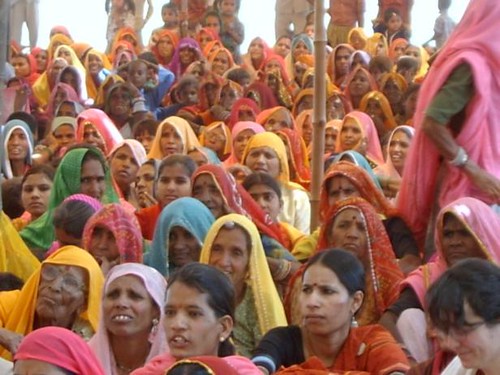
Having issued that warning, I invite you to consider what local level data from rural India reveals. Some background: since the mid-1990s, one-third of Village Council head positions have been reserved for women, and Village Councils make decisions about the provision of many important public goods.

This study used a dataset of 265 Village Councils in Rajasthan, located in India’s northwest adjacent to Pakistan, and West Bengal, located in the east adjacent to Bangladesh. The survey compared investments in Village Councils that contained reserved positions for women and those that did not.

The finding: the gender of the politician does influence policy in rural India. In both states, when the Village Councils have women members, there are significantly more investments in drinking water as opposed to investments in roads and education.

This post is the first of several to pursue the question of gender and leadership. Your comments and contributions are most welcome.

Image: “India04_tilonya_mela-womensday2” from flickr user thaddeus, licensed with Creative Commons.

Anthro in the news 4/12/10

• Flexians make it to Huffington Post Book Club selection
The HuffPost pick is cultural anthropologist Janine Wedel’s Shadow Elite: How the World’s New Power Brokers Undermine Democracy, Government, and the Free Market: “It’s a gripping, disquieting book that exposes and explains why it’s so hard to bring about any real change in our country.” Wedel dubs the shadow elite “flexians” for their ability to survive and have influence no matter who is in the White House.

• Pulling a Tocqueville: review of The Cracked Bell
A reviewer for the HuntingtonNews gives two thumbs-up to Tristram Riley-Smith’s new book about America, The Cracked Bell: America and the Afflictions of Liberty: “With lively, insightful commentary, careful research, and illuminating personal anecdotes, Riley-Smith uses images like the cracked liberty bell…to explain where things went wrong, and how we can make them right.” Riley-Smith, who has a doctorate in anthropology, spent three years at the British Embassy in Washington, DC, and is now working in Whitehall.

• Possible 9/11 victims in landfill
Anthropologists and other experts are studying what may be human remains from the 9/11 attack in Manhattan found in the massive Fresh Kills landfill located on Staten Island. About 30 anthropologists and archaeologists are sifting through sections of the landfill to search for remains of the more than 1,000 victims who have not been identified.

• The embrace of Sufism
Pnina Werbner, professor of social anthropology at the Keele University, UK, delivered the keynote address at the 5th Annual Humanities and Social Sciences Conference 2010 at Lahore University, Pakistan. The topic of the conference was “Cultural Practices and Religion.” Werbner noted that Sufi pilgrimages and festivals are distinct for their openness to people of different social classes and to women as well as men.

• Rethinking Patagonia
A new study of the indigenous peoples of Patagonia combines data from archaeology, cultural anthropology, and ethno-history to document the complexity of pre-contact society and the 100 years of resistance to outsiders. Juan A. Barceló, archaeologist and lead researcher, is with the Autonomous University of Barcelona. Findings are reported in Arctic Anthropology.

• Paleo wow leads to paleo war
When the discovery of 1.9 million year-old pre-human fossils in a cave in Malapa, South Africa, were announced, a media frenzy (on an anthropological scale) ensued. The remains are the partial skeletons of a boy aged 11-12 years and a woman. They were discovered by the son of Lee Berger, a palaeontologist at the University of Witwatersrand, South Africa. The skeletons reveal a mosaic of traits that do not allow it to be placed neatly within the Australopithecines or Homo. Berger claims it is a new species; others disagree. While the jury is still out, many media sources have jumped on the “new species” bandwagon, including the Economist. Don’t they know how serious it is to declare a new species? Many paleontologists/paleoanthropologists have been mentioned or quoted in the media: Chris Stringer of the Natural History Museum in London, Rick Potts of the Smithsonian National Museum of Natural History in Washington, Ian Tattersall of the American Museum of Natural History in New York, Don Johanson of Arizona State University, William Kimbel of Arizona State University, Tim White of the University of California at Berkeley, Bernard Wood of the George Washington University, Bill Jungers of Stony Brook University, and Peter Brown of the University of New England in Australia, and no doubt several others I have missed. To get up-close and personal, go to the BBC news site for a brief video showing interviews with Berger and his son, on location.

Excremental journeys

Who knew that so many commuters on trains and buses in England carry fecal bacteria on their hands? Val Curtis, medical anthropologist and public health expert, teamed up with five other researchers to assess the presence or absence of fecal bacteria on the hands of over 400 people in five UK cities.  Dr. Curtis is a leading proponent of hand washing with soap in developing countries as a powerful mechanism to reduce infant and child mortality.

The findings from the UK study are gripping (so gripping in fact that you may never want to shake anyone’s hand again).

Overall, 28 percent of the 404 people sampled had bacteria of fecal origin on their hands. The authors break that figure down by region and gender. The further north you go, the higher are the percentages of men (not women) with fecal bacteria on their hands. In Newcastle, the most northerly city in the study, nearly 60 percent of the men had fecal bacteria on their hands compared to 5-15 percent in London and Cardiff. The percentage for women in all five cities had a more narrow range, between only 20-30 percent.

Beside region and gender, mode of transportation also revealed differences. Men on buses are more likely to have fecal bacteria on their hands than men who ride trains. And professionals are more likely to have fecal bacteria on their hands than others.

These findings and some complicating factors cry out for further research. First, no difference appeared between people who reported having washed or not washed their hands that morning.  Second, the bacteria that were isolated are found in other contexts such as working with food or animals. Third, the  sample sizes, especially of men in London  (only six) are small, and London is the only truly “southern” city in the study. Fourth, the study assessed only the absence or presence of fecal bacteria and not degrees of difference in the latter.

Blogger’s note: I eagerly await findings from larger follow-up studies that take into account age and ethnicity, and that sample people in more cities. Then on to Scotland and Ireland…and maybe even to the Washington DC metro system that I use to get to work.

SOURCE: G. Judah, P. Donachie, E. Cobb, W. Schmidt, M. Holland, and V. Curtis, Dirty Hands: Bacteria of Faecal Origin on Commuters’ Hands. Epidemiological Infections, 2009.

Image: “Brazil fans on London undergound,” from flickr user markhillary, licensed with Creative Commons.

Anthro in the news 4/5/10

• You can get what you want
Many families in the United Kingdom with sons but no daughters increasingly seek high-tech services to ensure that they have a daughter.  An article in the Guardian profiles two English families with multiple sons who went abroad and paid substantial amounts of money to have a daughter.  The most frequent destination is the United States where sex selection is legal in every state  (sex selection is not legal in the UK).  A doctor at one US clinic reports that “business has gone wild.” Will the UK sex ratio start to tip toward more males than females? Probably not soon, since studies indicate that most UK families desire a balanced number of sons and daughter, or even more girls. So why do so many British people spend around $40,000 for a process called Preimplantation Genetic Diagnosis (in which the mother is implanted with a fertilized ovum of the desired gender)? A researcher (un-named) in the Department of Sociology and Anthropology at the University of Guelph, Canada, is studying parents’ desires to have a child of a particular gender. These  desires and the severe disappointment related to failure, are called Gender Disappointment (GD) or Extreme Gender Disappointment (EGD). GD and EGD are characterized by feelings of  sadness, guilt, and desperation especially among women.

• User anthropology
An article in the New York Times Magazine entitled “Can Cellphones End Global Poverty?” profiled British researcher Jan Chipchase for his role in promoting “user anthropology.” Employed by Nokia and trained as a designer, Chipchase travels the world, along with teams of social scientists including cultural anthropologists, to learning about human behavior. The goal is to inform the company about how to design products, from software to laptops and cellphones, that respond to people’s on-the-ground needs and preferences.

• Dangerous women in Chechnya
An undergraduate student at the University of Chicago majoring in anthropology co-authored an op-ed in the New York Times on Chechen women suicide bombers. Along with others involved in the Chicago Project on Security and Terrorism, she analyzed every Chechen suicide attack since they began in 2000. Twenty-four Chechen women have carried out suicide attacks, constituting forty percent of the total number of suicide attackers.  The women’ s motives appear to derive from their experiences with Russian troops, particularly as widows of men who have been killed. Recommendations include holding fair elections, adopting international standards of humane conduct among security forces, and equitable distribution of oil revenues so the Muslims benefit.

• Women the stronger sex
Two animal researchers at the University of Cambridge discovered that men have weaker immune systems than women. They use evolutionary models to explain why: men had to compete for females so they put their energies into that pursuit, leaving their bodies less able to fight off infections.  David Begun, professor anthropology at the University of Toronto, offers a different explanation for women’s superior immune defenses: they developed this capacity in their role as primary child care-givers. Constant exposure to viruses from children may have, he suggests, helped women develop the ability to fight them off.

• Not a friendly takeover
Human skeletons unearthed in Peru tell a tale of death by the Spanish conquerors that involves guns, steel lances or hammers, and possibly light cannons. Melissa Murphy of the University of Wyoming is leading the research team. They analyzed 258 adult Inca skeletons from a burial ground. “The nature and patterns of these skeletal injuries were unlike anything colleagues and I had seen before,” she comments. Findings are published in the American Journal of Physical Anthropology.

• Maya ruins okay after concert stage collapses
A prominent item in the mainstream media this week was about Chichen Itza, a 1200 year-old Maya site in Mexico and the scene of a concert by Sir Elton John. Following the collapse of the under-construction stage, a spokesman for Mexico’s National Institute of Anthropology and Archaeology reported that the ruins had not been damaged.  Three workers were injured.

• Angkor collapses due to climate change
A prolonged drought, interspersed with intense monsoons, led to the demise of the city of Angkor in Cambodia during the 15th century. Decades of drought strained its ability to survive. Occasional but massive monsoons flooded the city’s irrigation system with mud and debris, making it difficult for the nearly one million residents to obtain water. A study by a team of US and Asian researchers, sponsored by the US National Science Foundation, has used the method of tree-ring dating to demonstrate these trends over many years. Michael D. Coe, emeritus professor of anthropology at Yale University and noted archaeologist, comments “…that is the exact scenario for the city’s collapse.” Findings are published in the Proceedings of the National Academy of Science.

All we like sheep

Spring is a perilous time for sheep. Lambs are born in the spring, and often capricious weather can spell their doom. In the spring, many one year-old lambs are slaughtered to provide meat for a feast. It is the time of the sacrifice of the lambs.

Sheep are one of the earliest domesticated animals, and they still figure largely in the economies of pastoralist cultures from Afghanistan to Zimbabwe with China currently having the most sheep of any country in the world. Images of sheep appear in ancient rock art. Their wool provided one of the first textiles for humanity. Artisanal cheese from sheep’s milk is now a highly sought-after product. And don’t forget haggis.

What do cultural anthropologists have to say about this important animal? Compared to the amount of published sources by archaeologists: not much. In my search of AnthropologyPlus and AnthroSource, using the search words “sheep” or ‘lamb,” I found fewer than 30 articles published since 1995. I then looked in Google Scholar, using the search terms “culture sheep” and “culture lamb” and found a few more sources scattered among the many non-anthropological studies.

Several sources in the following list have to do with herding practices. Another prominent theme is the importance of sheep as items of exchange and sacrifice. Others look at sheep in mythology, symbolism, and healing. The most famous individual sheep in the world, Dolly, attracted some recent attention in terms of bioscience and ethics.

Cultural anthropologists have not written much about the animals in our lives, period. So sheep are not any more neglected than are dogs, horses, pigs, and other animals wild or domesticated. Cultural anthropologists have probably written more books with the word “car” than “sheep” in the title. Perhaps these gentle, low-demand, high-yield animals deserve more of us.

The following sources are the result of a few hours’ research and, with apologies again, they are not open-source:

Abu-Rabia, Aref. 1999. Some Notes on Livestock Production among Negev Bedouin Tribes. Nomadic Peoples 3(1):22-30.

Ayantunde, Augustine A., Timothy O. Williams, Henk M. J. Udo, Salvador Fernández-Rivera, and Pierre Hiernaux. 2000. Herders’ Perceptions, Practice, and Problems of Night Grazing in the Sahel: Case Studies from Niger. Human Ecology 28(1):109-140.

Bolin, Inge. 1998. Rituals of Respect: The Secret of Survival in the High Peruvian Andes. Austin: University of Texas Press.

Maggie. 2005. Quartering Sheep at Carnival in Sud Lípez, Bolivia. In Wendy James and David Mills, eds., The Qualities of Time: Anthropological Approaches. Pp. 187-202. New York: Berg Publishers.

Brower, Barbara. 2000. Sheep Grazing in National Forest Wilderness: A New Look at an Old Fight. Mountain Research and Development 20(2):126-129.

Dám, Laszlo. 2001. Buildings of Animal Husbandry on Peasants’ Farms in Hungary. Acta Ethnographica Hungarica 46(3/4):177-227.

Continue reading “All we like sheep”

Upcoming event at GW

Please join us for an event next week on April 8 at the Elliott School of International Affairs, part of GW’s new Global Women’s Initiative:

Global Women’s Forum:
Global Women 2020: Challenges and Priorities over the Next Decade

Thursday, April 8, 2010
6:00 – 7:15 pm
1957 E Street NW, Lindner Family Commons (Room 602)

Katherine Blakeslee, Director, Office of Women in Development,
U.S. Agency for International Development

Mayra Buvinic, Senior Director, Gender and Development, Poverty Reduction and Economic Management, The World Bank

Kathleen Kuehnast, Gender Advisor, Gender and Peacebuilding Initiative,
U.S. Institute of Peace

Alyse Nelson, President and CEO, Vital Voices Global Partnership

Moderator:
Barbara Miller, Chair, GW Global Women’s Initiative; Associate Dean for Faculty Affairs, Elliott School of International Affairs, George Washington University

Please RSVP at Global Women 2020

Sponsored by the Elliott School of International Affairs

Taking the pulse of the world

Guest post by Anna Applefield

Global Pulse 2010 is  a 3-day on-line “global conversation” on a variety of topics pertaining to development, including entrepreneurship, global health, education, and the comparative advantages of global or local approaches.  It is hosted by the U.S. Agency for International Development and led by experts in their respective fields.  Its  aim is to take the “pulse” of the world by posing questions and allowing participants to comment, respond to each other, and  generate a conversation.

It’s not too late for you to join the conversation: it continues through March 31. Go to the forum’s website. Choose a subject or issue and then select a more focused discussion. Each focused discussion begins with a question that is posed by an expert. Individuals can comment on the response and then start a thread of conversation. The cumulative effect is an array of simultaneous conversations on any one topic.

People participating in the various conversations appear to come from diverse backgrounds, both professionally and regionally. For example, in a thread about of “global citizenship” vs. national citizenship, I read posts from university students, small business owners, and NGO and government employees representing Egypt, Morocco, Australia, Belgium, Jordan, and the United States. While the individual comments themselves are interesting, it is even more impressive to see  extremely varied perspectives come together in a cohesive discussion.

Join in!

Anna Applefield earned her BA from Skidmore College and is currently pursuing her MA in International Development Studies at the Elliott School of International Affairs at George Washington University.