What is World Development all about?

Many people would argue that the journal, World Development, is one of the most pre-eminent publications in the field of development. Knowing that, I decided to search it for articles on Haiti. My search resulted in two articles that actually contain the word Haiti in the title: one on collective action and watershed management published in 1995 and the other on taxation in the coffee economy published in 1993.

In addition to these two Haiti-specific articles, my search produced another 244 articles that include content about Haiti or the Caribbean.

World Development started in 1973. It publishes a volume each year with an issue each month. Each issue contains anywhere between 8-15 articles. Let’s assume an average of 10 articles per issue. That’s 120 articles a year over a period of 36 years for a total of 4320 articles published since the beginning.

And only two have the word Haiti in the title. The poorest country in the Western Hemisphere is apparently of almost no interest to “mainstream” development scholars and experts.

Image: “New Mission, Laugon, Haiti,” from Flickr user glasshalffull91, licensed with Creative Commons.

Anthro in the news 1/18/10

• Symbols of trauma and spirituality in ruins in Haiti
Rebuilding symbolic structures and spaces are an important part of helping Haiti recover from the earthquake disaster. In Port-au-Prince, the National Cathedral, the presidential palace, the parliament building, the United Nations headquarters, and local churches have collapsed or are in ruins. An article in the National Post comments that the collapsed presidential palace in particular is now a potent symbol of a country in deep distress. But it’s a complicated symbol. Douglass St. Christian, associate professor of anthropology at the University of Western Ontario, Canada, is quoted as saying, “The presidential palace is a source of great pride, but it’s also a reminder of the absolute horror of Duvalier’s (dictatorial) rule…So the Haitians are, on the one hand, going to be traumatized by the ruin of something that’s come to represent their emergence from that regime, and on another hand, glad that it’s gone.” More clearly traumatic is the loss of so many churches, since 90 percent of Haitians practice Catholicism. St. Christian urges that, during the reconstruction phase, international attention be given to restoring meaningful structures and spaces to help the social and psychological healing process.

Grief and trauma counseling: one size does not fit all
Medical sociologist Ethan Watters, in a radio interview on KCBS, comments that mental health support in Haiti offered by Western organizations needs to take care to pay attention to the cultural specifics of the Haitian people. Most research on trauma and PTSD, he says, has been done on Americans and it drives the assumption of mental health experts that this knowledge is universally applicable: “Anthropologists know that there are great differences around the world in how to think about trauma, the meaning you attach to trauma…Those experiences are simply not the same the world over. We could do great damage and harm when we rush into another culture with our notions of PTSD and our notions of healing.” He recommends that counselors study the culture before they try to help and that they provide support to existing systems.

• Iranian political culture shifting
In an article in the Los Angeles Times, William Beeman, professor of cultural anthropology at the University of Minnesota and expert on Iran, explains the growing momentum in Iran for political change:  “Iran is a hierarchical society. Folks in the superior position must care for those in the inferior position or they will be toppled. The folks in the lower position will cease to support them — in fact will work to undermine them.”

• In the army now

An article in the National Defense Magazine notes that the army’s anthropology teams are in demand. So far, 27 teams have been developed and fielded. Col. Mark Crispi, director of project development for the program says: “The mission of the human terrain system is to support the combat unit.”


Continue reading “Anthro in the news 1/18/10”

What low-income Haitians want: lessons for aid-givers

In rural Haiti, before entering anyone’s yard, one calls out : “Onè! (Honor!), waiting to hear the welcome, “Respe!” (Respect) before entering. Cultural anthropologist Jennie Smith-Paríolá did long term fieldwork with “peasant” groups in Haiti’s Northeast, Central Plateau, and Grand Anse regions. She learned much about the values of honor/respect and how they infuse Haitians ideas of right and wrong and the kind of life that humans ought to be able to have.

Many countries and organizations are committed to helping Haiti recover from the devastation of the earthquake and to move ahead to build a stronger country than existed before. The shock of the earthquake’s toll in terms of mortality, loss of family and loved ones, and physical destruction is serving as a wake-up call to the Haitian government and to other countries and institutions that something, now and onwards, seriously, must be done to help the Haitian people achieve a better future.

Typically, countries and organizations tend to give the kind of aid that they tend to give…regardless of the context of the place and people in need. Among other forms of help, the US has sent in the military. In fact, as of today’s newspaper accounts, the US is in charge of the airport and the majority of planes landing carry US military. Planes bringing food and water are being held back.

Patterns of giving are entrenched and hard to change. But they must be. While the US military no doubt  serves an important role in helping to retrieve bodies and maintain order in what is an increasingly desperate situation, aid efforts should not ever be dominated by “military aid.”

Smith-Paríolá worked with and learned from the poor and disempowered of rural Haiti, many of whom have formed small-scale community organizations to provide services and to organize production and trade. From them, she heard incisive critiques of outsiders’ concepts of progress, democracy, and development. She listened to their aspirations and their views of how outsiders need to change. Read her book, When the Hands Are Many: Community Organization and Social Change in Rural Haiti. It conveys the voices, aspirations, and even songs of the people.

Here is what poor Haitians define as elements of a good society:

1. relative economic parity
2. strong political leaders with a sense of service who “care for” and “stand for” the poor
3. respe (respect)
4. religious pluralism to allow room for ancestral and spiritual beliefs
5. cooperative work
6. access of citizens to basic social services
7. personal and collective security

Smith-Paríolá notes that aid organizations have contested the first two of these: the first is seen as counter-productive to economic progress and the second as counter-productive to democratic principles.

In terms of respe, David Brooks’ editorial (see Samuel Martínez’s response here) in the New York Times on January 14 is a good example of the lack thereof among many outsiders.

The fourth point, from the local people’s viewpoint, can be achieved even though many people are affiliated with Protestant or Catholic missions. They feel that religious/spiritual pluralism is viable and that different belief systems are mutually informing.
Working in groups is part of rural life. It is accompanied by laughter, songs, jokes, games, and sometimes drinking. Collective play and performance “heat up” labor. Aid agencies often look down on what they perceive as rowdy and undisciplined behavior.
The sixth point is currently beyond the reach of most rural Haitians. It includes adequate schooling (primary and secondary schools with teachers and regular hours of operation), literacy training for adults, decent transportation (just a nearby road), farming equipment (hoes, machetes, plows, fertilizers, pesticides), “Western” health care (an adequate clinic within walking distance), a fair judicial system (providing equal justice to the poor), enough land to live on (land redistribution), and a healthier environment.

As the government is increasingly unable to provide for people’s livelihoods and other forms of basic needs, unrest has also increased. Crime rates have risen steeply in Port-au-Prince and also, to some extent, in rural areas. More and more often, Haitians voice concerns about feeling safe.

The lessons are clear: major changes are required in the culture of big aid organization, in how they define need, what kinds of help they provide and how they provide it. They must form coalitions with Haitian community groups based on a practiced respe that honors differences and similarities in values. They must reframe their thinking to look at the shortcoming of the powerful and wealthy rather than of the poor. Most importantly, following the values of poor Haitians, economic inequality must be reduced to the extent that if one person is eating, everyone is eating.

How to do this? A first step is that big aid givers  have to abandon their authoritative knowledge of what’s best for Haiti and listen to the Haitians. This strategy means that the typical architecture of big aid will come crumbling down just like so many buildings struck by the earthquake. A different kind of reconstruction is in order: collaborative, culturally-informed aid must replace the age-old top-down kind of aid.

The people of Haiti need help, but on their terms. Let’s start with respe and move on from there.

Image: “Map of Haiti,” from Flickr user DrGulas, licensed with Creative Commons.

“Tough love,” hold the love

Guest Post by Samuel Martínez

David Brooks’ New York Times op-ed, “The Underlying Tragedy,” debates a major truth: there is no such thing as a “natural disaster,” only natural adversities for which humans are better or worse prepared to cope. He spins so many mistruths from that insight, however, that the “tough love” approach that he seems to recommend for Haiti seems destined to produce a lot of toughness (and most of that verbal) with little “love.”

We’ve already seen it multiple times that hurricanes leave vastly disproportionate damage from one island in the Antilles to the next. And we’ve seen that poverty coefficient do its ghastly math specifically in Haiti as recently as 2008 when four hurricanes caused thousands of deaths there while taking a much lower toll in human life in neighboring Cuba, where severe storm damage also happened.

No doubt about it: people in countries where poverty reigns, communication infrastructure is deteriorating, and state institutions are weak are unjustly vulnerable to seeing their lives and families wrecked by natural disasters.

And the fact that we’ve seen such disparities be manifested many times before (albeit on a smaller scale of destruction than Tuesday’s quake) also raises questions about why Haiti was so badly prepared.

That said, it is an obscenity for Brooks to blame the magnitude of the disaster on Haitian culture at the very moment when these, ostensibly culturally-impaired people are literally throwing their shoulders to concrete in a last effort to save loved ones, neighbors and even strangers, for whom the rescuers care for no reason other than they all are human.

As a cultural anthropologist I could talk for hours about the Rove-esque dimensions of attacking Haiti precisely at its culture, the one area where it is generally understood to be “rich.”

But just what is the point of Brooks’ blanket denunciation of an entire people’s way of life?

Surely, in response to a disaster of this magnitude there must be blame enough to go around. How about apportioning some criticism also to the Western governments that have pledged billions in recent years to Haitian reconstruction while actually giving much less?

The answer (to Why blame the culture?) becomes more clear as Brooks goes on and likens what he styles as Haiti’s patho-cultural syndrome to Black inner-city teenagers suffering from diminished expectations and habits of blaming others for their own shortcomings. Nothing matches up in Brooks’ linkage of Harlem and Port-au-Prince — the comparison is a total clunker — nothing matches up, that is, other than a discourse of veiled white supremacy designed to blame Blacks for whatever ill God and man throws their way and to provide a white-dominated state with a standing excuse for doing too little, too late.

And now that we’re on the topic of disaster, avoidable human costs, and blame, does the name “Katrina” mean anything to Mr Brooks?

Is there no decency? Is there no sensitivity to race-baiting among the editorial staff of our nation’s leading news outlet? Of course there isn’t and never has been in relation to Haiti. I can’t even so help thinking that Brooks’ “The Underlying Tragedy” is one more sign of how coarse the political right’s discourse has gotten in just the last year. With all the racially-coded vitriol of the last months still in the air, should we be surprised that blame is the only thing right-wing commentators will say Haitians deserve in plenty?

Samuel Martínez is an Assistant Professor in the Department of Anthropology at the University of Connecticut.

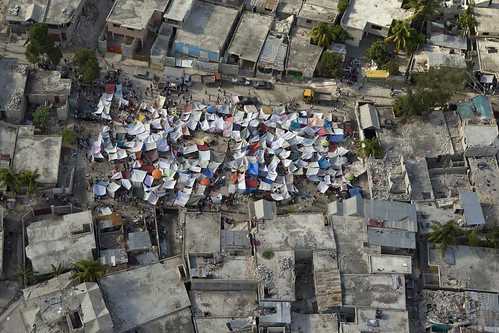
Image: “Haiti Earthquake” by Flickr user United Nations Development Programme, licensed by Creative Commons.

Recent sources on Haitian culture and social change

This list is intended to provide a guide to recent resources on culture and society in Haiti for people who wish to be better informed about the context in which the recent earthquake and its devastation are occurring. With apologies, most of the journal articles are not public access.

Furthermore, we really encourage everyone to visit InterAction’s Haiti response page, which includes a variety of ways to help out.

Benoît, C. 2007. “The politics of vodou: AIDS, access to health care and the use of culture in Haiti”. Anthropology in Action 143, 59-68.

Coreil, J. & Mayard, G. 2006. “Indigenization of illness support groups in Haiti”. Human Organization 652, 128-139.

Curci, S. 2008. “Mapping Haitian history: a photo essay”Journal of Haitian Studies 142, 120-30.

Farmer, P. 2004. “An anthropology of structural violence.” Current Anthropology 453, 305-325.

Farmer, P. E. 2001. “The consumption of the poor: tuberculosis in the 21st century.” Ethnography 12, 183-216.

Farmer, Paul. 1992. AIDS and Accusation: Haiti and the Geography of Blame. Berkeley: University of California Press.

Farmer, P. E. 2008. “Mother courage and the future of war.” Social Analysis 522, 165-184.

Giafferi, N. 2004. The violence of relations in fieldwork: the Haitian example. Terrain 43, 123-40, 159.

Guilbaud, P., & Preston, M. 2006. “Healthcare assessment study in Les Cayes, Haiti: towards a framework for rural capacity development and analysis”. Journal of Haitian Studies 122, 48-69.

Hastings, A. 2007. “Eradicating global poverty: is it really achievable?” Journal of Haitian Studies 132, 120-134.

James, E. C. 2004. “The political economy of “trauma” in Haiti in the democratic era of insecurity”. Culture, Medicine and Psychiatry 282, 127-149.

Continue reading “Recent sources on Haitian culture and social change”

Upcoming event: Theological Jihad in Bin Laden’s Audiotape Library

For those of you in the D.C. area, our friends at the GW Institute for Middle East Studies (IMES) are hosting a very interesting talk next week:

IMES Research Colloquium

Theological Jihad in Osama Bin Laden’s Audiotape Library

by
Flagg Miller
Cultural anthropologist and associate professor of religious studies
University of California, Davis
&
Resident Fellow at the Woodrow Wilson International Center for Scholars
Monday, January 25th, 2010
3:00 p.m. – 4:30 p.m.

IMES Conference Room
Suite 512, 1957 E Street, NW
George Washington University
Washington, DC

**Coffee will be served**
For a copy of the paper,
RSVP to rsvpimes@gwu.edu by Wednesday, January 20th

Email   imes@gwu.edu  •  Web  http://www.gwu.edu/~imes

Short term ethnographic consultancies for the U.S. census

From the Washington Association of Professional Anthropologists (WAPA):

The U.S. Census Bureau seeks up to 18 ethnographers to conduct short-term paid contract research for 4-6 months during Census 2010 data collection operations. The study aims to address the issue of persistent differential census miscounts of some race/ethnic subpopulations. Contract ethnographers will receive training at the Census Bureau, then conduct coordinated evaluations of enumeration methods and census coverage in designated race/ethnic communities. The researcher will go to a designated race/ethnic site for 7-9 continuous days during a census data collection operation. He/She will accompany a census interviewer, observe and tape the census interview, then conduct an on-the-spot ad hoc debriefing to resolve any anomalies in who should be counted in the household and/or in household structure.

The researcher will observe/tape/debrief in 35 households, prepare transcripts and case studies, and write a site report identifying types and sources of coverage error, which types of households and persons are at coverage error risk, and other factors affecting enumeration as well as assessing the extent to which coverage errors vary among race/ethnic groups. We seek experienced qualitative researchers who have done or are currently doing research in the U.S. in one or more of the following race/ethnic communities: American Indian (reservation), Alaska Native, African American, Asian, Hispanic/Latino, Native Hawaiian/Other Pacific Islander, Middle Eastern, and non-Hispanic white. To be considered, each researcher must be a U.S. citizen, send in all application materials, and must commit in writing to do the research in his/her designated research site for 7-9 days during one of these three time periods: March 29-April 9 (Indian reservation), May 5-22 (the other sites), or August 30-September 30 (all sites).

For more information on the study and how to apply, please send an e-mail with “Request for Information on 2010 Census Evaluation Contracts” in the subject line to all three of the following: Laurel.K.Schwede@census.gov, Rodney.Terry@census.gov, and Matthew.Clifton@census.gov.  The deadlines for sending in complete applications are February 1 (for the Indian reservation in March) and February 10 for the Indian reservation in August and for all other sites from March to August.

Why is Haiti so poor?

UPDATE 1/14: This post was linked in a story by Discovery News’ James Williams.

Haiti and the Dominican Republic share the island of Hispaniola. Following the island’s discovery by Columbus in 1492, Spanish colonialists exterminated the island’s indigenous Arawak Indians. In 1697, the French took control of what is now Haiti and instituted an exceptionally cruel system of African plantation slavery. In the late 1700s, the half million slaves revolted. In what is the only successful slave revolution in history, they ousted the French and established the first Black republic in the Western Hemisphere.

Haiti’s population of over eight million people occupies a territory somewhat smaller than the state of Maryland in the United States. The land is rugged, hilly or mountainous. More than 90 percent of the forests have been cleared. Haiti is the poorest country in the Western Hemisphere. Extreme inequality exists between the urban elite, who live in the capital city of Port-au-Prince, and everyone else.

The people in the countryside are referred to as peyizan yo (the plural form of peyizan), a Creole term for small farmers who produce for their own use and for the market (Smith 2001). Many also participate in small-scale marketing. Most peyizan yo in Haiti own their land. They grow vegetables, fruits (especially mangoes), sugarcane, rice and corn.

Accurate health statistics are not available, but even rough estimates show that Haiti has the highest prevalence of HIV/AIDS of any country in the region. Medical anthropologist Paul Farmer emphasizes the role of colonialism in the past and global structural inequalities now in causing these high rates (1992).

Colonial plantation owners grew fabulously rich from this island. It produced more wealth for France than all of France’s other colonies combined and more than the 13 colonies in North America produced for Britain. Why is Haiti so poor now?

Colonialism launched environmental degradation by clearing forests. After the revolution, the new citizens carried with them the traumatic history of slavery. Now, neocolonialism and globalization are leaving new scars. For decades, the United States has played, and still plays, a powerful role in supporting conservative political regimes.

In contrast to these structural explanations, some people point to problems with the Haitian people: They cannot work together, and they lack a vision of the future.

Opposed to these views are the findings of Jennie Smith’s ethnographic research in southwestern Haiti, which shed light on the life of peyizan yo and offer perspectives on their development (2001). She found many active social organizations with functions such as labor sharing, to help each member get his or her field planted on time, and cost sharing, to help pay for health care or funerals. Also, peyizan yo have clear opinions about their vision for the future, including hopes for relative economic equality, political leaders with a sense of social service, respe (respect), and access of citizens to basic social services.

The early colonizers did not decide to occupy Haiti because it was poor. It was colonialism and its extractive ways that have made Haiti poor today.

Sources:

“Culturama: The Peyizan Yo of Haiti,” in Barbara D Miller, Cultural Anthropology, 5th edition, Pearson. 2009, p. 404.

Smith, Jennie M. 2001. When the Hands Are Many: Community Organization and Change in Rural Haiti. Ithaca, NY: Cornell University Press.

Farmer, Paul, 1992. AIDS and Accusation: Haiti and the Geography of Blame.

Image: “Haitian Girl” by Flickr user Billtacular, licensed by creative commons.

Thanks to Samuel Martínez of the University of Connecticut for pointing out that the Haitian Creole plural “yo” means that one should not include an article in front of the noun.

To profile or not to profile?

The attempt on Christmas day of the so-called underwear bomber to blow up a plane on its way to Detroit has raised worldwide concern about passenger no-fly lists, increased airport security checks, and civil liberties. Two recent survey-based studies conducted in the United States before the Christmas day event shed light on Americans’ attitudes toward racial/ethnic profiling in airports.

Airport racial/ethnic profiling is defined as the targeting of certain people, based on perceptions of their race/ethnicity, for additional scrutiny by criminal justice officials.

Using 2004 Gallup poll data, researchers asked whether Blacks, Latinos (referred to in the study as Hispanics), and Whites feel that racial/ethnic profiling is widespread in airports and whether or not it is justified. Blacks were significantly more likely than Whites and Latinos to state that they believe that such profiling is widespread in airports. There were no differences between Whites and Latinos on this question. Two other significant variables appeared: older people are less likely to perceive widespread profiling in airports and liberals are more likely to do so.

Whites are significantly more likely to believe that airport ethnic/racial profiling is justified. Other variables appeared as significant: males, people with children in school, and more religious people are more likely to believe that profiling is justified. Liberals and people who live in suburbs are less likely to feel profiling is justified.

The second study first compares support for ethnic profiling in the U.S. as a counter-terrorism tactic with support for profiling Black motorists. The researcher uses the 21st Century Americanism Survey, a national, random telephone survey conducted in 2004.

Results show that support for counterterrorism profiling is higher than support for profiling Black motorists. Another finding is that people are more supportive of profiling immigrants than of U.S. citizens. The most powerful predictor for profiling was being a White American Christian. Other important variables are lower levels of education, being a Republican, fearing being a victim of an attack, and being proud to be an American.

Both studies demonstrate that those who are least likely to experience airport profiling are most supportive of it. Clearly, racial/ethnic profiling exists in U.S. airports and disproportionately causes discomfort to many non-white passengers who for one reason or another “fit” the profile. Has it worked to deter any potential terrorists? We don’t have an answer to that question. Should all passengers be subject to equal scrutiny? Yes.

Otherwise, you risk letting the Salahis into the White House, metaphorically speaking.

Image: “DIA Security Line” by Flickr user michanne5, licensed by Creative Commons.

Anthro in the news 1/11/10

• Tell it to the Marines
NPR aired an interview with cultural anthropologist Paula Holmes-Eber who teaches “operational culture” at Marine Corps University in Quantico, Virginia. Classes include discussion of cultural sensitivity and the cultural/social consequences of military presence and military actions, such as blowing up a bridge.

• Nacirema craziness goes global
In an article called “The Americanization of Mental Illness” in The New York Times Magazine, Ethan Watters (blog) describes how Western, especially American, globalization includes the spread of Western/American understandings of mental health and illness. He points to some of the negative consequences of this trend.

In discussing why people diagnosed with schizophrenia in developing countries fare better than those in industrialized countries, he draws on the work of medical anthropologist Juli McGruder of the University of Puget Sound. McGruder’s research in Zanzibar shows how Swahili spiritual beliefs and healing practices help the ill person by avoiding stigma and keeping social and family ties intact. Note: Nacirema is “American” spelled backwards.

• Guardians of the nameless dead
The bodies of hundreds of victims of political violence in Colombia are often disposed of by being thrown into rivers. Sometimes the bodies wash up on the river bank. WIS News describes the work of one local civil servant, Maria Ines Mejia, who spends time recovering bodies from the Cauca River and thereby helping authorities record the deaths and chronicle the killings.

Maria Victoria Uribe, an anthropologist with Colombia’s National Commission of Reconciliation and Reparation, names people like Mejia as “unknown heroes.” Michelle Hamilton, an expert in body composition who directs the Forensic Anthropology Center at Texas State University, notes that “…you can imagine trying to grab onto a water-logged body with the skin slipping off. It can come off in your hands.”

• Celebration and warning
Survival International’s “weighty coffee-table book,” We Are One: A Celebration of Tribal Peoples, is reviewed in the Ecologist. The unity and diversity of indigenous peoples around the world is celebrated in beautiful photographs and through the words of tribal and non-tribal people. Given that Survival International commissioned the book, it also expectedly contains a message of deep concern about the dangers to survival that so many indigenous/tribal cultures face.

• Who rules?
Janine Wedel is a cultural anthropologist and professor of public policy at George Mason University. Her book, The Shadow Elite: How the World’s New Power Brokers Undermine Democracy, Government, and the Free Market, was reviewed in the Financial Times and by Arianna Huffington of the Huffington Post. Wedel has appeared at several book launches in D.C.
Continue reading “Anthro in the news 1/11/10”