anthro in the news 12/12/16

Comet Ping Pong restaurant in DC, site of recent fake news about child trafficking prompting an armed man to “self-investigate” on December 4  Source: Jonathan Ernst/REUTERS
Comet Ping Pong restaurant in DC, site of recent fake news about child trafficking prompting an armed man to “self-investigate” on December 4
Source: Jonathan Ernst/REUTERS

sex panic and social media

The Montreal Gazette carried an op-ed by Roger Lancaster, professor of anthropology and cultural studies at George Mason University, and author of Sex Panic and the Punitive State. He comments on the rise of “fake news” and its circulation, especially as related to imputed sex-related crimes: “We have good reason to think that the role of fakery is expanding in the public sphere. Part of this expansion has to do with the speeding-up of communication, its dissemination through networks that lack protocols or fact-checking. This is part of the long story of modernity. Fear and confusion propagate faster through radio and television than by way of mass-produced broadsides or fliers; the Internet is a more efficient means of converting anecdote into evidence and rumour into “fact” than was the Hearst newspaper chain of yesteryear.”

big deal phone call
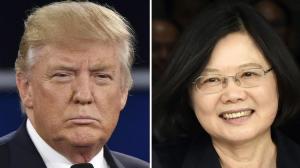
U.S. president-elect Donald Trump and Taiwan's President Tsai Ing-wen Source: Staff/AFP/Getty Images/Chicago Tribune
U.S. president-elect Donald Trump and Taiwan’s President Tsai Ing-wen
Source: Staff/AFP/Getty Images/Chicago Tribune

In a guest column in The Orlando Sentinel, Robert Moore, professor emeritus of anthropology at Rollins College in Florida, comments on the recent phone call that president-elect Trump had with the president of Taiwan:  “The relationship between China and the U.S. is likely to be the world’s most significant vortex of diplomacy for at least the next few decades…Thanks to that phone call, we might do well to take a good look at Taiwan, one area in which America’s and Beijing’s interests do not perfectly coincide. Whether we view Taiwan as a province of China (which is what our One-China policy requires) or as an independent, self-governing entity (which, in reality, it is), we have to admire it for its robust, democratic institutions.”

Continue reading “anthro in the news 12/12/16”

anthro in the news 12/5/16

screen-shot-2016-12-05-at-10-01-39-am

better voting projections with ethnography

Anthropologist and writer for the Financial Times, Gillian Tett argues that U.S. election polling would have benefited from ethnography: “…pollsters and political pundits need to move beyond their obsession with complicated mathematical models, and participate in more ethnographic research into subtle cultural trends of the sort that anthropologists do.” A letter to the editor, in response to her article, says that sedation of respondents would provide more accurate information about voting preferences, a “truth serum” effect.

combating hate

vqobabc2Paul Stoller, professor of cultural anthropology at West Chester University, published a piece in The Huffington Post describing some recent hate incidents in the U.S., framing his words as a “letter to our students.”  The examples are: incidents in New York City in a supermarket and in a diner, booing of a Gold Star family on a flight, and negative social media during the Presidential Medal of Freedom Ceremony.  He concludes by saying: “You can take your knowledge and transform it into practice. You can observe small-scaled interactions and ethnographically describe incidents of hate as well as examples of social tolerance. You can post these descriptions on social media to create an ethnographic record of both intolerance and tolerance that will spread far and wide on the Internet—an anthropology of us.”


Continue reading “anthro in the news 12/5/16”

anthro in the news 11/28/16

gay_china_book

dear “comrade”

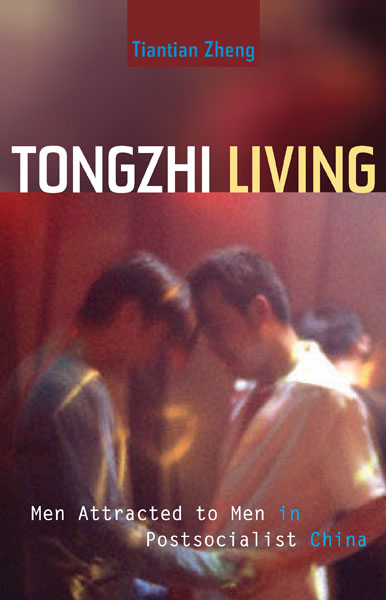
Quartz published an article about the changing use and meaning of the term tongzhi, “comrade,” in China. Originating in the early Qin Dynasty (221-206 B.C.E), the word tongzhi was a common form of address during China’s Communist Revolution of 1921-1949. The article quotes linguistic anthropologist Andrew Wong, associate professor at the University of California East Bay, who says that the term “signalled solidarity, equality, respect, and intimacy among the revolutionaries.” With the emergence of a market economy starting in 1978, the term’s popularity waned. In the late 1990s, Chinese gay people began to use tongzhi as a term of address, it is still in use today. Party rules published earlier in November outline stricter party governance, including the revival of the use of tongzhi to promote an atmosphere of social equality. In the meantime, complications will arise given the ongoing and widespread use of the term among gay people. [Blogger’s note: for related reading, see Tiantian Zheng’s ethnography, Tongzhi Living: Men Attracted to Men in Postsocialist China].

well worth revisiting

9781598535051The Philadelphia Inquirer carried a review of a two-volume, edited set of works by Loren Eiseley. Eiseley, who died in 1977, was the Benjamin Franklin Professor of Anthropology and the History of Science at the University of Pennsylvania. The Library of America and editor William Cronon have presented his work in Collected Essays on Evolution, Nature, and the Cosmos that “serves as a treasure trove of 20th-century science writing.” The review goes on to say that Eiseley had “a singular voice in American letters, one well worth revisiting.”


Continue reading “anthro in the news 11/28/16”

anthro in the news 11/21/16

imgonline-com-ua-twotoone-ctrsobwujpo9

two views on the Trump win: class or region?

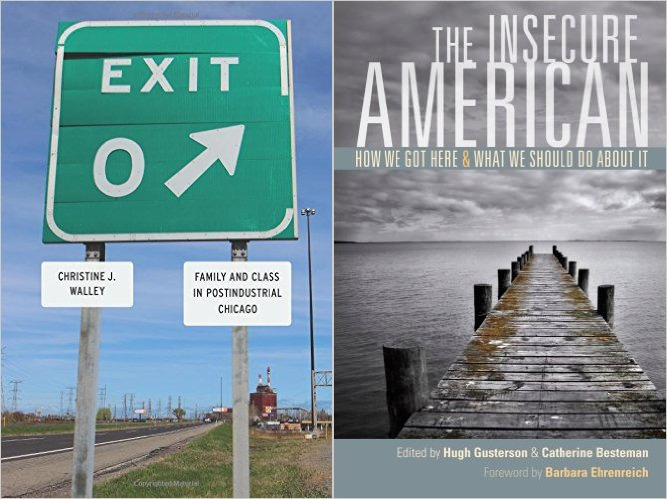
An article in The Minneapolis Star Tribune included commentary from two social anthropologists at the annual conference of the American Anthropological Association. Christine Walley, professor of anthropology at the Massachusetts Institute of Technology, showed a documentary she made, Exit Zero, about the closing of a steel mill in Illinois, and drawing from her book with the same title. It is an example of the changes that caused white, rural Midwestern workers to turn to Trump. Hugh Gusterson, professor of anthropology and international affairs at George Washington University, agrees. He wrote a book, The Insecure American, which looked at the U.S. in 2009 when many in the middle class retreated to gated communities and were worried about their retirement funds, health insurance, terrorist attacks and immigrants. “A lot of people are trying to understand this election in terms of class,” Gusterson said. “But I’m more struck by how geographical it was.”

fascism in the land of the free

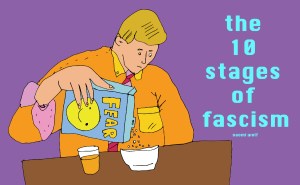
From Naomi Wolf, The End of America: Letter of Warning to a Young Patriot Source: Adbuster Magazine, 11/10/15
From Naomi Wolf, The End of America: Letter of Warning to a Young Patriot
Source: Adbuster Magazine, 11/10/15

Mark Schuller, professor of anthropology and NGO leadership at Northern Illinois University, published an article in CounterPunch reviewing social repercussions of Trump leadership and values which have strong elements of fascism. He ends by noting that: “…the historical and anthropological record[s] show that empires often descend into fascism during their final decline. Whether this is the end of empire, and whether there are alternatives, is up for we the people to decide.”


Continue reading “anthro in the news 11/21/16”

anthro in the news 11/14/16

imgonline-com-ua-twotoone-tppb0k53z38w

anthropology in the time of Trump

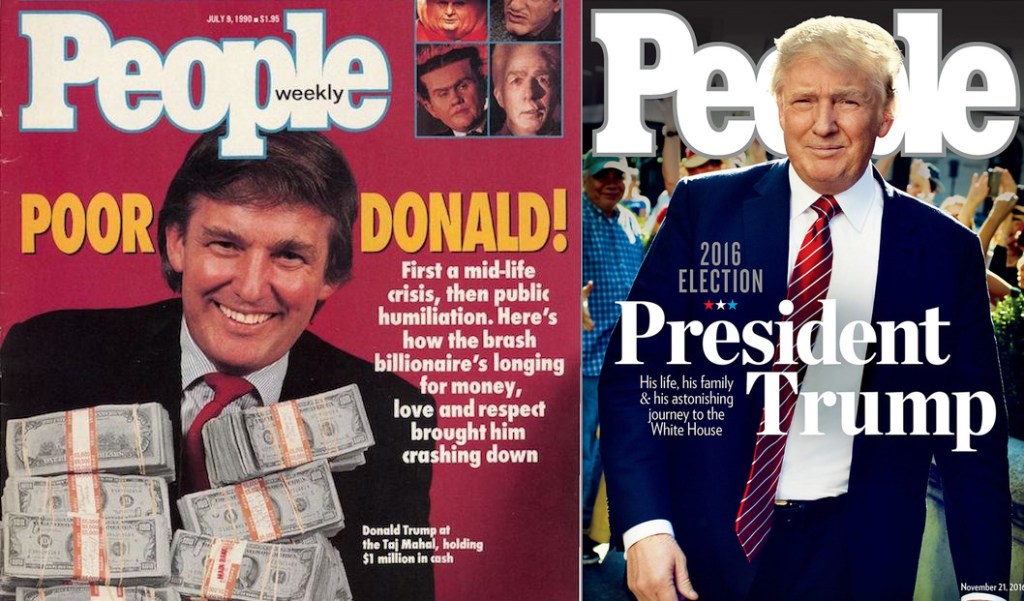
Cultural anthropologist Paul Stoller, professor at West Chester University, published an essay in The Huffington Post revisiting his article of March 2016, The Anthropology of Trump: Myth, Illusion and Celebrity Culture: “In that piece, I tried to demonstrate how Mr. Trump had brilliantly manipulated the fundamentals of celebrity culture—glitz, illusion and fantasy—to create a kind of alternative reality in which shallow perception is more appreciated than profound insight. In the mythic culture of celebrity, as President-elect Trump understands so well, lies become truth and conspiracies become convincing evidence that our system is ‘rigged.’” Stoller argues that ethnography, thick description, and cultural critique are of even greater importance now.

immigrant anxiety in the time of Trump

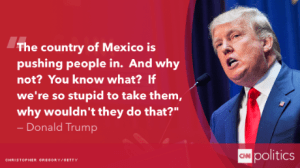
WTNH News (Connecticut) reported about widespread anxiety among immigrants in the U.S. about a Trump presidency given his many statements about illegal immigrants including this one 150709094619-donald-trump-quote-mexico-large-169that he made at rally: “Day one my first hour in office those people are gone.” Joyce Bennett, assistant professor of anthropology at Connecticut College, is quoted as saying: “It’s putting people in a really nervous position.” She works closely with immigrants in New London, Connecticut. In Connecticut, undocumented immigrants can get a driver’s license, and they have access to health services.


Continue reading “anthro in the news 11/14/16”

anthro in the news 11/7/16

screen-shot-2016-11-07-at-9-49-39-amnot all hair is equal   

BBC News reported on the research of social anthropologist Emma Tarlo tracing the global industry in human hair, especially wigs, weaves, and extensions. Tarlo, professor of anthropology at Goldsmiths, University of London, is the author of Entanglement: The Secret Lives of Hair. While China is the biggest exporter and importer of human hair and harvests huge amounts from its own population, European hair is the most valuable because of its fine texture, variety of its colors, and relative scarcity. Tarlo is quoted as saying: “People who work in the industry are conscious of the fact Made in China is viewed as a negative label and market it in more glamorous ways instead.” [with audio]

welcome to the Drone Age9780262034678

Foreign Affairs published a review of five books on drone warfare including one by Hugh Gusterson,  professor of anthropology and international affairs at George Washington University. The reviewer refers to Drone as “gently critical” and a “thoughtful examination of the dilemmas this new weapon poses.”


Continue reading “anthro in the news 11/7/16”

event in DC on November 5th

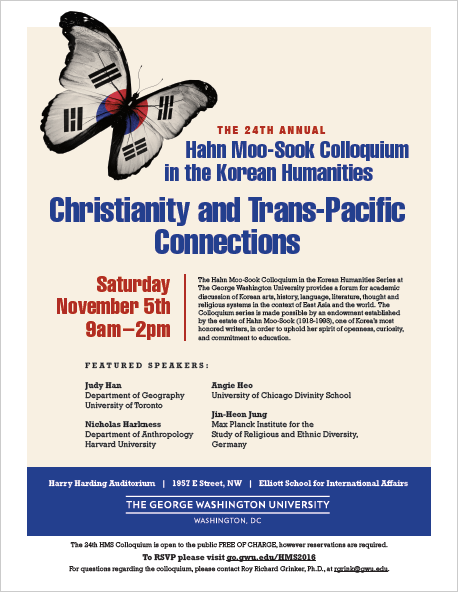
screen-shot-2016-11-02-at-10-29-53-amThe George Washington University (GW) will be hosting their 24th annual Hahn Moo-Sook Colloquium in the Korean Humanities this Saturday, November 5th, 2016, from 9am–2pm. The event will focus on Christianity and Trans-Pacific Connections, with Judy Han, Department of Human Geography University of Toronto, Scarborough; Nicholas Harkness, Department of Anthropology Harvard University; Angie Heo, University of Chicago Divinity School; and Jin-Heon Jung, Institute for the Study of Religious and Ethnic Diversity, Max Planck Institute, Göttingen. The colloquium will take place at 1957 E Street, NW, in Room 213 (The Harry Harding Auditorium), in Elliott School for International Affairs at GW. It is open to the public but reservations are required

anthro in the news 10/31/16

Source: Creative Commons

Tweeting hate   

USA Today reported on the surge in hate speech on Twitter during the U.S. presidential campaign especially via social media. The article quotes Sophie Bjork-James, post-doctoral fellow in the anthropology department at Vanderbilt University:  “While various groups have been targeted with hate speech on Twitter during this election, I don’t think anything compares to what Jewish journalists are going through…Many white nationalists have been inspired by the Trump campaign to increase their involvement, and a central part of this ideology is anti-Semitism.” 

Behind the presidential masks

An article in Smithsonian magazine asks, what’s behind America’s obsession with presidential masks? Among several interpretations reviewed is that of Nancikeriyo_emoticons_by_delekete Loudon Gonzalez, professor emerita of anthropology at the University of Maryland. College Park. She links the role of performance during political campaigns to the theory of carnivalesque in which people use humor to come together and seek social change through expressing both hope and fear. 


Continue reading “anthro in the news 10/31/16”

anthro in the news 10/24/16

It is now accepted, even by the UN, that UN Peacekeeping forces in Haiti from Nepal brought cholera with them in 2010. Before that, Haiti was cholera-free.

Interview with Paul Farmer

National Public Radio (U.S.) carried an interview about the situation in Haiti with Paul Farmer, medical anthropologist, medical doctor, and co-founder of Partners In Health. The first question: Do you think cholera could spread more widely after the storm as a result of people drinking contaminated water? His answer: “I don’t want to say I’m terrified, but that’ll do. You can die in hours from cholera. It’s one of the true infectious disease emergencies.”

Anthropology needed more than ever

cvqhabdueaal85o-233x300The Huffington Post published an op-ed by anthropologist George Leader, post-doctoral researcher at the University of Pennsylvania and adjunct professor at the College of New Jersey.  Commenting on presidential candidate Donald Trump’s negative remarks about particular groups of people, Leader writes: “It would serve Americans quite well to learn from the field of anthropology and colleges and high schools should do more to encourage students to take some courses. We must educate our next generation of business leaders, doctors, nurses, engineers and those pursuing all careers towards a worldview that is not limited but conscious. Anthropology should be an integral part of the education of policy makers and law enforcement.”

Continue reading “anthro in the news 10/24/16”