anthro in the news 3/14/16

Screen Shot 2016-03-14 at 10.57.41 AM
Source: Creative Commons/Flickr

People posting: Why and what

The Economist carried an article about the emerging findings of a multi-country anthropological study of social media led by Daniel Miller of University College London. Researchers spent 15 months at locations in Brazil, Britain, Chile, China (one rural and one industrial site), India, Italy, Trinidad and Tobago, and Turkey. They embedded themselves within families and the communities. Participant observation offered nuanced insights into the roles of social media in the study sites which could not be gained by analyzing participants’ public postings.



1.jpg
Source: Pixabay

What’s in a name: HTS rebranding and growing

WFAA-TV/ABC (Dallas) described how the much-debated Human Terrain System of the United States Army, which the U.S. said it “killed,” is alive and well. It has a new name and awaits an even bigger budget from the Department of Defense. “The American Anthropological Association, the world’s largest organization of the field’s scholars, condemned the program [the HTS] at its outset for putting at risk its social scientists and the people they surveyed. Anthropologists could be used by the military to target insurgents, a violation of their ethics not to harm those whom they study, according to the association.” The new name, which so far lacks a presence on Wikipedia, is the Global Cultural Knowledge Network. [Blogger’s note: the American Anthropological Association issued a statement saying that it is “profoundly disturbed” that the U.S. Army has not dismantled the HTS].
Continue reading “anthro in the news 3/14/16”

LSE fried rice is not for everyone

By Sean Carey

London’s Chinatown, which lies between Shaftesbury Avenue and Leicester Square, is changing fast. Why? Mainly because the area’s biggest landlord, Shaftesbury, is raising rents exponentially. Unsurprisingly, this increase in fixed costs is squeezing out many long-standing restaurateurs and other small businesses, such as specialist Chinese supermarkets, gift shops, herbalists and acupuncturists.

So if you’re thinking of visiting London’s Chinatown, my advice is to come along soon before the area becomes unrecognizable or disappears altogether.

And if you’re something of a foodie you might want to try a relative newcomer to the Chinatown restaurant scene, Old Town 97 on Wardour Street. Apparently, the restaurant’s name commemorates the year Hong Kong ceased to be a U.K. colony and returned to China as a “Special Administrative Region.”

cb2a2561-ebf3-42b1-b33c-ef592e22887c (1)
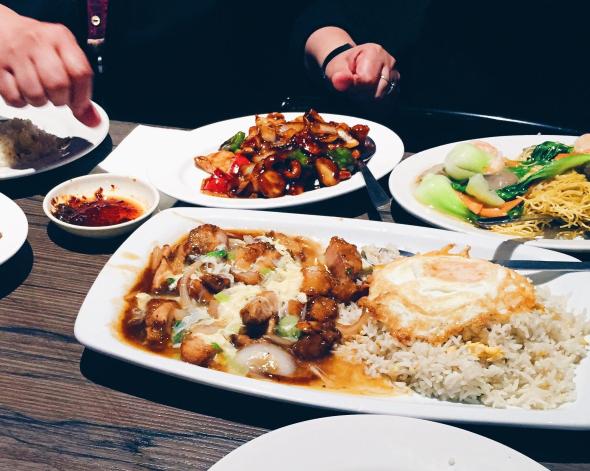
LSE Fried Rice (center) at Old Town 97 in London’s Chinatown, Source: Ryan Carey

Compared with some nearby upmarket Chinese restaurants the food in Old Town 97 is very reasonably priced. And there’s a twist: as well as generic (Anglo-) Cantonese dishes such as crispy duck, chicken and cashew nuts, and prawns in black bean sauce you will be able to eat an item that is not listed on the menu – “LSE Fried Rice”. It’s a real bargain at £9.50.

What can you expect? Well, LSE Fried Rice is served on a large, white oblong plate and consists of large portions of egg fried rice and fatty pork, cooked with honey and black pepper, and smothered with an eggy sauce. It’s then topped with a fried egg. I have to confess that having tried the dish it’s not to my taste – too oily, too fatty, too sweet. But then I don’t have a Cantonese or Hong Kong palate. Nevertheless, I can pretty much guarantee that if you do eat LSE Fried Rice in its entirety in the afternoon or evening you won’t experience hunger pangs until well into the following day. Continue reading “LSE fried rice is not for everyone”

anthro in the news 3/7/16

1.jpg
Trump declaring party loyalty in September 2015. Source: Wikipedia

Trump’s shallow celebrity culture

Paul Stoller, professor of anthropology at West Chester University in Pennsylvania, published an article in The Huffington Post asking how to explain the rise of Donald Trump: “As an anthropologist, I see the rise of Trump from a cultural vantage. He is the embodiment of celebrity culture — a world filled with glitz, fantasy and illusion. It is culture in which shallow perception is more valuable than deep insight. If you watch Donald Trump perform his shtick, you hear pretty much the same thing. Mr. Trump comes on stage, recites his poll numbers, insults his opponents, invites famous supporters to the stage to sing his praises, and then talks, without giving concrete factual examples, about how bad things are and how he’s the man to make things better.”


A three year old representing herself in court?

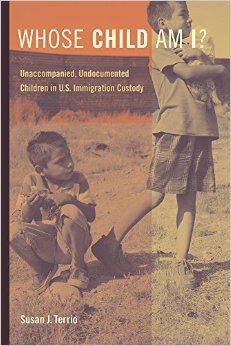
1As reported by The Seattle Times, a senior Justice Department official in the state of Washington is arguing that 3- and 4-year-olds can learn immigration law well enough to represent themselves in court, taking an unconventional position in a growing debate over whether immigrant children facing deportation are entitled to taxpayer-funded attorneys. The article quotes Susan J. Terrio, a Georgetown University anthropology professor, who said she has observed hundreds of children in various immigration court proceedings, many of whom couldn’t speak English, for her book Whose Child Am I? Unaccompanied, Undocumented Children in U.S. Immigration Custody.  Some were as young as 10 years old. They “were incredibly passive,” she said, and “they responded with monosyllabic answers…It didn’t appear that they understood anything at all.”

Continue reading “anthro in the news 3/7/16”

A Presidential Affair

This article first appeared on the Stanford University Press blog.

6a00d8342f027653ef01b7c813da9f970b-800wi

In January of 1998 news leaked that President Bill Clinton had engaged in ‘improper’ relations with White House intern Monica Lewinsky. People around the country debated whether a man with such moral character was fit to run the country. This carried over into Congressional hearings and Clinton eventually became the second president to be impeached, charged with perjury and obstruction of justice. He was later acquitted in the Senate, served out the rest of his term in the White House and went on to become a popular former president known for doing good around the world.

Continue reading “A Presidential Affair”

anthro in the news 2/29/16

1
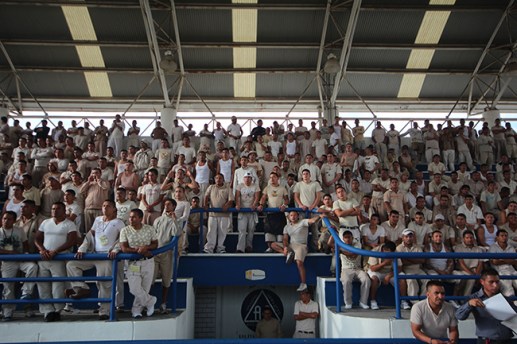
Prisoners attending a prison concert which is meant to be a positive activity for them. Source: Noisey

Inmates take control in many Mexican prisons

Quartz reported on the rising trend of prisoner gangs being in control of prisons in Mexico with a reported nearly 60 percent of state prisons under “inmate self-rule.” Inmate groups run many aspects of prison life, including family visits, the use of phones, and food. This situation is partly related to overcrowding of prisons which in turn is due to “preventive jailing,” according to social anthropologist Elena Azaola, a researcher at the Center for the Investigation and Higher Education of Social Anthropology. “There are many innocent people [in prison] who have still not been proven guilty,” said Azaola.


Sorry, sort of

1BBC News carried an article about the frequent use of the word “sorry” in the United Kingdom.  A recent survey of more than 1,000 people found that a person in the U.K. says “sorry” eight times a day on average. The article mentions the research of social anthropologist Kate Fox on English culture and language. In her book Watching the English, Fox describes experiments in which she deliberately bumped into hundreds of people in towns and cities across England. She encouraged colleagues to do the same abroad, for comparison. She found that around 80 percent of English victims said “sorry” even though the collisions were clearly Fox’s fault. Similar experiments in other countries yielded a similarly high use of “sorry” only in Japan.

[Blogger’s note: my, generally unpleasant, experiences on the DC metro system during rush area often involve me in scrum-like situations; in many instances, I say “sorry” when someone is pushing me or claiming my space in a line. I think I am actually asking them to apologize to me…they rarely do. In other words, my “sorry” means: “I am sorry that you are behaving so badly and sorry that you are not even apologizing to me for your bad behavior.” Sorry is complicated].

Continue reading “anthro in the news 2/29/16”

Anthropologist pens a best-seller in South Korea

Republished with permission from The University of California 

Sang-Hee-Lee-2015.jpg
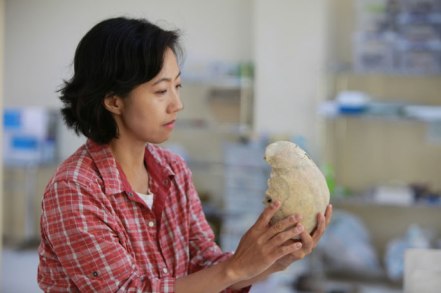
“A new book by paleoanthropologist Sang-Hee Lee about human evolution is a best-seller in South Korea.” Photo by Hee-Joong Lee. Source: University of California

Anyone who has ever wondered how humans became meat eaters, why so many adults are lactose-intolerant, or the physiological impacts of walking upright will find intriguing answers in a new book by University of California, Riverside, paleoanthropologist Sang-Hee Lee.

But you will have to wait a while for the English translation.

Written in Korean, “Human Origins” (ScienceBooks, Seoul, Korea) has captivated a broad spectrum of readers in South Korea and turned Lee into something of celebrity. Published in September 2015, “Human Origins” was named Science Book of the Year by SisaIN, an influential Korean media outlet, and has been on the respected Kyobo Bookstore’s Best Seller list since publication.

Although not written as a textbook, two Korean universities have adopted “Human Origins” for anthropology courses, an elementary school made it required reading for all sixth-graders, and mothers have brought their daughters to public lectures to meet and be photographed with Lee.

All of which has caught the UCR associate professor of anthropology by surprise.

“The response has been very rewarding,” Lee said. “For any of my published research papers, maybe 10 people will read them. With ‘Human Origins,’ people are writing about it on their blogs, and people coming to my talks have said it changed the way they look at life.” Continue reading “Anthropologist pens a best-seller in South Korea”

anthro in the news 2/22/16

anth1.jpg

Food trends in the UK

BBC News reported on results from a long-term study of changes in food consumption in the U.K. since the 1970s: Pasta is rising, tea is down, skim milk is up. The article quotes Emma Jayne Abbots, lecturer in social and cultural anthropology and heritage at the University of Wales Trinity Saint David, on milk. The decline of consumption of whole milk and the rise of skim milk suggests that public health messages had an impact on consumption. Abbots is quoted as saying: “Switching to skimmed milk was heavily promoted in the late 1990s as part of a focus on heart health and cholesterol levels…It wouldn’t have been due to cost as full fat is the same price.” [Blogger note: I await findings broken down by region, class, ethnicity, and gender].


Guns, freedom, and security on U.S. campuses

anth1
Logo of Students for Concealed Carry. Source: Wikipedia 

Alan Boraas, professor of anthropology at Kenai Peninsula College, published an op-ed in the Alaska daily News, addressing a bill introduced in the Alaskan Senate that would allow concealed weapons on all University of Alaska campuses. His motive is to counter the increase in campus shootings by allowing the student body and faculty to arm themselves. Another rationale is that prohibition of guns on campus is a violation of Second Amendment rights. Boraas writes: “We have created a false mythology that the gun is the answer. In the midst of an epidemic of intolerance, we will be better off trying to understand the causes and alternatives to violence rather than perpetuating the means to enact it.”

Continue reading “anthro in the news 2/22/16”

Nancy Scheper-Hughes shares reflections on the Catholic Church

epublished with permission from Berkeley News

Scheper-Hughes275B
Nancy Scheper-Hughes. Source: Berkeley News

In her research, writing and teaching, medical anthropologist Nancy Scheper-Hughes focuses especially on violence, suffering and premature death on the margins of the modern world. Best-known for her work on the global trade in human organs, she was invited to participate in a Vatican conference last summer on human trafficking. The experience brought the Berkeley professor — a lifelong Roman Catholic and sometime critic of the church — into close proximity with Pope Francis. Scheper-Hughes recently shared reflections on the pope and the state of the Catholic Church with Berkeley News.

Continue reading “Nancy Scheper-Hughes shares reflections on the Catholic Church”

anthro in the news 2/15/16

CDC_map_of_Zika_virus_distribution_as_of_15_January_2016
Countries that have past or current evidence of Zika virus transmission as of January 2016. Source: Wikipedia.

Zika spurs abortion rights debate in Latin America

The Washington Post carried an article about how the surge in microcephaly cases in Brazil has reignited a debate on abortion and the reproductive rights of women in Latin America. The article quotes Debora Diniz, professor of anthropology at the University of Brasilia who is spearheading the right-to-terminate campaign: “Women should not be forced to go through with a pregnancy where serious birth defects are still not fully known…They should not be penalized for a government’s failing policies because it has been negligent in the handling of an epidemic.” She said the campaign’s argument rests with women having the right to choose whether to have the child and the right to specialized prenatal care and social assistance if they choose to have the child.


Medical students without borders  diagnostics-161140_960_720

National Public Radio (U.S.) reported on the widespread health care roles of medical students from the U.S. who spend time in low-income countries as part of their training and who, while there, may carry out procedures for which they are not fully trained. Commentary from Melissa Melby, assistant professor of anthropology at the University of Delaware, commented in the piece, noting that at first she was pleased to hear a pre-med undergraduate excitedly describe participating in a brief medical outreach program in an impoverished Central American community — until the student proudly recounted how she had performed a pelvic exam on patients. Melby says: “No one here [in the United States] would allow you to perform medical procedures for which you’re not licensed…And that should not change when you cross international boundaries to developing countries.”

Continue reading “anthro in the news 2/15/16”

Best Cultural Anthropology Dissertations 2015

laurel-wreath-150577_960_720


Welcome to another year of my cultural anthropology dissertation picks. Every year my scanning of the year’s dissertations reveals different prominent themes, as informed by my search of Dissertation Abstracts International (which as I have noted in previous year’s posts, is anything but international; as far as I can tell, the scope is nearly 100 percent U.S.).

This year I was struck by the many studies related to food and to gender, and more studies focusing on race, education, and media. Health continues to be important as do rights and the rise of activism, both intersecting with race, class, gender, and ability.  The rise of food as a topic is particularly poignant given the recent death of Sidney Mintz. Mintz can well be considered the founder of “food anthropology” with his landmark publication of Sweetness and Power in 1985. He would no doubt have been pleased to see this trend and these many wonderful studies.

My usual search terms reflect the focus of the anthropologyworks blog: social diversity, social inequality, structural violence and resistance, and the importance of cultural anthropology in studying and revealing complex relations in all the above and offering findings that can help change the world for the better through their research, writing, teaching, advocacy, and activism.

The question of open access to these sources thus arises. As far as I can tell, of these 40 dissertations, only four are open access (Antoine, Donaldson, Oliveiria, and Richard); one is embargoed until April 30, 2017, after which it will presumably be open access.

Given the facts that many of these dissertations are the product of education at publicly funded institutions and that much of the research was funded by public money such as the National Science Foundation, it is difficult to understand why the public is excluded from accessing most of these works. I have no idea what kind of a deal ProQuest has with universities in the United States, but Proquest is likely making quite a nice profit from payment to access dissertations. Or, it may not be, since the price is so high in which case the Proquest arrangement serves to keep important new knowledge out of the public domain because of its pricing, just like the scholarly journals.  [Readers, if I am missing something important here, please let me know].

On a brighter note: Congratulations to these 40 dissertation writers. I wish you well and look forward to hearing about your accomplishments in the future.

See also the best cultural anthropology dissertations of 2009, 2010, 2011,20122013, and 2014.


Continue reading “Best Cultural Anthropology Dissertations 2015”