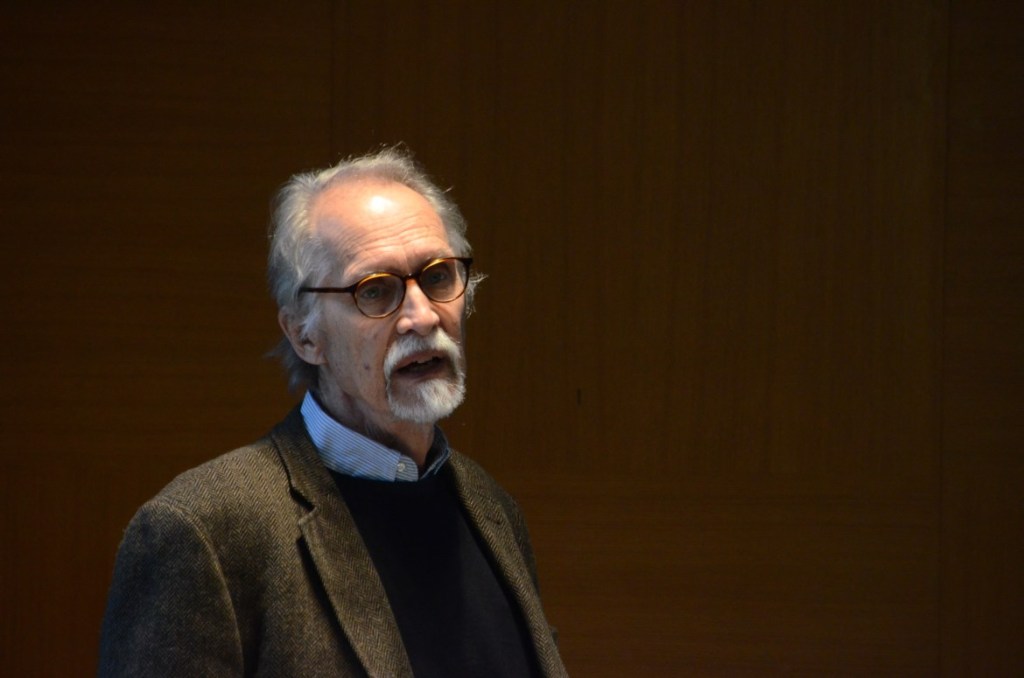
Prof. Emeritus Anthony Oliver-Smith, anthropology, University of Florida, explores ways to study natural disasters during a lecture on Wednesday. Vas Mathur / Sun Staff Photographer
Natural disasters must be studied and managed using a “holistic standpoint” that extends beyond an investigation of natural causes, said Prof. Emeritus Anthony Oliver-Smith, anthropology, University of Florida.
During the Wednesday lecture — part of the new Working Group on Disasters — Oliver-Smith explained that he and his team study the “social, economic, political, and cultural roots” of natural disasters to “take a much deeper look at what drives the construction of risks and of vulnerability and of disasters,” he said.
One of the most influential articles in anthropology must surely be Jared Diamond’s 1987 piece, “The Worse Mistake in the History of the Human Race.” Diamond offered the startling, at the time, insight that the emergence of agriculture brought with it, along with higher food yields, entrenched social inequality. Diamond does not state that the relationship between agriculture and inequality is unavoidable, but the implication is there. Now, David Graeber, professor of anthropology at the London School of Economics, and David Wengrow, professor of comparative archaeology in the Institute of Archaeology of University College London, have joined forces to ask if the emergence of agriculture necessarily involves social inequality. They write in Eurozine: “For centuries, we have been telling ourselves a simple story about the origins of social inequality. For most of their history, humans lived in tiny egalitarian bands of hunter-gatherers. Then came farming, which brought with it private property, and then the rise of cities which meant the emergence of civilization properly speaking…Almost everyone knows this story in its broadest outlines. Since at least the days of Jean-Jacques Rousseau, it has framed what we think the overall shape and direction of human history to be. This is important because the narrative also defines our sense of political possibility. Most see civilization, hence inequality, as a tragic necessity. Some dream of returning to a past utopia, of finding an industrial equivalent to ‘primitive communism’, or even, in extreme cases, of destroying everything, and going back to being foragers again. But no one challenges the basic structure of the story. There is a fundamental problem with this narrative. It isn’t true.”
being African in China
Sixth Tone (Shanghai) carried an interview with American anthropologist Gordon Mathews of the Chinese University of Hong Kong. He discusses the research findings in his book, The World in Guangzhou: Africans and Other Foreigners in South China’s Global Marketplace, focusing on the business dealings of Guangzhou’s African traders, their relationships with local people, and their future in China. The African community in Guangzhou has changed the social fabric of the city. The mostly male entrepreneurs have started relationships with Chinese women, and some are now raising mixed-race children. Despite the close ties between Chinese and Africans in the city, racism persists, and racial awareness in the nation generally remains low. “Chinese see somebody like me, and they’re aware of whiteness, but they are simply not aware of Africans, South Asians, and these other groups,” Mathews says.
Genevieve Nnaji is a top Nigerian actor. Credit: FEVA TV.
Nollywood-Bollywood relations
An article in The Telegraph (India) offers insights about the relations between Mumbai’s Bollywood film industry and its sister industry in Nigeria, Nollywood. Nollywood is the world’s second largest film producer after Bollywood. The article includes commentary from Brian Larkin, professor of anthropology at Columbia University and author of the book, Bollywood Comes to Nigeria:“After Maine Pyar Kiya was released, one friend told me it was his favourite movie: ‘I liked the film…’ because it taught me about the world’… The style of the movies and plots deal with the problem of how to modernise while preserving traditional values – not usually a narrative theme in a Jean-Claude Van Damme or Steven Spielberg movie.” However, Larkin also points out that the Nigerian audience is not happy with the contemporary “westernised content” of Hindi films.
global and local politics vs. cultural heritage
The shrine of Mauj Darya in Lahore, one of the threatened sites. Credit: Wikimedia Commons
National Public Radio (U.S.) reported on a China-financed city rail system in historic Lahore, Pakistan. Activists objecting to the construction say that the method used to dig the train route is tearing through Lahore’s dense urban fabric rather than spending more time and money to build the system underground. “It has become an election stunt,” said Nadeem Omar Tarar, an anthropologist and director of the National College of Arts in Lahore who has written against the new rail line. The project is being executed in a short time and with immediate positive visibility, he said, in order to complete it before national elections, expected this summer. Mega transport projects are a signature of the Pakistan Muslim League-Nawaz, the conservative party that rules both the federal government and Punjab state, whose capital is Lahore.
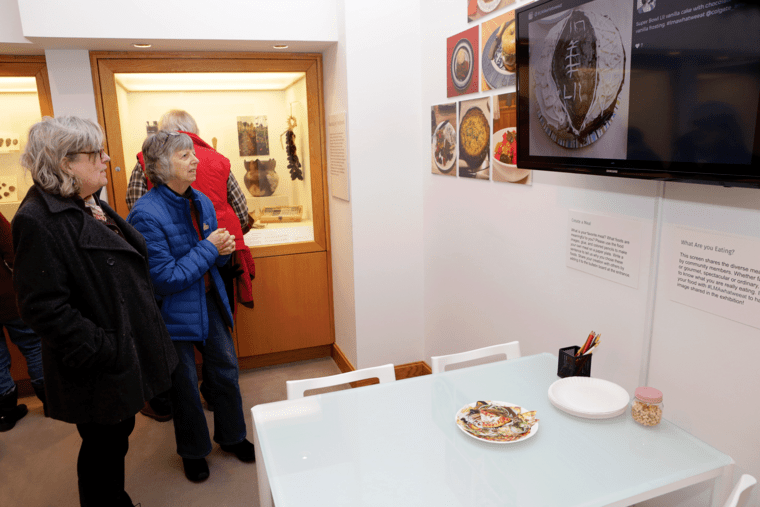
Gerard H.Gaskin; Food For Thought: Viewers examine a detailed exhibit on the culture of food and the way humans interact with it.
The Longyear Museum of Anthropology officially opened the exhibit titled “Setting the Table: Food, Place, Community” on Thursday, February 8 at 4:30 p.m. The turnout was impressive, with students, professors, and members of the Hamilton community showing up to appreciate art and discuss the universally shared impact of food on community. In the spirit of appreciating food, refreshments were served at the exhibit’s opening, including cupcakes from Flour and Salt.
The exhibit draws inspiration from Colgate University faculty and students, including students enrolled in the Fall 2017 course entitled “Food” with Associate Professor of Sociology Christopher Henke.
Gowns made from recycled materials. Credit: James Wendlinger/The South China Morning Post
activist anthropology meets sustainable fashion
An article in The South China Morning Post reported on Sustainable Sunday Couture in Hong Kong which features Filipino domestic workers as models and dresses made from recycled materials. In addition to an exhibition of gowns at the Philippine consulate in Admiralty, the organizers of Sustainable Sunday Couture decided to use the city as a promotional catwalk. Julie Ham, the project coordinator and an assistant professor of sociology at the University of Hong Kong, and Chen Ju-chen, lecturer in anthropology at Chinese University who specializes in Filipino beauty pageants, are working with a group of volunteer models, make-up artists, dressers, and photographers for the project.
we have to try
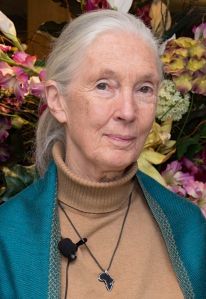
Jane Goodall, 2015. Credit: Wikipedia
The Huffington Post published an article about Dame Jane Goodall, as she nears her 84th birthday. The primatologist is angry that humanity has killed thousands of orangutans and frustrated that we, in our quest to grow and conquer, have changed the planet forever: “Goodness, if we could spend the same money learning about the world that we spend on wars…. We’re so stupid aren’t we? We seem to have lost the connection between our clever brains and our hearts.” But she has hope: “We truly have harmed the world, but I still think there’s a window of time for us to try and turn things around. It can never get back to the way it was … but we have to try.” Goodall is one of the most recognized scientists of our time. She was one of several pioneering women in the 1960s who forged a pathway through lecture halls filled with men. Her research on chimpanzees changed the understanding of animal intelligence and human evolution.
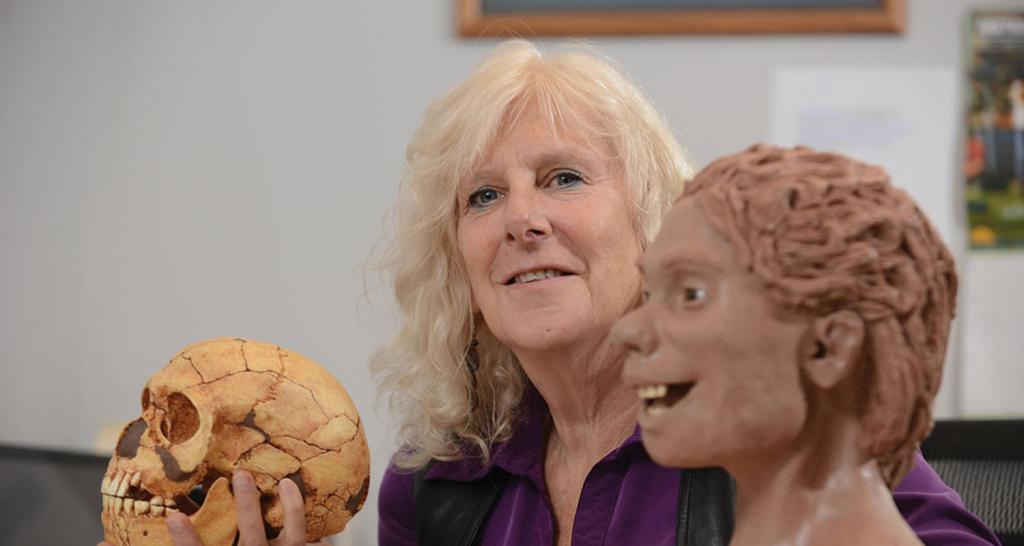
Linda Spurlock is a professor in the department of Anthropology on the weekdays, but in her down time, she does work that takes her mind out of textbooks and into the medical examiner’s office.
Spurlock is a consultant for the Cuyahoga County Medical Examiner’s office as a biological anthropologist and facial reconstruction artist. She helps reconstruct skeletons and draw sketches of what the people would have looked like before death.
A view of the U.S Congress building from Garfield Circle. Credit: Matthew Straubmuller/Flickr
speaking truth to power
STAT interviewed Kathryn Clancy, professor of anthropology at the University of Illinois, about her activist work in addressing sexual harassment in science in the U.S. Last week, she took her findings to the U.S. Congress. Clancy has studied the many ways sexual harassment pervades science, from university research labs to field sites. She has surveyed researchers about their experiences of sexual harassment and assault during scientific field work. She has called out universities, which she says have not done enough to create change in research labs, to her thousands of Twitter followers. In the interview, she comments: “I have some thoughts I’m sharing in terms of things that I think we need more funding for and mandates that Congress could think about to improve the situation. We don’t need more unfunded mandates. Universities, if they’re going to start doing things right, they need money to do it right. If Congress really wants to eliminate sexual harassment, they have to figure out how to fund science better. [That] means creating some targeted funding initiatives toward empirically looking at how to reduce sexual harassment in the workplace. That would allow us to do a better job thinking about designing interventions.”
keep your eyes on guns
Credit: meketrefe/Pixabay
The Tri-City Herald (Washington State) published a commentary by Mark Mansperger, associate professor of anthropology and world civilizations at Washington State University-Tri-Cities. He writes: “Instead of taking a long-term strategy of turning our schools and other public places into fortresses, or implementing measures as senseless as arming teachers, let’s face the obvious and travel the path that rational people have done in most other advanced nations: Take meaningful steps to reduce the availability of guns.”
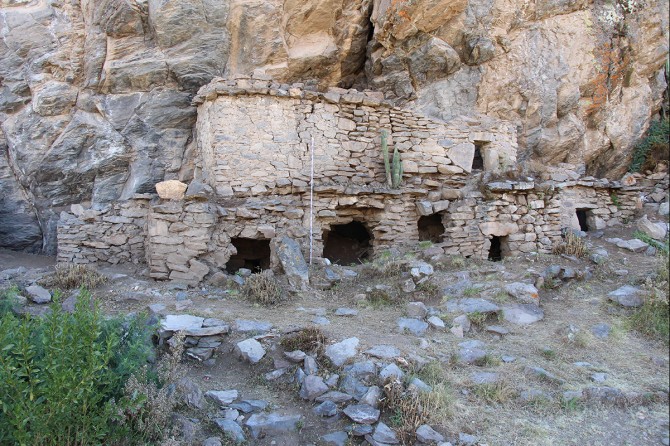
Above-ground tombs at the cemetery site of Yuraq Qaqa (Colca Valley, Peru).
The idea of binding and reshaping a baby’s head may make today’s parents cringe, but for families in the Andes between 1100-1450, cranial modification was all the rage.
Like Chinese foot binding, the practice may have been a marker of group identity. Its period of popularity in what is now Peru, before the expansion of the Inca empire, was marked by political upheaval, ecological stress and the emergence of new cultural practices. In a study published in the February edition of Current Anthropology, Matthew Velasco, assistant professor of anthropology, explores how head-shaping practices may have enabled political solidarity while furtheringsocial inequalityin the region.
Panorama of Bois Cheri Tea Plantation in Mauritius. Credit: Vincent Lim Show Chen/Flickr
happy 50th birthday, Mauritius
African Arguments published a piece by Sean Carey, honorary senior research fellow in the School of Social Sciences at the University of Manchester and anthropologyworks contributor. He writes: “The story of how Mauritius defied the gloomy predictions of its fate is well told. A few years before independence in 1968, Nobel-prize-winning economist James Meade wrote the little island in the Indian Ocean off as a basket case. A few years after independence, writer V. S. Naipaul dismissed the nation as an ‘overcrowded barracoon’. Yet Mauritius proved them wrong and went on to become one of Africa’s most lauded nations. It regularly tops indices for political freedoms, rule of law and human development on the continent. It has had ten competitive elections and seven peaceful transfers of power. And it is frequently held up as an exemplar of political stability and cohesion, containing within it several ethnic groups – including Hindus, Muslims, Afro-Creoles, and Sino- and Franco-Mauritius – all living together in relative harmony.” So there.
exodus from Puerto Rico
Change-of-address requests to the U.S. Postal Service from Puerto Rico and the US Virgin Islands to locations in the states and Washington, DC. Credit: CNN analysis, U.S. Postal Service/CNN
CNN reported on the heavy flow of migration from Puerto Rico to the United States following Hurricane Maria.Before the hurricane hit Puerto Rico on September 20, there already was an unprecedented migration from the Caribbean island to the mainland United States, at least in part because of Puerto Rico’s financial crisis. Academics are using words such as “exodus” and “stampede” to describe the massive post-hurricane outflow of people. CNN quotes Jorge Duany, professor of anthropology at Florida International University: “This is the greatest migration ever from Puerto Rico since records have been taken.”
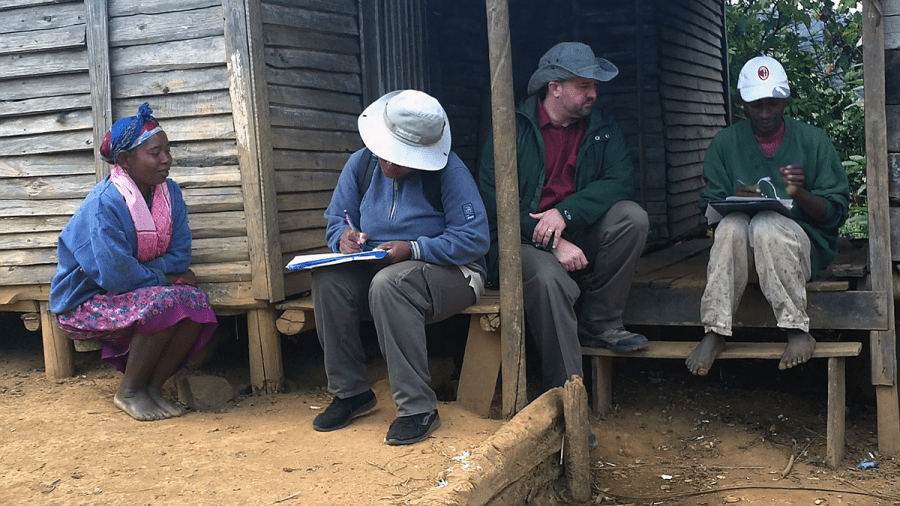
Professor Douglas Hume with his research assistants in Mahatsara, Madagascar, in summer 2012; they were conducting an ethnographic interview with an informant (not pictured). Provided by Douglas Hume
The act of caring for yourself, or self-care, varies from culture to culture. People all across the world demonstrate care for themselves based on their needs or the needs of their larger community.
According to Dr. Douglas Hume, department chair of sociology, anthropology and philosophy, the Malagasy— or people native to Madagascar—care for others in the community and, in turn, find that they are able to care for themselves.


 Sixth Tone (Shanghai)






 anthropologyworks