
Gender Across Borders Women & Peacebuilding in the Middle East Series is looking for articles that explore the roles women should play in bringing peace to the Middle East.
Deadline to submit articles is Tuesday, Jan 25
Gender Across Borders Women & Peacebuilding in the Middle East Series is looking for articles that explore the roles women should play in bringing peace to the Middle East.
Deadline to submit articles is Tuesday, Jan 25
NOTE: These two events have been rescheduled for Friday, March 4. The workshop will be at 3pm and the performance will be at 6:30pm in the same location.
Gina Athena Ulysse, Wesleyan University Associate Professor of Anthropology, African Studies, Environmental Studies, and Feminist, Gender, and Sexuality Studies and Inaugural Fellow in the College of the Environment will be holding two events at GW – a workshop in the morning followed by a presentation in the evening. See below for details.
Because When God is Too Busy: Haiti, Me and THE WORLD

When: Friday, January 28, 5 – 6 pm
Where: 1957 E Street NW, 6th floor, Lindner Family Commons
The Elliott School of International Affairs
The George Washington University
Free and open to the public. Please RSVP here
Professor Ulysse’s training as a cultural anthropologist informs this dramatic monologue about how Haiti’s past occupies its present. She weaves history, personal narrative, theory, and statistics in spoken-word with Vodou chants to reflect and deconstruct childhood memories, social (in)justice, spirituality, and the dehumanization of Haitians. Professor Ulysse is currently working on a montage ethnography, C’est Mon Devoir (It is My Duty): Stories of Civic Engagement, Urban Degradation and the Earthquake in Haiti.
Alter(ed)natives
When: Friday, January 28, 11:00am – 12:30pm
Where: 1957 E Street NW, 6th floor, Lindner Family Commons
The Elliott School of International Affairs
The George Washington University
Free and open to the public. Please RSVP here
Professor Ulysse explores the border zones between ethnography and performance, and discusses as she puts it, “why we need the visceral in the structural” to participate in the decolonizing project of accessing and reclaiming a full subject.
Both of these events are sponsored by the CIGA Seminar Series, part of the Elliott School of International Affairs and its Institute of Global and International Studies
• In Sudan: the Crusades still?
Cultural anthropologist and Africa scholar Mahmood Mamdani says that the creation of a new Western sanctioned nation-state in southern Sudan — a religiously and politically contested area at the edge of the Arab-Muslim world — is proof that the jihadis are fighting an international system bent on stemming the spread of Islam. Mamdani is a professor at Columbia University and author, most recently, of Saviors and Survivors: Darfur, Politics, and the War on Terror.
• So you think you deserve an A in this course?
In her letter to the editor of the NYT, Carol Delaney questions proposed bills in the U.S. that would allow students and professors to take guns to campus. “What professor won’t worry about giving failing grades when an angry student can march into [or her] his office and shoot him [or her]?” Delaney is emerita professor of cultural anthropology at Stanford University.
• The economics, not erotics, of the bound female foot
A Wall Street Journal article on the end of female footbinding in China includes insights from two Stanford University anthropologists: Melissa Brown, assistant professor of cultural anthropology and Hill Gates, emerita professor of anthropological sciences. Both point to the economic factors underlying the practice. In the words of Brown: “How do you get a naturally healthy 6-year-old to sit for hours? You break her feet.” The practice, in this view, forced girls and women to work at home, spinning yarn, processing tea, and shucking oysters.
• Culture through cooking
A WaPo article about Diana Kennedy’s magisterial new book on Oaxacan cuisine conveys her message to everyone that they should learn about world cultures through their food. She also specifically exhorts anthropologists to learn to cook. Blogger’s note: Whether anthropologists and people with an anthropological heart are following Kennedy’s advice or marching to their own drum, it is remarkable how many top chefs have an anthropology background including Kennedy’s nemesis, Rick Bayless.
• UBC Museum of Anthropology cancels exhibit on disappeared women
The University of British Columbia’s Museum of Anthropology canceled an exhibit that was supposed to open in February featuring 69 massive portraits of women who vanished from Vancouver’s Downtown Eastside. The museum director said that the exhibit was not likely to produce the kind of positive dialogue originally intended.
• Rise in juvenile delinquency in Brunei
The rise in the number of young offenders in Brunei in recent years may be related to rising birth rates and increased vigilance by law enforcement, said Professor Frank Fanselow, head of the Sociology-Anthropology programme at the Universiti Brunei Darussalam. Overall rates of juvenile delinquency in Brunei are low compared to rates worldwide.

Tunisia burst onto the news scene with its recent political upheaval and ousting of the president (pictured).
What do cultural anthropologists know and write about Tunisian society?
I do not include a bibliography with this post, but will try to do so later. Instead, I simply point you to a fascinating dissertation by Rodney Collins, submitted in 2009 at Columbia University, on masculinity of working class men in Tunis, coffee drinking and the state.
Erica James, associate professor of anthropology at Massachusetts Institute of Technology, who spoke on a panel I moderated last January, has generously allowed AnthropologyWorks to post the preface to her important, new book, Democratic Insecurities: Violence, Trauma, and Intervention in Haiti (University of California Press).
Preface to “Democratic Insecurities: Violence, Trauma, and Intervention in Haiti” by Erica James (MIT): Cal… http://d1.scribdassets.com/ScribdViewer.swf?document_id=46742018&access_key=key-1zluwxau9z7z3vmku311&page=1&viewMode=list
Tourism, Heritage, and Sacred Space in China
Robert J. Shepherd, Assistant Professor of Anthropology, Honors and International Affairs
When: Wednesday, January 19, 2011 from 12:30 – 1:45 PM
Where: Lindner Family Commons, Room 602
1957 E Street, NW
The Elliott School of International Affairs
George Washington University
Please RSVP here
Although the Chinese government has become one of the most prominent supporters of the UNESCO-led World Heritage movement, the economic, political and bureaucratic reasons for this are often at cross-purposes with the preservationist goals of UNESCO. This presentation will examine the relationship between heritage projects, tourism, and economic development in China by focusing on the Buddhist pilgrimage destination of Mount Wutai, Shanxi Province, which was added to the UNESCO World Heritage list in 2009. Professor Shepherd’s work on tourism, cultural heritage issues, and the side effects of market changes in China has appeared in Southeast Asia Research, Consumption, Markets, and Culture, the International Journal of Cultural Studies, and the Journal of Contemporary Asia, among other publications. His book, When Culture Goes to the Market: The Politics of Space, Place and Identity in an Urban Marketplace (Peter Lang) was published in 2008.
Sponsored by the Sigur Center for Asian Studies
The Case of Organ Transplantation in Egypt: Reassessing Bioethics and Contemporary Islamic Thought
Sherine Hamdy, Kutayba Alghanim Assistant Professor of Social Sciences and Assistant Professor of Anthropology, Brown University; author, Our Bodies Belong to God: Bioethics, Islam, and Organ Transplantation
When: Wednesday, January 19, 2011 from 6:00 – 7:30 PM
Where: Lindner Family Commons, Room 602
1957 E Street, NW
Elliott School of International Affairs
George Washington University
Please RSVP here
Our Bodies Belong to God centers on why Egyptians were largely reluctant to accept transplant medicine. In the print news, on state television, radio, film, and in religious sermons, opinions clashed over this life-saving but death-ridden medical practice. Egypt’s organ transplant debate immediately presents a number of puzzles. Why did organ transplantation in particular, as opposed to other biotechnological practices, set off such a heated debate? Why was Egypt the pioneering Arab Muslim country in the field of transplant medicine, and yet the most resistant to passing a law?
• This mine is my mine
China is pushing to establish its first wholly owned substantial mining project in Australia, in the Weld Range in the western part of the country. The Weld Range is rich in iron ore. It is also the home of Wilge Mia, the world’s oldest known continuing mining operation. For more than 30,000 years, its ochre has been mined and traded. The Australian government has told the Chinese government that it is welcome to develop its projects as long as they do not take over existing producers. Traditional owners are staking a claim to Wilge Mia and other Weld Range sites. They have engaged the Eureka Archaeological Research and Consulting Centre, a University of Western Australia-affiliated anthropology service, to assess the cultural value of the sites. They are also working with Terra Rosa Cultural Resource Management, a private group, to help define site boundaries and prevent their destruction.
• The healers: Bostonians of the year
The Boston Globe named three people Bostonians of the year, and they are all involved in founding Partners in Health in rural Haiti to deliver health care to the poor. They are Paul Farmer, Ophelia Dahl, and Louise Ivers. Since the 2010 earthquake, PIH is also working to heal the local and global health system. Blogger’s note: Yes, you can make a difference, it won’t be easy, and anthro/public health is an effective combo.
• A doctor without borders
The Sunday Times (London) carried a review of Tracy Kidder’s book, Mountains beyond Mountains: The Quest of Dr. Paul Farmer, A Man Who Would Cure the World, which was published in 2003. Eight years later, Partners in Health in Haiti has even more work on its hands, has expanded its clinics, and now incorporates micro-lending services at clinics. Kidder’s documentary of Paul Farmer continues to inspire readers around the world, and the “Paul Farmer effect” endures.
• Survival: learning from Irish Travellers
Dennis Foley, cultural anthropologist at Newcastle University in Australia, will spend several months in Ireland studying the challenges that the Travellers face and comparisons with Australian Aborigines in terms of mobile survival patterns.
Guest post by Charles Fruehling Springwood
Worldwide, perhaps a billion guns? Where do guns come from? Who makes them? Who sells them? What kinds of guns do Colombian drug lords buy? Marxist guerillas in the Philippines? A middle-class doctor in Finland, where some 15 million Fins own guns? A poor farmer in southern Mexico? An American situated on the U.S.-Mexican border, sporting binoculars and a Glock pistol, scanning the horizon from atop his Winnebago RV? Who gives up or gives away guns?

Questions such as these have concerned me for the past year, as I have conducted ethnographic research among gun-owners in the Midwestern U.S. In particular, I have been drawn to the prevailing meanings that highlight a growing movement encouraging the public “open carry” of pistols in addition to enhancing the right to carry concealed weapons.
Why do a growing number of gun owners in the U.S. seek to naturalize the visibility of a gun on a person in a growing number of public spaces? In unpacking this ‘penchant to pack,’ I have zeroed in on the desires for guns and how this fascination turns on the significance of the relationship of embodiment a gun has with its user, especially when the user “wears” her or his weapon? As cultural things — both material and semiotic in form — do guns become less an instrument of the mind and more a part of the mind and an extension of the self?
All of these questions assumed a new kind of urgency this weekend, when Jared Loughner attempted to assassinate Arizona Rep. Gabrielle Giffords (D-Ariz.), killing six bystanders and wounding 13 other people.
Arizona boasts one of the most liberal environments for gun ownership and usage, commonly allowing citizens to openly and publically carry guns on their person. I do not know if Loughner was exercising his right to open carry as he approached the Giffords public meet and greet event at the supermarket, but the gun he used for commit this horrific act was legally his.
As an anthropologist, I am especially interested in the “conditions of possibility” that surround events such as this shooting – those discourses, images, and actions – that fall short of causing such tragedies but clearly animate them and provide cultural scripts for their unfolding.
Continue reading “Guns don’t kill people: Bullets kill people”
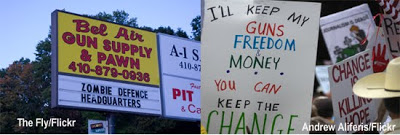
Archaeologists spend a lot of time analyzing weapons of our prehistoric past. Cultural anthropologists are more likely to study bananas, cars and wedding dress style. Commodity studies in cultural anthropology rarely address weapons.
No doubt one reason is that they are hard to study — people are less likely to want to share stories about their weapons than their cars or favorite food. A few brave anthropologists have ventured into gun studies. A few others provide contextual insights into U.S. culture and links to the love of guns among so many people.
Here are some recent sources (most are not publicly accessible, with my apologies) by anthropologists:
Journal articles from my AnthroPlus search via my university library:
 anthropologyworks