Anthro in the news 1/27/14

  • From Davos, with anthropology
    Jim Yong Kim. Photograph: Enrique Castro-Mendivil/Reuters

Several media sources connected with Jim Yong Kim during this year’s World Economic Forum in Davos, Switzerland. According to coverage from CNN in Davos, World Bank president and medical anthropologist Jim Yong Kim has called for a concerted global effort to help Syria’s refugees, saying the international community has failed to formulate an adequate response to a “humanitarian crisis of enormous proportions…”

CNBC also reports on Kim and his view that that Southern Europe is facing the risk of losing a whole generation to chronic unemployment: “Among the things that we’re especially concerned about are the extremely high rates of youth unemployment because that has implications not just for the short term, but especially in the medium to long term.”

The Huffington Post presents Kim’s views on pollution, noting that he has called on global leaders to address climate change: “This is the year to take action. There are no excuses.” His clarion call comes shortly after a WEF report revealed that failure to arrest, and adapt to global warming is one the greatest threats facing our planet.

  • More about Jim Kim: The World Bank and big dam problems

Chixoy Dam.

The Washington Post, in its business section, published an article about the U.S. pushing for greater oversight of the World Bank as it pushes ahead with its new plan to solve extreme poverty through major hydro-elective projects: “In a blow to plans set by World Bank President Jim Yong Kim, the United States recently approved an appropriations bill that orders the bank’s U.S. board member to vote against any major hydroelectric project — a type of development that has been a source of local land conflicts and controversies throughout the bank’s history including the ongoing case of the displacements and human rights abuses related to the Chixoy dam in Guatemala. The measure also demands that the organization undertake ‘independent outside evaluations’ of all of its lending.” [Blogger’s note: In October, CIGA hosted a talk at the Elliott School by Barbara Rose Johnston who is a leading advocate and expert on the Chixoy dam project and the human rights abuses it involved].

  • Forcing women into marriage

An article in Al Jazeera on forced marriage among Hindus, Muslims, and Jews around the world, mentions the work of cultural anthropologist Ric Curtis of John Jay College of Criminal Justice. Curtis, along with some of his students, interviewed 100 students at several City University of New York campuses, focusing on students from Middle Eastern, North African and Southeast Asian (MENASA) countries to try to determine the extent of forced marriage, an issue he suspects is more widespread than what the research shows: “All that we are seeing is the ugly tip of the iceberg, but how much more is there?”

Continue reading “Anthro in the news 1/27/14”

Anthro in the news 1/21/13

• Revenge against French fueling conflict in Mali and Algeria

Mali. Source: CIA Factbook
Mali. Source: CIA Factbook. The contested region is in the north.

An article in The Star (Toronto) about how Mali’s conflict spilled across its borders into Algeria this past week quoted Bruce Whitehouse, a cultural anthropology professor at Lehigh University, and a Fulbright scholar who has lived in Mali.

He says: “They want to get back at the French desperately and they have a history of carrying out a tit-for-tat response when it comes to French intervention …They clearly want to portray what they’re doing as a direct and balanced response to what’s being directed against them … It will bring a lot more pressure from the United States and European governments to get involved … (It) might be a good thing from Mali’s point of view. Algeria has what’s reckoned to be the most capable military there and they have experience and they know the terrain.”

• Mali: Where music is dangerous

An opinion piece in the Cyprus Mail says that Islamic extremism is stopping the music in Mali:

Talking Timbuktu
Talking Timbuktu/Amazon.com

“We all have a favourite album. Mine is Talking Timbuktu, the collaboration between the great Malian musician Ali Farka Tourι and Ry Cooder. Arguably it’s some of the best guitar playing you’ll ever hear. Ali died in 2006, but his son Vieux carries the sound onward, that curious mix of African soul and heart with a blues base.

“So it was with utter horror that I heard Lucy Durán, who hosts the BBC programme World Routes and teaches the anthropology of world music at SOAS (University of London), say in an emotional comment this week that one of the terrible side effects of the extreme Islamic fundamentalism now invading northern Mali is the silencing of music. Outlawed under Sharia law, all instruments, radio, CD players have been destroyed, and as Lucy chillingly said, those seen playing guitars were threatened with having their fingers cut off.”

Continue reading “Anthro in the news 1/21/13”

The health of the U.K. high street

By contributor Sean Carey

So now we know. Mary Portas, the high profile retail expert commissioned by U.K. Prime Minister David Cameron and his deputy Nick Clegg, has just issued her review of the high street after a seven-month consultation. Portas became a household name after appearing in the BBC TV show Mary Queen of Shops in 2007.

She issued a grim warning that around a third of all U.K. high streets are “degenerating or failing.” Three reasons for the decline are:

• the expansion of out-of-town shopping parks by about one-third over the last decade, which has acted as a magnet for consumers keen to avail themselves of free parking;

• the expansion of the major supermarkets into areas like pharmacy and optical services, which were traditionally the preserve of the high street and town center.

• and the growth in Internet shopping.

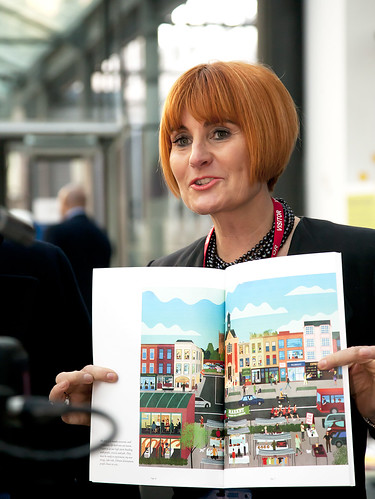
Mary Portas, pictured here at the Department for Business, Innovation & Skills - has published her review of the future of high street. December 2011. Flickr/bisgovuk
With a “Town Centre First” strategy, Mary Portas, the coalition government’s retail czar makes 28 recommendations, including plans for a “National Market Day”, which would allow budding entrepreneurs to try out a retail concept with the buying public (“Why not rent out tables for a tenner and get everyone involved?”), a relaxation of the rules making it easy to set up street stalls, mentoring of small shopkeepers by larger retailers, and an army of volunteer “Town Rangers” to protect high street areas from anti-social behavior and shoplifting.

Portas wants betting shops to be classified separately by planning authorities so that numbers can be monitored more readily. “I believe the influx of betting shops, often into more deprived areas, is blighting our high streets,” she said. Other ideas include transforming long-term unused retail spaces into gyms, bingo halls and crèches.

As one might expect, the responses are mixed.

Some are very positive. For example, James Daunt, CEO of Waterstone’s, a predominantly high street-based book chain, who recently denounced online retail giant Amazon as a “ruthless, money-making devil” was clearly voting for his own tribe when he commented: “I’ve always believed that booksellers should be at the heart of the communities they serve, and that is exactly what we are doing with Waterstone’s. Mary Portas obviously has a similar, strongly held philosophy and her report holds much sense.”

Others like Evening Standard journalist Anthony Hilton are more critical: “Tomorrow belongs to the internet. Web-based purchases are growing by the day. The car is being displaced by the armchair. Retail parks are struggling, let alone the high street.”

Oxford High Street. Flickr/FlickrDelusions
Somewhere in the middle are the puzzled retail experts, who are trying to work out the dynamics of the interface between physical shopping experiences and purchases made through the Internet. “While there is much discussion of the death of the high street in recent years, ultimately, people want to touch and see things and this is borne out by the growth of Apple’s retail outlets across the UK, for example,” said Anton Gething, co-founder and product director at social commerce experts nToklo. He went on to cite the physical eBay store in central London as well as an interesting experiment by the House of Fraser store in Aberdeen “that has no products, simply free coffee and assistants with iPads.”

Other commentators think that worrying about the fate of the High Street is a waste of time. For example, Margareta Pagano, business editor of The Independent on Sunday, anticipated Mary Portas’s report by suggesting that the proper focus should be on high-value “i-street” employment rather than the defence of traditional, physical retailing space. She argues: “What’s more, the U.K. is actually one of the most sophisticated markets in the world for online retailing, leading the way with the technology as well as the software design and distribution; so we shouldn’t be too worried by the switch from bricks and mortar to online as it’s also creating new jobs.”

The Prime Minister, who accompanied Mary Portas on a walkabout of Camden Markets in north London on Tuesday, announced that the government will respond to the high street review next spring rather than make an instant judgment on its virtues. This is an astute move in a politically fluid situation caused by a sharp disagreement between the two coalition partners –- Cameron’s Conservatives and Clegg’s Liberal Democrats — over Britain’s use of the veto at the recent EU summit on economic integration. The feeling is that the rupture in relationship makes a general election in the U.K. a genuine possibility in the not too distant future.

David Cameron would certainly not want to make an enemy of a high profile TV personality possessing considerable cultural capital if the campaign trail beckons.

See Sean’s article, “What Westfield London reveals about the future of shopping”, in the New Statesmen