
By contributor Sean Carey
“My congratulations to the encampment outside St Paul’s for sending almost the entire British establishment into a tizzy every bit as confused as some of the protesters themselves,” writes Andrew Rawnsley in the Observer. The left-leaning newspaper’s award-winning chief political commentator goes on to express his amazement about the massive impact a small group of young, middle-class men and women equipped with nylon tents and hastily-made banners can have on the country as part of an anti-capitalist protest which has now spread to around 900 cities worldwide.
He continues:
“You have brought a frown to the forehead of the prime minister, hyperbolic froth to the lips of Boris Johnson [the Mayor of London], attracted the disdain of a pomposity of pontificators and thrown the state church into something approaching a constitutional crisis. It is twisted knickers time among pundits, politicians and prelates.” Perhaps mindful that Hallow’een was imminent, Rawnsley mischievously adds: “Imagine what might be achieved if this movement can get really serious and starts taking its protest more directly to the avaricious bankers, corporate larcenists and crony capitalists who are the central source of their discontent with how we live now.”
Were the various beneficiaries of global capitalism identified by Rawnsley quaking in their boots or enjoying a nice round of golf before a traditional Sunday lunch somewhere in the Home Counties on a pleasant autumnal day? Despite the protests, life probably went on as usual. Nevertheless, as Rawnsley rightly observes, something is going on, but what exactly?
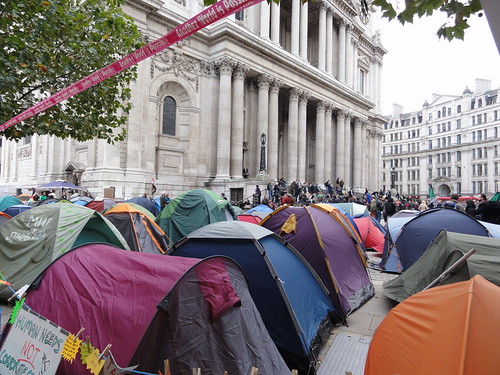
Another intriguing question is why the encampment in the churchyard of St Paul’s is causing so many social actors so many problems and causing the chattering classes to chatter quite so much.
Believe me, the U.K. mainstream media — newspapers, radio and television and its digital equivalent blogs, Facebook, YouTube and especially twitter — are full of stories about the encampment outside the Church of England cathedral, designed by Sir Christopher Wren after the great Fire of London, and seat of the Bishop of London.
Last Thursday the current occupant, Dr Richard Chartres, who has been at the receiving end of criticisms from those on both sides of the argument, felt obliged to say: “The Church’s own role in this has now inevitably come under scrutiny. Calls for the camp to disband peacefully have been deliberately interpreted as taking the side of Mammon, which is simply not the case. The original purpose of the protests, to shine a light on issues such as corporate greed and executive pay, has been all but extinguished – yet these are issues that the St Paul’s Institute has taken to heart and has been engaged in examining.”
Continue reading “St. Paul’s anti-capitalist protest: Location, location, location”
 anthropologyworks