
by Barbara Miller
A feature of the Bulletin of the World Health Organization is called “Lessons from the Field.” This month’s features a report by Sabine Gabrysch and colleagues on a successful case of “cultural adaptation of birthing services” in rural Ayacucho, Peru. The project took two years and included detailed formative research, design of a new culturally adapted model, implementation, and evaluation of implementation and impact.
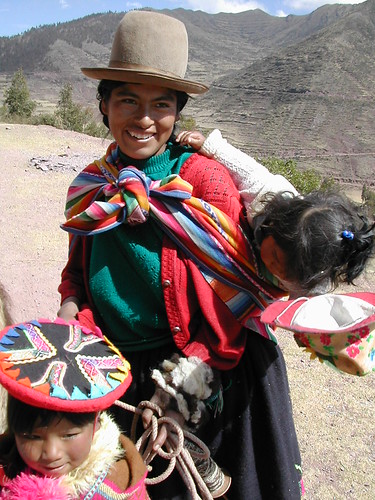 The problem was that birthing clinics, based on a Western model, were underutilized by women in the region for deliveries. After the “culturally adapted” birthing centers were provided, the number of births at the centers increased. The assumption is that maternal and child health will be improved by use of the center for birthing.
The increased number of births at the “culturally adapted” centers is attributed to a participatory approach which involved asking indigenous women about their views of what the center should provide in terms of services. They want staff to be able to speak Quechua. They want to be able to deliver squatting and not lying flat on their backs. They want the placenta returned to them for proper burial.
The centers took these factors into account including providing a rope and a bench in the delivery rooms to facilitate birthing in a crouched position. After a trial period, the professionals working at the centers agreed that it is possible to blend Western training in birthing with local preferences.
Thirty years ago, Brigitte Jordan’s path-breaking book, Birth in Four Cultures, was published. Among its many important lessons is that the Western way of birth is just one of many and one that has some costs along with its benefits. Brigitte Jordan pioneered the critique in cultural anthropology of Western birthing. More recently, Robbie Davis-Floyd, in her several publications, has helped moved it into the mainstream of anthropology and beyond.
It is wonderful, of course, that Gabrysch and colleagues have learned the lesson of why “professionals” must listen to the people and shrug off the choking cloak of their authoritative knowledge. But I fret that it continues to take so long for the professionals to learn. So many decades, so much grant money, so many lives lost and withered because we didn’t listen to them. It’s not rocket science.
Photo, “woman and children”, from Flickr via Creative Commons.

 anthropologyworks
Interesting article – at MSF, we’ve had midwives come into our clinics in Bangladesh and use the traditional birthing stools and ropes, but with staff turnover, the practice was reverted back to the “Western” stirrups and bed. Will forward to the field and see if they can’t get back into the practice of culturally acceptable practices… its still a long haul though. It seems that a lot of our national staff are the ones that frown on “traditional” practices and want modernity.
LikeLike
Dear Barbara,
I completely agree that it takes far too long and that it’s not rocket science! It was not primarily a scientific study at all but rather a project by Salud Sin Limites Peru, an NGO who has been working for many years trying to make these changes in Ayacucho and other parts of Peru. (They are a partner organisation of Health Unlimited.) They also collected some data along the way and we felt it would be a good idea to publish these and highlight the issue among the public health community. There was no research grant involved in this. Hopefully it will help to speed up the process of making health services responsive to people!
Kind regards,
Sabine
LikeLike