Ethnographica Journal on Culture and Disability (EJCD) is a new peer-reviewed journal that is grounded in ethnographic research and writing as the principal means of understanding the significations of Dis/Ability. The journal invites scholarly contributions that engage in conceptual dialogues across disciplines in the social sciences and humanities in general, but also in bioethics, and science and technology studies in relation to social and cultural anthropology.
Moreover, the Journal has to be situated in a line of critical thinking, often reflected in terms of ‘models’. The so-called ‘social and cultural models’ are engaged in critical thinking of disability as limited to Western contexts. Therefore EJCD wishes to engage in a spectrum of cross-cultural views, and to document ‘disability’ in both local and global contexts. Last, EJCD is also engaging with the transformation of the self, communities, living spaces and technology resulting from experiences with disability.
The slim, elegantly dressed blonde-haired woman in her early forties emerges from the side entrance of the House of Fraser into the pedestrianized part of Old Cavendish Street at the junction with Oxford Street, purposefully heading to her next destination. A smile slowly appears on her face as she hears the melodious sound coming from the 8-strong steelband, which is playing the Christmas classic Ding Dong Merrily on High. Her pace slows. She stops. She then transfers her three shopping bags to her left hand and with her right hand retrieves some change from her handbag. Then, bending down carefully, she puts her contribution in the NSPCC children’s charity collection box placed on the pavement. Unlike other people, who have gathered around, she does not linger but disappears into the crowd. This is the last Sunday before Christmas Day. Undoubtedly, she has more presents to buy. But because of the Sunday Trading laws, the shops will close in two hours at 6 PM. So she needs to get a move on.Ebony Steelband, Notting Hill Carnival 2010. Flickr/Ibrahim_D
The members of the Ebony Steelband, who are wearing the instantly recognizable NSPCC t-shirts on top of their normal clothes as well as Santa Claus hats, are wrapped up in the musical moment and barely register what is taking place a few yards in front of their pitch.
The hands of the two young pannists, one male and one female, playing the small, “lead” or “tenor” pans, move at blistering speed in perfect synchronicity as the piece comes to its climax. The crowd of several hundred people applaud. Many of them, including young children whose parents have provided some coins, place money in the charity box. Then the band starts the next number, We Wish You a Merry Christmas. And so it goes on.
Apart from knowing that this tradition originated in Trinidad and Tobago, I claim no expertise on steelbands. But even to my untrained ear this is high quality stuff. I want to find out more.
So I talk to Michelle Francis, aged 44, who is standing behind the band swaying rhythmically to the music. “I don’t play myself, but I’m the manager,” says Michelle, who is wearing a heavy-padded, black jacket and woollen hat as protection from the cold night air. “My father, who comes from Trinidad, started Ebony in 1968 in Ladbroke Grove and it’s all grown from there. We’re still based in the same area, but we now go into schools to teach the kids about the tradition. We’ve now got steelbands in Leeds, Leicester and Huddersfield.”
Michelle tells me that the Ebony Steelband Trust, a registered charity, was the first black organization in the UK to receive the Queen’s Award for voluntary work in 2005. “That was quite something – it made us all very proud,” she says. She goes on to explain that, while the size of the band varies over the year, the core group has around 35 members. But before the Notting Hill Carnival, which is held over the bank holiday weekend at the end of August and is the second largest street festival in the world, the number will grow to around 110 as other pannists fly over from Trinidad and Tobago to join in.
Although everyone playing today is of African-Caribbean heritage – Trinidadian, Jamaican and from some smaller islands — the Ebony Steelband is both culturally and socially “open.” “We don’t have any restrictions — we have English, Irish and even Japanese people playing the pans,” says Michelle.
The Ebony Steelband has been playing for charity in different parts of the Oxford Street area for the last four years. “You have to have a license, you can’t just turn up,” explains Michelle. But the band has clearly put time and effort into their Christmas repertoire – as well as Ding Dong Merrily on High, members also play classics like We Wish You a Merry Christmas, Winter Wonderland, Sleigh Ride, Rudolph the Red-Nosed Reindeer, and Walking in the Air.
Having just learned that today the Ebony Steelband has been playing in temperatures hovering around freezing since 11 AM and will finish at 6 PM, “it must be hard work,” I say. “If you are a beginner then it’s hard work,” Michelle replies. “But if you are experienced like all the people here today it’s easy enough. You just get used to it. We’ve been here every day since 8 December and we’ll finish next Saturday on the 24th, Christmas Eve.”
Earlier in the day, I talked to some managers and shop assistants in a number of shops along Oxford Street, once, along with Regent Street and Bond Street, London’s foremost shopping area. I wanted to find out how sales were going. I was told that the number of people buying products seemed to be down from last year, and many were reluctant to buy without the incentive of some sort of discount. Some of this behavior can undoubtedly be explained by the economic downturn – consumers are justifiably careful about spending their hard-earned cash, especially at a time of rising unemployment – but the area now has significant competition from two new, large shopping centers, Westfield London in west London, and Westfield Stratford near the Olympic Village in east London developed by the Australian-owned, Westfield Group. Tony Travers, Director of LSE London, a research center at the London School of Economics, has argued recently that “although the pound’s weakness has spared central London the worst effects of the long economic downturn” because it has brought in visitors from Europe, the Middle East and elsewhere who have taken advantage of favorable exchange rates, “it is inevitable Stratford Westfield will take trade from West End stores.”
Later, it occured to me that, while the noise level produced by musical groups like the Ebony Steelband can easily be accommodated in open areas like Oxford Street and its surrounding areas, this is not the case with conventional, enclosed shopping malls where the sound would be deafening. Given that charity donations have held up well in the U.K. despite consumers cutting back in other areas of expenditure, maybe the New West End Company, which represents 600 traders in the area, who employ a considerable number of people, has found a secret formula in their competition with the two Westfield shopping malls as well as with the comparative ease of Internet shopping.
Surely, the combination of a highly accomplished steelband and a nationally recognised charity should be deployed more often.
This special issue invites papers from a diversity of international perspectives and country contexts, and from a variety of education disciplines, to address the theme of migration, religion, and education. Education should be considered broadly to include all stages / levels of formal education, as well as non-formal and informal education.
Possible topics include but are not limited to:
* religion and identity among migrant students
* the “problematization” of religious minority students in host society schools
* representation of migrant’s religions in school curricula
* religious literacy among education policy makers
* religious awareness among teachers and administrators
* religion as a form of cultural capital among migrant students
* religion and migrant teachers
* court decisions bearing on the religious identities and practices of migrant students
Please send abstracts to Bruce Collet colleba@bgsu.edu by February 15, 2012. Responses to submitted abstracts will be sent by April 2012. Full article submissions from invited papers will be due July 1, 2012. Papers invited for the special issue will undergo blind review procedures.
• Anthro of hackers
“Anonymous is by nature, as well as design, difficult to define,” said New York University assistant professor of media, culture and communication Gabriella Coleman at a gathering at the Brookings Institution on Dec. 9. “It made my life as an anthropologist very difficult at times.” She has spent the past decade studying hackers, meeting with members of the hacking community and using formal academic tools to understand this emerging sector of society.
• The future of shopping in the U.K.
Sean Carey, contributing blogger at aw, published a piece in the New Statesman on what Westfield London reveals about the future of shopping in the U.K. He writes, “The key element in Westfield’s success is the same as for street markets: offering consumers something different from what is available in convential high streets.”
• Sports, masculinity and sexual excess in India
Also from India, an interview in the Bangalore Mirror with cultural anthropologist Joe Alter, professor at the University of Pittsburgh focuses on his new book, Moral Materialism: Sex and Masculinity in Modern India. Son of missionary parents who lived in India, Alter explains why he chose to look at celibacy and masculinity together.
• Experiencing a rationed Christmas Residents of Hearne, Texas, were able to experience a Christmas styled in the 1940s when Camp Hearne featured a “Rationed Christmas 1944.” Camp Hearne was a prisoner of war camp during World War II. “The prisoners here were from the German Afrikan Korps and there were about at its peak about 4,500 prisoners…,” said Michael Waters, an anthropology professor at Texas A&M University. The short program discussed how local residents had to ration goods like sugar, and so cookies were made with sugar substitute. People were able to visit the camp and learn about what life was like there nearly 70 years ago.
• Take that anthro degree and… …become a brand anthropologist: Richard Wise is the resident Brand Anthropologist at the experiential marketing firm, Mirrorball. He received a masters at the University of Sorbonne in Paris. He has spoken at various conferences, most recently the Future Trends Conference in Miami. You can follow him on Twitter @CultureRevealed or his Tumblr where he highlights cultural trends and offers insights. You can read an interview with him at Curiosity Matters. In response to the question, “As a cultural anthropologist, you approach planning from an intellectual, academic angle. How valuable is the study of cultural trends to brands?” he responds, “Look at the list of problems brands bring you to solve. They almost always come back to cultural issues.”
• Maya musical scale played its own tune
The pre-Columbian Maya had a musical scale different from the western one, according to experts who examined and played 125 instruments recovered from Maya sites, according to Mexico’s National Institute of Anthropology and History. After 18 months of work, researchers have identified the possible sounds played at funerals, at agricultural ceremonies to bring rain, and when hunting birds by attracting them with imitation birdcalls. Museum director Diana Magaloni said this research project will continue with some 200 pre-Columbian instruments from the Gulf cultures and 40 more from the Mexica culture.
• Yale returns artifacts to Peru
NPR carried a story about how Yale University is giving back thousands of ceramics, jewelry and human bones from the Peabody Museum in New Haven to the International Center for the Study of Machu Picchu and Inca Culture. Yale anthropology professor Richard Burger has been in charge of the ancient artifacts for nearly 30 years. Standing in the courtyard of a museum in Cuzco, Peru, he says the historic building was placed above an Inca palace — set atop a foundation of ancient Inca stone walls: “The Inca who built this palace was the son of Pachacutec or Pachacuti, as he’s sometimes called,” Burger says. “Pachacuti was responsible for building Machu Picchu, so in some way, the materials are returning to the son of the builder of Machu Picchu. It’s like bringing back the family goods.”
So now we know. Mary Portas, the high profile retail expert commissioned by U.K. Prime Minister David Cameron and his deputy Nick Clegg, has just issued her review of the high street after a seven-month consultation. Portas became a household name after appearing in the BBC TV show Mary Queen of Shops in 2007.
She issued a grim warning that around a third of all U.K. high streets are “degenerating or failing.” Three reasons for the decline are:
• the expansion of out-of-town shopping parks by about one-third over the last decade, which has acted as a magnet for consumers keen to avail themselves of free parking;
• the expansion of the major supermarkets into areas like pharmacy and optical services, which were traditionally the preserve of the high street and town center.
• and the growth in Internet shopping.
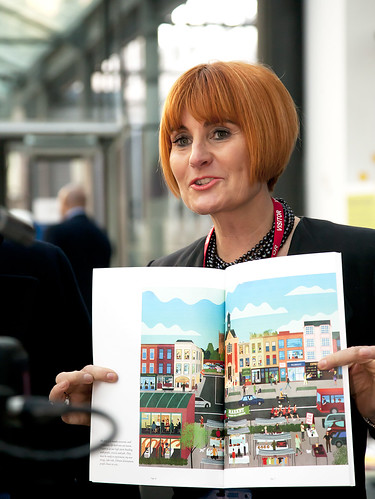
Mary Portas, pictured here at the Department for Business, Innovation & Skills - has published her review of the future of high street. December 2011. Flickr/bisgovukWith a “Town Centre First” strategy, Mary Portas, the coalition government’s retail czar makes 28 recommendations, including plans for a “National Market Day”, which would allow budding entrepreneurs to try out a retail concept with the buying public (“Why not rent out tables for a tenner and get everyone involved?”), a relaxation of the rules making it easy to set up street stalls, mentoring of small shopkeepers by larger retailers, and an army of volunteer “Town Rangers” to protect high street areas from anti-social behavior and shoplifting.
Portas wants betting shops to be classified separately by planning authorities so that numbers can be monitored more readily. “I believe the influx of betting shops, often into more deprived areas, is blighting our high streets,” she said. Other ideas include transforming long-term unused retail spaces into gyms, bingo halls and crèches.
As one might expect, the responses are mixed.
Some are very positive. For example, James Daunt, CEO of Waterstone’s, a predominantly high street-based book chain, who recently denounced online retail giant Amazon as a “ruthless, money-making devil” was clearly voting for his own tribe when he commented: “I’ve always believed that booksellers should be at the heart of the communities they serve, and that is exactly what we are doing with Waterstone’s. Mary Portas obviously has a similar, strongly held philosophy and her report holds much sense.”
Others like Evening Standard journalist Anthony Hilton are more critical: “Tomorrow belongs to the internet. Web-based purchases are growing by the day. The car is being displaced by the armchair. Retail parks are struggling, let alone the high street.”
Oxford High Street. Flickr/FlickrDelusionsSomewhere in the middle are the puzzled retail experts, who are trying to work out the dynamics of the interface between physical shopping experiences and purchases made through the Internet. “While there is much discussion of the death of the high street in recent years, ultimately, people want to touch and see things and this is borne out by the growth of Apple’s retail outlets across the UK, for example,” said Anton Gething, co-founder and product director at social commerce experts nToklo. He went on to cite the physical eBay store in central London as well as an interesting experiment by the House of Fraser store in Aberdeen “that has no products, simply free coffee and assistants with iPads.”
Other commentators think that worrying about the fate of the High Street is a waste of time. For example, Margareta Pagano, business editor of The Independent on Sunday, anticipated Mary Portas’s report by suggesting that the proper focus should be on high-value “i-street” employment rather than the defence of traditional, physical retailing space. She argues: “What’s more, the U.K. is actually one of the most sophisticated markets in the world for online retailing, leading the way with the technology as well as the software design and distribution; so we shouldn’t be too worried by the switch from bricks and mortar to online as it’s also creating new jobs.”
The Prime Minister, who accompanied Mary Portas on a walkabout of Camden Markets in north London on Tuesday, announced that the government will respond to the high street review next spring rather than make an instant judgment on its virtues. This is an astute move in a politically fluid situation caused by a sharp disagreement between the two coalition partners –- Cameron’s Conservatives and Clegg’s Liberal Democrats — over Britain’s use of the veto at the recent EU summit on economic integration. The feeling is that the rupture in relationship makes a general election in the U.K. a genuine possibility in the not too distant future.
David Cameron would certainly not want to make an enemy of a high profile TV personality possessing considerable cultural capital if the campaign trail beckons.
Stuart Kirsch, anthropology professor at the University of Michigan, shared a link to a Huffington Post editorial updating the human rights situation there. Written by the Lowenstein International Law Clinic at Yale University, the essay highlights land grabbing and controversial development plans in the West Papua rain forest. The Clinic will be producing a full report in near future.
• And deliver us from leaders
CounterPunch carried a piece about OWS and commentary about one of its important non-leaders, cultural anthropologist David Graeber: “Mainstream liberals and the Institutional Left frequently criticize the Occupy movement for its lack of public spokespersons and its lack of clear demands. But according to David Graeber, it came very close to having those things — and to being just another protest that fizzled out after a few days.” Graeber, an anarchist University of London anthropology professor, attended a preliminary meeting in early August to prepare for the next month’s Occupation. As he recounts, it was shaping up as a typical top-down movement controlled by the usual suspects of the Institutional Left. So he returned to London.
• Our debt, our selves
The New York Times book review section included a one-page review of David Graeber’s new bookDebt: The First 5,000 Years. According to the reviewer, the book “…reads like a lengthy field report on the state of our economic and moral disrepair. In the best tradition of anthropology, Graeber treats debt ceilings, subprime mortgages and credit default swaps as if they were the exotic practices of some self-destructive tribe. Written in a brash, engaging style, the book is also a philosophical inquiry into the nature of debt — where it came from and how it evolved. Graeber’s claim is that the past 400 years of Western history represent a grievous departure from how human societies have traditionally thought about our obligations to one another. What makes the work more than a screed is its intricate examination of societies from ancient Mesopotamia to 1990s Madagascar, and thinkers ranging from Rabelais to Nietzsche — and to George W. Bush’s brother Neil.” [Blogger’s note: Debt is a big book, about a big subject, and worth the time. I have made it only to page 120 so far, where Graeber asks, “What, then is debt?” I took a sneak peak to the end, on page 391, where he writes: “What is a debt anyway? A debt is just the perversion of a promise. It is a promise corrupted by both math and violence. If freedom (real freedom) is the ability to make friends, then it is also, necessarily, is the ability to make real promises.”]
• U.S. Christmas traditions
Benjamin K. Swartz, retired Ball State University anthropology professor, has long been interested in Christmas traditions in the United States. He presents his findings in “The Origin of American Christmas Myth and Custom.” He writes that “fundamentally, Christmas celebration is based on intertwining of two ethnic patterns, Roman transition rites and Germano-Celtic Yule (jiuleis) rites-feasting and mortuary practice.” He notes that the “first known use of the word Christes-Maess was in England, 1038,” and traces the holiday from when “Puritans passed an anti-Christmas law in 1659” to 1885, when “a law was enacted giving federal employees Christmas day off.”
• Lap dancing as art?
The Bloomberg Times covered Judith Hanna’s research on lap-dancing and the controversy about whether or not it is an art form. Hanna, a professor of cultural anthropology at the University of Maryland, has spent almost 50 years studying the cultural expression of dance. Since 1995, Hanna, has helped clubs repel efforts to tax, regulate or close them, arguing more than 100 times that striptease is just as much an art as ballet. Next year, her lap-dances-are-art argument will be part of an appeal before New York’s highest court. A stripper in heels is like a ballerina en pointe, she says, and her communication of feeling is no different than that of the New York City Ballet— and no less protected by the First Amendment. “Patrons of gentleman’s clubs aren’t just there to look at nude bodies…They want to read into it. It’s not just the eroticism, it’s the beauty of the body, and the fantasy they create.” Hanna says she has observed at least 1,500 performances in her defense of the $12 billion U.S. exotic-dance industry, which comprises about 4,000 clubs. When a city or state passes a law to kick the clubs out of town, owners turn to Hanna. She sends clients an average bill of about $3,000, and estimates that she has 45 wins to 21 losses.
• Take that anthro degree and…
→become an artist. San Francisco Public Defender Chief Attorney and collage artist Matt Gonzalez recently interviewed fellow artist Joanna Ubach. Ubach was born in Portugal and attended Colegio do Bom Successo in Lisbon where she studied anthropology and fine art and where she first began painting with oils. In 2007, she earned a B.A. in anthropology and fine art from the University of Arizona. She lives in San Francisco and is undertaking a masters degree in fine art at the Academy of Art. Examples of her work can be found at her website.
→become an actress. Thandie Newton is known as one of Hollywood’s most intelligent actresses after studying social anthropology at Cambridge University in England. The Crash star has revealed that she first discovered reading because it allowed her to escape her tricky teenage years.
→become an activist/entrepreneur. Hecky Villanueva was working for a doctorate degree in anthropology at the University of Arizona when he heard about the bamboo bike business in the United States. He surfed and searched the internet about bamboo bikes, since he wanted to start a similar business in the Philippines. He was finally able to contact a bamboo bike builder in California named Craig Calfee. In 2009, Craig visited the Philippines upon Hecky’s request and conducted a bamboo bike building workshop. This was how KawayanTech started. The company makes bikes for children and adults as well as mountain bikes for more adventurous types.
The Anthropology Department at UC Davis and the Davis Humanities Center will appoint an Andrew W. Mellon Postdoctoral Fellow for the 2012-2013 academic year. The Fellow will be involved in the scholarly activities of the Sawyer Seminar, “Indigenous Cosmopolitics: Dialogues About the Reconstitution of Worlds” that will unfold during that academic year.
The fellow will help organize and participate in seminar events (including workshops, public lectures and reading groups) and design and teach a one quarter-long/ten weeks introductory undergraduate course on the topic. The appointment will be from August 1, 2012 to June 30, 2013. Stipend is $50,000.
On December 2nd, US Secretary of State Hillary Clinton met with Burmese pro-democracy leader Aung San Suu Kyi at her house in Burma (renamed Myanmar by the military government in 1989). It was truly a historic meeting. Aung San Suu Kyi had spent most of the past 22 years under house arrest, but was freed in November 2010. President Thein Sein, a former military general who was inaugurated in March 2011, has surprised Burmese citizens and the world by introducing tentative political and economic reforms and reaching out to Aung San Suu Kyi and the United States. United States Secretary of State Hillary Clinton meets with Burma's pro-democracy leader Aung San Suu Kyi, December 2, 2011. Wikimedia Commons
Hillary Clinton’s visit was meant to encourage the government to commit to further reforms, as well as to demonstrate support for Aung San Suu Kyi and the democratic movement. Hillary Clinton and Aung San Suu Kyi gave a joint press conference on Aung San Suu Kyi’s porch, which ended with a heartfelt embrace. Clearly these two women feel great affection for each other, and for Burmese inside and outside the country, it was an ecstatic moment.
In the press conference and other recent statements, Aung San Suu Kyi emphasized the need for the rule of law and the cessation of civil war in Burma. If there were rule of law, meaning independent courts as well as protections for freedom of speech and peaceful assembly, there would be no more political prisoners.
Currently there are several hundred prisoners of conscience, including a number of women. In 2009, Hla Hla Win was sentenced to 27 years in prison for her undercover reporting on the second anniversary of the monks’ 2007 protests and other sensitive stories for an exile media outlet. In 2008, Nilar Thein was sentenced to 65 years in prison because of her leading role in non-violent political protests in 2007 and earlier. Her husband is also a political prisoner, and their young daughter must now be raised by her husband’s parents.
In the ethnic states, decades of civil war have resulted in widespread destruction and displacement, while countless girls and women have been raped. As Burmese women’s groups and the UN Special Rapporteur on Human Rights for Burma have documented, Burma Army soldiers commit rape with impunity. While for decades, the Burmese military leadership has sought to force the country’s non-Burman populations into submission, Aung San Suu Kyi has called for a genuine union of Burma in which the rights of ethnic minorities would be respected. If she, the United States government, and others can persuade Burma’s military leadership that a federal system of government is viable, then genuine peace can be restored and the healing process can begin.
If all goes according to plan, Aung San Suu Kyi will run for parliament in an upcoming by-election for a number of vacant seats. She is encouraging other women to run as well. They are likely to push for more attention on health, education, poverty alleviation, and humanitarian assistance.
Should the reform process continue, Burma could at last move toward recognizing and valuing the contributions of all its citizens. That would really be something to celebrate.
Christina Fink is a professor at George Washington University’s Elliott School of International Affairs. An anthropologist who has focused on Burma for many years, she is the author of Living Silence in Burma: Surviving Under Military Rule (2009).
When: Monday, Dec 12th | 4:30 pm – 6:00 pm Where: The National Committee
71 W. 23 Street Suite 1901
New York, NY 10010 US
The National Committee will hold a program with Dr. Tashi Rabgey, co-director of the University of Virginia Tibet Center. Drawing on her rich experience working on the Tibetan Plateau, Dr. Rabgey will discuss her views of recent developments in the region and her work on language protection issues during an off-the-record discussion.
To register, please RSVP to events@ncuscr.org by 5:00 p.m. on Friday, December 9.
Dr. Rabgey is the founding director of the Tibet Sustainable Governance Program (TSGP), which seeks to advance scholarship, research and new perspectives on the challenges of governance and sustainability of communities on the Tibetan Plateau. TSGP has developed a unique research exchange with the Chinese State Council on bilingualism and language policy in Tibetan education, entrepreneurship and economic development. Other TSGP projects include the Tibetan Social Business and Sustainable Entrepreneurship Initiative and the Tibetan Education to Employment Initiative. TSGP is a joint initiative of the UVa Tibet Center and Machik, a D.C.-based nonprofit Dr. Rabgey co-founded with her sister Losang Rabgey that works to develop opportunities for education, capacity-building and innovation on the Tibetan plateau.




 To register, please RSVP to
  anthropologyworks